
Macon Commissioners Unanimously Pull Plug on Sheriff's Flock Cameras
Board of County Commissioners • Macon CountyJuly 15, 2026
Locunity is an independent informational service and is not an official government page for this commission. All information is sourced from public footage and an analysis of official agendas with the aid of responsible, fact-checked AI. to report an error or omission.
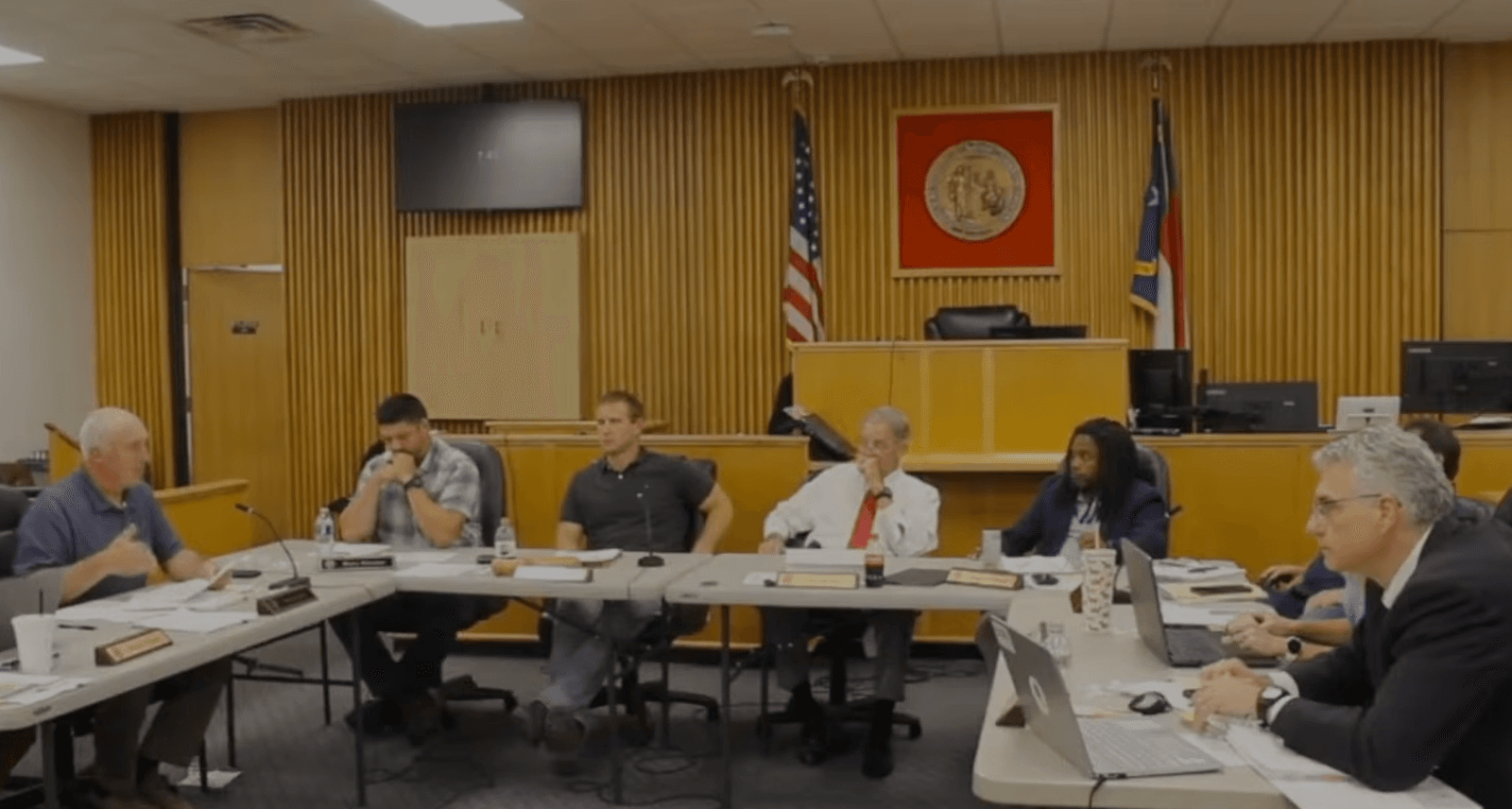
Macon County commissioners on July 15, 2026, ended the Sheriff's license plate reader program, even though the Sheriff's Office credits it with a more than tenfold jump in meth seizures. Two 5-0 votes defunded the Flock Safety cameras and ordered them removed as soon as feasible. The same packed meeting advanced data center restrictions, rebuffed a $326,000 request from the regional library and previewed a contested redistricting fight.
- Flock cameras defunded and ordered removed, 5-0, after roughly 15 residents spoke against them
- Data center restrictions head to Planning Board Aug. 6, with a public hearing to follow
- Fontana Regional Library's $326,000 request withdrawn; commissioners point to its $2.7M reserve
- Planning Board's 3-2 redistricting plan draws heavy opposition and calls for a referendum
1 Big Thing: The Flock Network Goes Dark
Why it matters: The vote ends a 16-camera surveillance network that had run since spring 2024. Residents framed it as warrantless tracking, while law enforcement called it a crime-fighting tool.
Where things stand: "We currently operate 16 cameras throughout Macon County, with 4 strategically being placed at schools," said the Macon County Sheriff. The county owns 12 of the cameras. The school system owns the other four, which it obtained through a grant. The network reads 1 million to 3 million tags a month.
Lieutenant Lee Tritt of the Sheriff's Office reported meth seizures of 1,241 grams in 2023, before the cameras. Seizures rose to 5,803 grams in 2024 and 13,956 grams in 2025. Felony charges rose from 115 to 365 between 2023 and 2024. "These cameras are almost like having an extra deputy," Tritt said.
Alex Grooth, a Flock Safety representative, said 40 court cases have upheld the readers. He said the data is purged after 30 days and stored in Amazon AWS GovCloud.
Commissioner John Shearl led a long cross-examination of Grooth and the Sheriff. He also raised a procedural complaint: "The former county manager signed this contract in November, and there was a change from the coding of that from capital to contract services with no information ever provided to the county commissioners." A county finance official responded that an accounting rule drove the change: "GASB 96 requires us to recognize the asset as capital."
The other side: Public commenters across the room cited the Fourth Amendment, officer misuse cases in Georgia, false accusations and recurring fees. "Flock sells that same exact military capability to local police, and it points the cameras at us," said public commenter Patricia. Public commenter Bodie Kaplan warned, "Our taxpayers will be locked into paying ever-increasing annual fees." Public commenter Heather Dombrowski urged the Sheriff to track offenders rather than the general public.
On the dais, two commissioners voiced misgivings before voting yes. Commissioner Barry Breeden called it a 50/50 issue. "My only stance on it is that these cameras are helping us keep drugs off the streets, out of my kids' hands, out of the grandkids' hands," Breeden said. Commissioner Danny Antoine said, "I'm a constitutional guy, so I get that side of it. But at the same time, I work with kids, and if one of those babies get abducted, I want that guy found immediately." Vice Chair Gary Shields said the dispute "should be handled in a court of law."
Decisions and stakeholder impacts: County Attorney Eric Ridenour narrowed the question for the board: "the issue before you is purely whether or not Macon County is going to spend Macon County money on cameras." Board Chair Josh Young sided with constituents: "I work for the people. The people put me here, and I've had an overwhelming majority of people reach out and say they just don't want it, period."
The board took two votes, each For: 5 (Young, Shearl, Shields, Breeden, Antoine), Against: 0, Absent: 0:
- Defund the cameras: Shearl moved; Antoine seconded.
- Remove the cameras as soon as feasible: Shearl moved; Breeden seconded.
The Sheriff's Office loses a tool and keeps the money. The roughly $47,000 budgeted for the cameras sits in the investigations contracted-services line. The Sheriff asserted that "once a budget ordinance is enacted, I can do with what I want," and Young agreed the Sheriff could use the funds at his discretion.
What's next: Grooth said service is paid through October and noted that the contract has a non-appropriation clause, which allows the county to exit if it stops funding the service. Shearl asked that the four school-owned cameras be moved to capture only school grounds.
Data Center Rules Advance
Why it matters: Residents warned that AI data centers would strain water, power, quiet and dark skies. The county is trying to make such facilities hard to build without an outright ban that could fail in court.
The basics: The county's High-Impact Land Use ordinance (Chapter 157) already limits cryptocurrency mining to noise-style restrictions. Mining may not operate between 7 p.m. and 7 a.m. The current rules do not specifically address data centers.
Where things stand: Ridenour and Planning Director Joe Allen drafted revisions to cover data centers through limits on setbacks, electricity and water use, audibility and operating hours. Ridenour argued that regulating these facilities is safer legally than banning them and defended short, concise language: "lots of words create lots of loopholes." One commissioner said the state no longer offers data center incentives and suggested an outright ban might be possible, pending clarification.
The other side: Speakers uniformly opposed large data centers, and several urged a moratorium like the Town of Franklin's. "I fear the idea of just slapping the data center label next to cryptocurrency is enough," said public commenter Matt Jackson, a Realtor. Another commenter pointed to a nearby precedent: "the Bitcoin facility in Andrews was converted to a data center, and that was the loophole they used." Public commenter Pam Haley was blunter: "Just no on data centers of all kinds." Public commenter Michael Lyons said any data centers that do come should face strict rules and pay heavily.
Decisions and stakeholder impacts: The board voted to request Planning Board review and schedule a public hearing. Antoine moved and Breeden seconded. The vote was For: 5, Against: 0, Absent: 0. "This is a 160D ordinance, which means it's a land planning ordinance that does require a public hearing beforehand," Ridenour said.
What's next: The Planning Board will review the revisions Aug. 6 at 5 p.m. at the Human Services Building. The commission's hearing will come before its next meeting, and a vote is possible that evening.
Library Gets No Bailout
Why it matters: About 38 library employees are waiting on a 2.8% cost-of-living raise. Meanwhile, Macon County is building its own library system after voting in June to leave Fontana Regional Library (FRL).
Where things stand: County Manager Warren Cabe estimated a county-run system at "tentatively... about $1,350,000" a year, roughly a $96,000 annual increase. He is applying for $115,000 in state aid this year. He also reported that Swain County's injunction blocked an expected surplus refund of "a little over $500,000." Cabe said the county's intent is not to change any library services.
FRL's Bill McGaha said the library system's interim budget cannot cover its raises. "We've got about 38 employees in Macon and Swain and the headquarters that are still waiting for a COLA raise, 2.8% they were supposed to get," McGaha said. He asked the county for $326,000.
The other side: Commissioners pointed to FRL's own reserves. "I want every employee to have every raise they were promised. Please don't misinterpret that. But you have the money sitting in the account," Young said. Breeden noted the trend: "you had $2.4 million last year, you got $2.7 million."
McGaha said FRL's finance officer described a "legal and policy issue" in tapping the reserve. Ridenour disagreed, saying the limit appears to be "a policy of that board, in which case I believe that board could change that policy."
Public commenters Linda Tyler and Dan Cole opposed leaving FRL. Cole questioned the June vote's legitimacy, saying the withdrawal was not on the agenda.
Decisions and stakeholder impacts: Shearl moved a $326,000 budget amendment, and Antoine seconded. Shearl then retracted the motion, so no vote was taken. Young pledged support next month if a statute actually bars FRL from using its fund balance. Cabe noted the county could hire a librarian before July 1. After a closed session, Ridenour read a statement asking the FRL board to "immediately resolve the lawsuit filed against it by Swain County."
Redistricting Plan Meets Resistance
Why it matters: The proposal would restructure a district system created by a 1976 referendum. That system guarantees seats for Highlands and Nantahala.
Where things stand: Allen said the Planning Board held four meetings and "received 20 comments from 16 different members of the public." It recommended "3 equal districts and 2 at-large seats," with every seat elected countywide.
Shearl, who represents Highlands and serves as the Planning Board liaison, defended the 3-2 model: "It has everything to do about fairness for every human in this county to give them the same opportunity." He said he sought no action so he could spend months on public outreach.
The other side: About 10 speakers opposed the plan. Most favored five single-member districts and a referendum. "Voters should choose candidates and elect officials. Candidates should not be allowed to choose their voters," said public commenter Joanne Rosner of Scaly Mountain. Public commenter Lisa Walker said that at the Planning Board, "only 1 person was in support of the 3-2 configuration." Lyons was the lone public supporter at this meeting.
What's next: The item was informational, and the board took no vote.
Minor Items
- 2027 revaluation: Tax Administrator Abby Grasswell will present proposed property values Aug. 11; new-value tax bills go out in July 2027.
- JCPC plan pulled: The Juvenile Crime Prevention Council certification was removed for a future briefing; the remaining consent agenda passed 5-0.
- SCC trustee: Logan Gillespie, the sole applicant, was appointed 5-0 to finish Brett Rogers's term.
- Rec park: Construction has started on the pickleball courts, closing part of the park.
- Roadless rule: MountainTrue will hold a public hearing July 23 at Cowee School, according to a public commenter.
Looking Ahead
Watch three dates: the Planning Board's Aug. 6 data center review, the Aug. 11 property-value presentation and the October end of paid Flock service.