
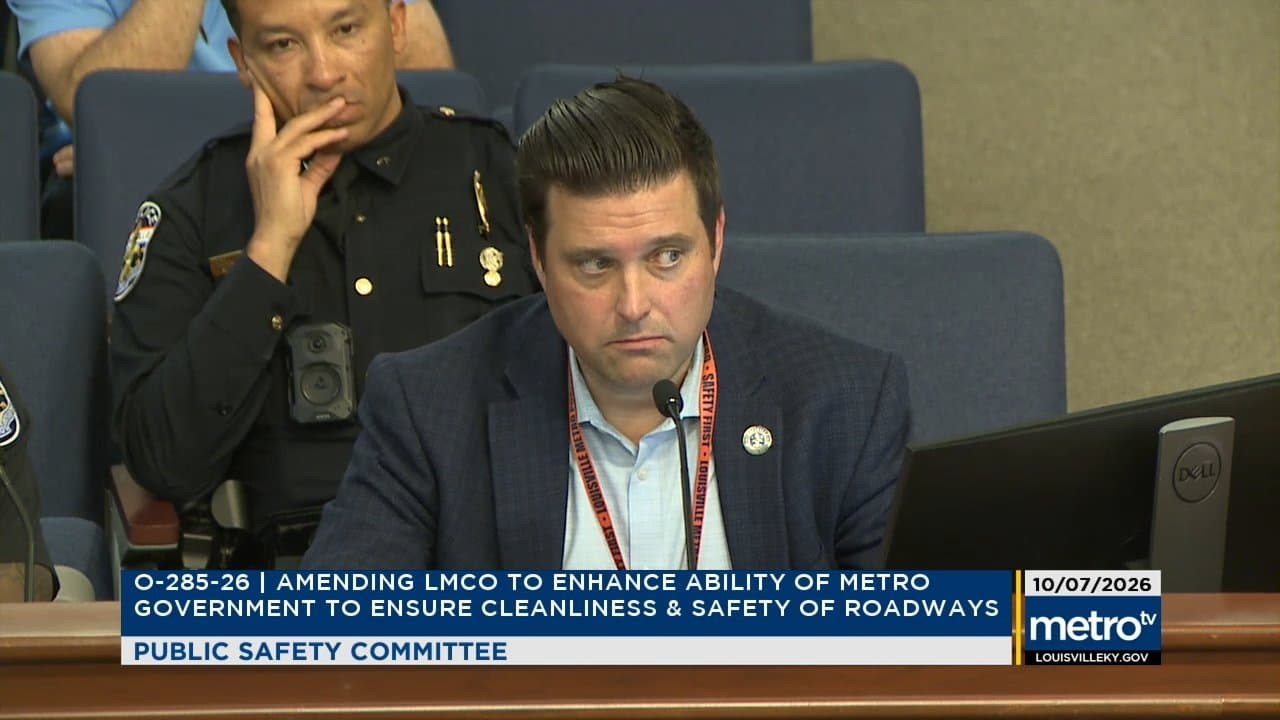
A Year In, Only One LMPD Reform Policy Has Monitor Approval
Public Safety Committee • LouisvilleOctober 7, 2026
Locunity is an independent informational service and is not an official government page for this commission. All information is sourced from public footage and an analysis of official agendas with the aid of responsible, fact-checked AI. to report an error or omission.
Louisville's voluntary police reform agreement has reached its first anniversary, and only one of its 13 sections, use of force, has full sign-off from the independent monitor. In a briefing to the Metro Council Public Safety Committee on Oct. 7, 2026, LMPD leaders said the department's work is ahead of the monitor's approvals, while one council leader questioned what taxpayers get for the monitor's cost. The committee also advanced fines for tow companies that leave crash debris on city roads.
- Only use-of-force policy approved under LMPD's 2,739-item Community Commitment; LMPD targets all approvals by the third quarter of 2027
- Vice Chair Tammy Hawkins floats returning the monitor's funding to the budget, citing its limited presence in Louisville
- Crash debris ordinance advances with 8 yes votes, adding fines for tow operators and new reporting duties
- LMPD trains every officer in trauma-informed tactics for domestic violence and sexual assault cases before monitor sign-off
Reform on Paper, Approval on Hold
Why it matters: The Community Commitment replaced a federal consent decree that a judge dismissed. With no court supervising the work, its pace and credibility are now how Louisville shows police accountability.
The basics: The agreement runs 214 pages, with 13 sections and 719 paragraphs. Those paragraphs contain 2,739 action items that must be built into policy, training or data systems. The independent monitor, Effective Law Enforcement for All (ELIFA), was installed in October 2025.
Where things stand: Assistant Chief Brian Kerger said LMPD wrote its own implementation and training plans, unlike departments under federal consent decrees. LMPD submitted the plans in December 2025, and ELIFA approved them in January 2026. Monitoring protocols followed in March 2026.
- Only the use-of-force section has completed policy approval.
- Seven other areas are "in collaboration," including supervision, street enforcement, recruitment and behavioral health.
- Kerger called behavioral health and disabilities the hardest section because it involves Metro agencies beyond LMPD.
"Our goal is to have all of the policies at least in the collaboration period by the end of this year," said Kerger. LMPD's goal for full approval is the third quarter of 2027. Kerger contrasted that timeline with the 15 to 20 years he said New Orleans and Baltimore needed.
The sequencing problem: Under the monitor's process, ELIFA reviews training only after it approves the matching policy, and reviews data only after training is approved. Kerger said that order conflicts with LMPD's training calendar. That calendar requires Kentucky Law Enforcement Council approval months in advance, and LMPD has already submitted its 2027 annual training.
LMPD is not waiting. Kerger said every officer is being trained in trauma-informed tactics for domestic violence and sexual assault responses, even though the related policies are not finished. Councilmember Shameka Parrish-Wright noted the month's focus on domestic violence awareness. LMPD Chief Paul Humphrey said the training covers gathering information to solve and prosecute crimes while keeping victims safe.
The other side: Councilmember Markus Winkler said the department's progress grid could mislead the public. "This isn't measuring what you've done; this is measuring what's been signed off," Winkler said. Kerger agreed and said every section has a draft policy and the required boards are operating.
Councilmember Kevin Bratcher, District 22, pressed on the legal footing. "Well, we don't have a technical consent decree with a federal judge, do we?" Bratcher asked. Humphrey confirmed it does not. "When our consent decree was dismissed by the judge, we felt it was appropriate to still continue with that change process for LMPD," said Humphrey. He added that the policy and training work would happen regardless of ELIFA.
Councilmember Betsy Ruhe asked how officers have responded. Humphrey pointed to the use-of-force overhaul of 2 to 2.5 years ago, which created a Force Investigations Unit and tiered investigation levels. "And I think officers are better at that than we were," he said.
Decisions and stakeholder impacts: The briefing was informational, and the committee took no action. Residents and advocates now have public benchmarks to track: all policies in collaboration by the end of 2026 and full approval by the third quarter of 2027.
Council Splits Over a Remote Monitor
Why it matters: A committee leader openly questioned the monitor's value and spending. That signals the reform agreement could face budget scrutiny.
Where things stand: ELIFA holds its own community meetings, which LMPD does not attend. LMPD treats those meetings as the monitor's time to give its own perspective. Most policy collaboration between the two happens virtually. LMPD also reports to the Community Safety Commission, has formalized a public policy-review process and has launched a community events calendar.
Vice Chair Tammy Hawkins, District 1, said ELIFA is rarely in Louisville and lacks boots on the ground. She said the community deserves more than monthly visits and that many residents do not check police websites. "Metro Council could be the liaison and we can put that money back in the budget," Hawkins said.
The other side: Parrish-Wright, District 3, cited her experience in third-party quality control. She urged colleagues to trust the process, saying independent monitors must collect and process data remotely.
Councilmember Ginny Mulvey-Woolridge, District 24, asked directly whether more in-person monitor time would help. Humphrey said the technical relationship works well virtually. "But as far as their ability to interact with the public, that probably affects that more than anything," he said. Humphrey also said change management limits how fast new policy can reach officers.
What's next: No action was taken, and no dollar figure for the monitor's contract was discussed. The cost and presence questions remain open for council follow-up.
Tow Firms Face Fines for Leaving Crash Debris
Why it matters: Bumpers, glass and other parts left behind after crashes create litter and the risk of secondary crashes on corridors such as Dixie Highway. Right now, the city cannot reliably connect debris to the crash that caused it.
Where things stand: Councilmember Crystal Bast, the sponsor, said no one has clear responsibility for crash debris today. "A crash scene should not be allowed to create other conditions for other crashes," Bast said.
Public Works Executive Director Wes Sidnor presented the scale of the problem:
- More than 16,000 crashes so far this calendar year
- 21,000 crashes last year
- Almost 300 car-debris complaints since the start of 2025
- 88% of residents in a survey who see litter as a problem
Public Works solid waste crews currently ride the highways daily to collect debris, and notifications are made by phone.
What O-285-26 does:
- Assigns cleanup duties. It sets debris-removal duties for tow operators and crash parties when a vehicle is removed.
- Sets a "reasonable efforts" standard. Drivers need not enter interstate traffic to retrieve parts, but they must report them.
- Adds fines. It creates a fine schedule for tow operators who leave debris behind.
- Requires reporting. Private tow operators must notify LMPD by a method Metro government prescribes. Staff said parties have 48 hours to report.
- Spreads enforcement. Police, code enforcement, ABC and Solid Waste officers can all enforce it.
- Builds a shared data system. Metro Technology Services will combine LMPD crash reports, tow reports and 311 complaints.
The ordinance was drafted with Deputy Mayor Nicole George, the Jefferson County Attorney's Office and input from the towing industry.
The other side: Committee leaders pressed for teeth. "So is there a mechanism to fine them if they're not doing their job?" asked Councilmember Dan Seum Jr., the committee chair. Sidnor said the ordinance ensures "that we would have the ability to go back and enforce on them." Hawkins found that wording too soft. "We want to be able to do it right then and there," she said.
Hawkins also asked what happens when an injured, elderly driver is taken to the hospital. LMPD Assistant Chief Corey Robinson said officers control crash scenes and can impound the vehicle to secure the scene. Robinson also said the shoulderless I-64 corridor near 9th Street needs a police presence for safe cleanup.
On industry buy-in, Robinson said he had spoken only with LMPD partner Suburban, which raised no concerns. Sidnor said feedback from Tony's Towing was incorporated.
Mulvey-Woolridge flagged a sequencing risk. "What I don't want to do as a legislative body is put something out there and then start having fines that we don't have something prescribed for them to be able to actually do," she said. She recommended writing the reporting method into the ordinance itself. Sidnor said an interim technology solution is ready. "I want to make sure that we're exhausting those communication efforts before we really jump into enforcement in that way," he said.
Decisions and stakeholder impacts: The ordinance passed without amendment. The clerk announced 8 yes votes. Individual votes and any no, abstain or absent counts were not read, although 10 members were listed present.
- Co-sponsors added: Joseph, Ruhe, Reed, Hawkins, Seum, Mulvey-Woolridge and Parrish-Wright.
- Who gains: Drivers on highway corridors and Public Works crews stand to benefit.
- Who takes on new duties: Tow operators face new obligations and potential fines.
- Rollout plan: Outreach materials for tow companies, equipment checks such as brooms on trucks, and a planned All In on Clean resource website.
What's next: The ordinance goes to the full Metro Council's consent calendar. The reporting method under Section 115.457(B) is still to be prescribed by Metro government.
Minor Items
- Fire training grant: R-120-26 accepts $38,000 from the Kentucky Fire Commission. The no-match grant buys Conex shipping containers and lumber for training props at the fire academy at 15th and Hill. It passed by voice vote and goes to the consent calendar.
- Massage facility rules: O-286-26, which would update massage facility regulations, was held until the next meeting at the sponsor's request.
- Firefighter memorial: Fire Chief Brian O'Neill invited the public to a Fire Prevention Week and fallen firefighter memorial gathering. The event was set for 10 a.m. Oct. 8 at the Firefighter Memorial in Jefferson Square.
Looking Ahead
The committee's next regular meeting is expected to take up the held massage facility ordinance. The crash debris ordinance and the fire grant head to the full council's consent calendar.