
LMPD Data Reveals Racial Disparities in Traffic Stops as Staffing Shortfall Hits 123 Officers
Public Safety Committee • LouisvilleAugust 5, 2026
Locunity is an independent informational service and is not an official government page for this commission. All information is sourced from public footage and an analysis of official agendas with the aid of responsible, fact-checked AI. to report an error or omission.
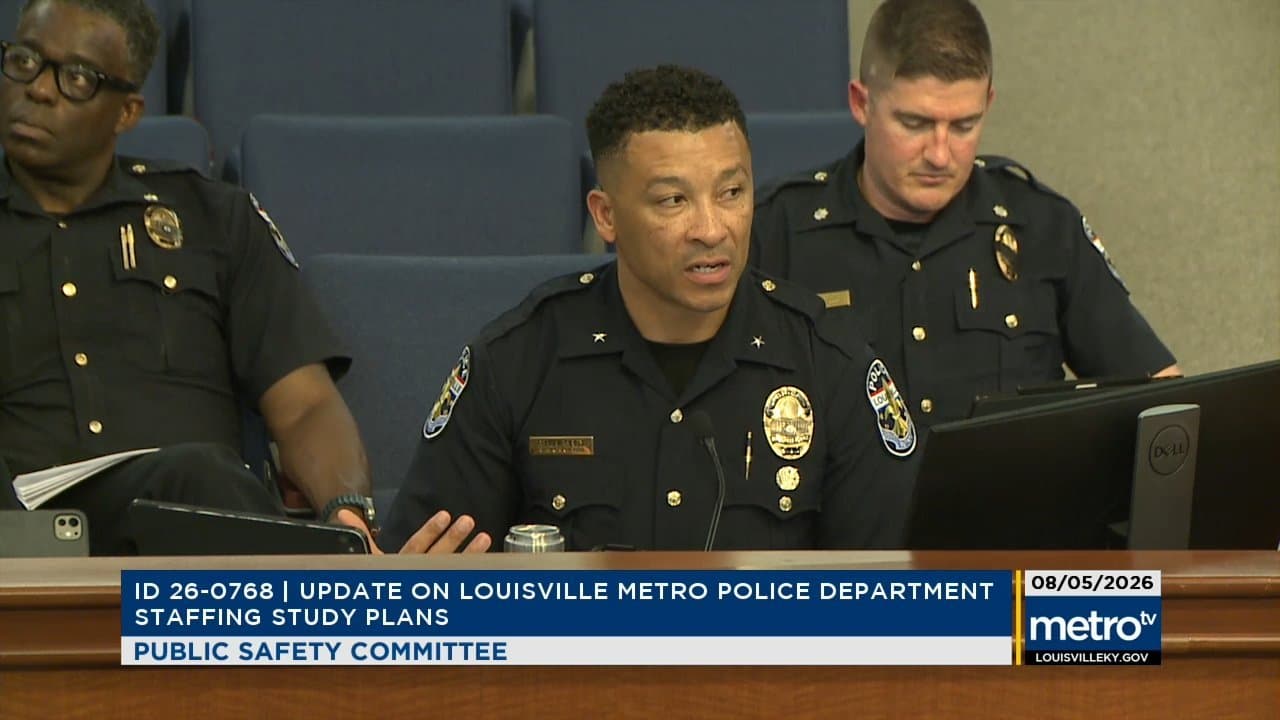
Louisville's Public Safety Committee got a candid look at two defining challenges facing the police department: systemic racial disparities in who gets searched during traffic stops, and a staffing gap that has the force operating with roughly 200 fewer officers than its historical allotment. The Aug. 5 session also advanced a housekeeping ordinance on waste hauler fees.
LMPD officers 66% more likely to search Black motorists, 11% less likely to find contraband, according to data analysis presented by the chief
Staffing study recommends 1,136 sworn officers; department currently has 1,013 with 61 recruits in the academy
Violent crime down 54% from 2021 peak, but car break-ins remain stubbornly high
Councilwoman Chapel challenges LMPD on abbreviated presentation of 200-page staffing report delivered the night before
Waste hauler fee cleanup ordinance advances unanimously to the consent calendar
Editor's Note: Due to a technical bug, the August 4th meeting report was missed. The error has been corrected. Apologies for the delay.
The Numbers Behind the Stops
Chief Paul Humphrey came before the committee to address findings from a data partnership with Sigma Squared, an analytics firm that applied academic-level methodologies to LMPD traffic stop data. The results were stark.
Why it matters: The analysis establishes Louisville's first comprehensive baseline for measuring racial bias in police stops — a dataset that will shape oversight, training, and budget decisions going forward.
Where things stand: Of roughly 37,000 motorists stopped last year, about 47% were white and 45% were Black. After controlling for similar circumstances, Sigma Squared's dashboards showed LMPD officers were 66% more likely to search Black motorists than white motorists — and 11% less likely to find contraband in those searches.
"66% more likely to search Black motorists after a stop than white, that is after like factors are controlled for," said Chief Humphrey. "The other number, which I think is really the number that deserves the most attention, is that we were 11% less likely to find contraband in those searches on Black people than white people."
The overall contraband hit rate across all searches was approximately 58%, which Humphrey called "relatively very high." He framed the disparity data not as an indictment but as a diagnostic tool, connecting it to the broader crisis of violent crime. During the 2020–2022 peak, an average of 123 Black people were murdered in Louisville annually. Over the full 10-year span of 2016–2025, more than 5,000 people were shot or killed.
"I'm a firm believer that we have saved hundreds of Black people's lives in the last few years by working with the community, trying to build trust, but also getting officers out there to do police work," Humphrey said.
Humphrey emphasized that Sigma Squared produced live dashboards, not a formal report — an important distinction as public discourse around the findings circulated. The $350,000 Sigma Squared contract was not renewed because an existing contractor can now reproduce the data more cheaply.
The other side: Councilmember Kevin Bratcher (District 22) offered a different lens, relaying what he hears from suburban constituents in the Fern Creek and Okolona areas: "We wish you would pull over more people here, no matter what color they are. Because it seems like there's not a lot of attention out here in the suburbs."
Councilmember Ginny Mulvey-Woolridge (District 24) pressed for continued public transparency, asking whether the data dashboards would remain accessible. Humphrey indicated the department would continue making information available.
Vice Chair Tammy Hawkins drew on personal experience to illustrate how officer approach during stops shapes public trust, recounting a tense encounter after a headlight went out: "One officer pulled up, the other officer pulled up, one was on one side with a flashlight and the other one was like, 'Need a driver's license.' And he was like, 'Don't move, don't move.'" Humphrey acknowledged the need for empathy training and described how the department is working to change officer behavior during encounters.
Inside the Accountability Machine
Deputy Chief Emily McKinley detailed the department's internal oversight apparatus. LMPD's audit unit — staffed with professional auditors — reviewed nearly 1,500 traffic stop body camera videos last year using scorecards to evaluate policy compliance.
"Our recruits go to Washington, D.C. They go through the Holocaust Museum and the African American History Museum to understand the impacts of policing throughout history," McKinley said, describing a training initiative designed to build empathy and historical awareness in new officers.
McKinley also explained the citizen stop form data collection process, which captures information anytime a person is stopped, whether in a vehicle or on foot.
123 Officers Short: The Staffing Gap
The second major presentation centered on a staffing study completed in late April — a document several hundred pages long that recommends LMPD maintain 1,136 sworn officers and 430 patrol officers.
Why it matters: Louisville is operating with roughly 200 fewer officers than its historical allotment of approximately 1,228. The gap forces reliance on overtime to maintain minimum patrol coverage and limits proactive policing in both suburban and high-crime areas.
Where things stand: LMPD currently has 1,013 sworn officers plus 61 recruits in the academy and 396 patrol officers — 34 short of the study's 430-patrol recommendation. The department's lowest point was approximately 975 officers. The first recruit class of the new budget cycle brought in 34–36 recruits, exceeding the budgeted target of 20.
"We're sitting at 1,013 sworn right now. Plus we have 61 recruits in the academy, which is a pretty high number relatively of recruits to what we've had over the past year," Chief Humphrey said.
The staffing model factors in calls-for-service volume, geographic distance between calls, and call complexity. Deputy Chief McKinley clarified that a 542-officer figure in the study includes both beat officers and detectives, since detective is not a separate rank at LMPD. Assistant Chief Corey Robinson further explained this classification structure.
"200 Pages Boiled Down to Two Slides"
Councilwoman Chapel delivered the sharpest critique of the evening, noting the report arrived in her inbox at 10:51 p.m. the night before the hearing.
"300 pages is difficult to comb through. But given that it's such a heavy lift and it looks like you all received this report in April, you've boiled down 200-and-something pages to two slides," she said.
Chapel also flagged a detail the presentation omitted: the study recommends 11 fewer positions in the Office of the Chief.
"While we can say that some places need more staffing, we can also look at some and say this is a little inflated and we need to dial it back," Councilwoman Chapel said.
She noted that patrol officers currently spend 40.7% of their time on proactive work — within the 40–45% ideal threshold identified in the study — but only because overtime is filling the gaps. Without adding officers, overtime spending continues.
Humphrey acknowledged the overtime dynamic and said the department's best recruiting tool is its own workforce: "Making their job as rewarding and making them feel supported and proud of the place that they work is one of my number one jobs."
Councilmember Ginny Mulvey-Woolridge asked what three actions would have the greatest impact on public safety, pressing for actionable priorities from the study's recommendations.
Chair Dan Seum Jr. (R-13) asked how the department determines the right number of officers — by per capita, city size, or population density — and whether reaching recommended levels would support foot patrols on Fourth Street Live.
Councilmember Jonathan "JJ" Joseph (District 12) asked about traffic enforcement and learned there are roughly eight dedicated traffic officers citywide, supplemented by some divisional traffic cars.
Vice Chair Hawkins pushed on equity, asking how the department would reach adequate staffing "so my colleague out Fern Creek won't be saying that he's not getting police presence — just so it's equitable across the board."
Crime Down 54%, but Car Break-Ins Won't Budge
Why it matters: The sustained decline in violent crime suggests policing and community strategies are working, but property crime — especially vehicle break-ins — remains a stubborn outlier affecting neighborhoods across the city.
Where things stand: Homicides and shootings have fallen 54% since the 2021 peak and 32% since 2023. As of August 2026, Louisville had recorded 52 homicides and 134 non-fatal shootings.
"I think we've had two of the five longest streaks without homicide in this calendar year — once in January and once in July — where we had over 20 days without a homicide," Chief Humphrey said.
Humphrey attributed the decline to increased police activity, growing community trust and cooperation, and the comprehensive Safe Louisville plan. However, car break-ins remain the one category where crime is not declining. LMPD has deployed SWAT, drone, and task force details to combat car-hopping crews and is pursuing conspiracy charges against organized groups.
"We're starting to put conspiracy cases on people, on groups of people who are doing this," Humphrey said. "But it is an area that is the place where crime is not down — the car break-ins."
Flock Cameras: Solving Crimes, Deleting Data
Deputy Chief McKinley addressed public concerns about the Flock license plate reader program, which Councilmember Mulvey-Woolridge said had been the subject of circulating misinformation.
"The data is stored for 30 days. It is deleted on a rotating 30-day basis. Every search is logged indefinitely by officers," McKinley explained. Officers must enter a case number, report number, and typed reason for each search.
McKinley cited specific cases where the cameras proved critical: homicides solved by identifying suspect vehicles near crime scenes, and an elderly man with Alzheimer's located quickly after driving away. Chair Seum urged continued public education about the program's safeguards.
Minor Items
Ordinance O-210-26 — An ordinance removing a conflicting section on waste hauler licensing fees from Chapter 51 of the Louisville Metro Code passed unanimously by roll call vote. The 2025 amendment had raised fees from $100 to $500, but a duplicate section created a regulatory conflict. Public Works Executive Director Wes Sydnor explained the fees fund staff who monitor dump sites and maintain an inventory of legitimate haulers: "It's also a mechanism that helps us better enforce illegal dumping." Vice Chair Hawkins commended Public Works' performance. The ordinance advances to the consent calendar.
The committee's next meeting is scheduled for Aug. 19 at 4 p.m.