
Planning Commission - May 07, 2026 - Meeting
Planning Commission • LouisvilleMay 7, 2026
Locunity is a independent informational service and is not an official government page for this commission.We use AI-assisted analysis and human editorial review to publish information.
Planning Commission Advances Senior Housing, Splits on Baxter Ave. Rezoning
Louisville's Planning Commission moved unanimously to send a 22-unit affordable senior apartment project in Smoketown to Metro Council, then fractured 7-2 over whether to rezone a long-vacant Baxter Avenue building for commercial use without a confirmed tenant. The May 7 session also green-lit a new Verizon cell tower in Valley Station, wrapping three public hearings in under two hours.
22-unit affordable senior housing project in Smoketown clears every vote unanimously, advancing to Metro Council with a zoning change, height variance, and development plan
Baxter Ave. rezoning to C-2 commercial passes 7-2 after commissioners add hours-of-operation and outdoor-music restrictions — chair and one member dissent over approving without a known business
New 185-foot Verizon cell tower approved 9-0 to fill a wireless dead zone in southwest Jefferson County
Property owner tells commission vandalism and homelessness plague vacant Baxter Ave. building, urging swift action
A Church's Vision for Smoketown Seniors
Grace Hope Presbyterian Church — a 128-year-old congregation in Louisville's historic Smoketown neighborhood — took its affordable housing vision to the Planning Commission and left with four unanimous votes clearing the path to construction.
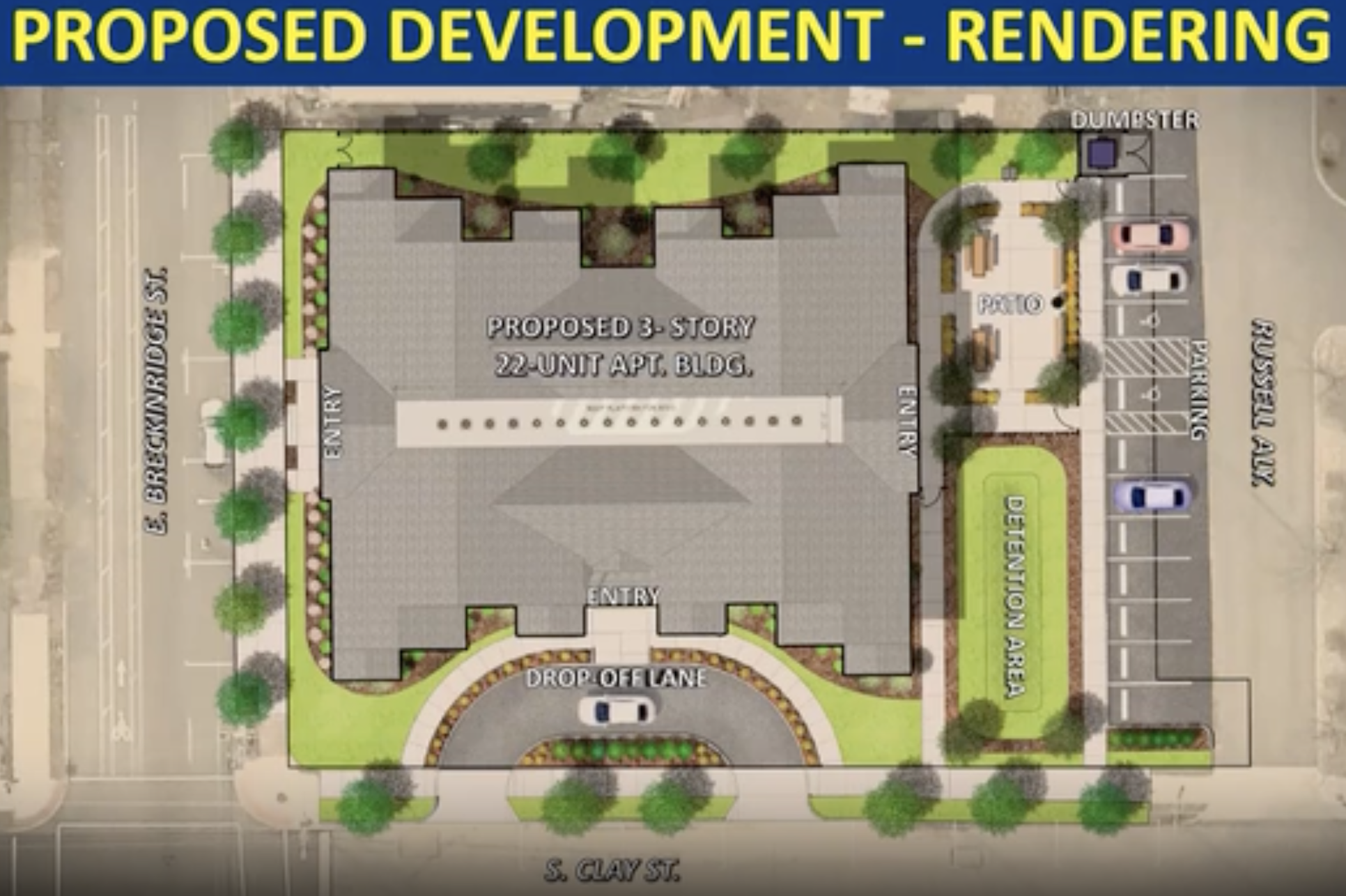
The basics: The church, working with developer Rebound Inc. and architect Bayes Design Works, proposed rezoning a 0.6-acre split-zoned parcel at 820 S. Clay St. from UN/C1 to R-8A multifamily residential. The plan calls for a three-story, 22-unit building — all one-bedroom apartments reserved for residents 55 and older — with an elevator, rooftop HVAC, a community walking trail and patio, a detention basin, and meeting space for social services.
Why it matters: Louisville faces an estimated shortage of 35,000 affordable housing units. This project tackles a slice of that deficit in a historically underserved neighborhood, pairing housing with wraparound services from Dare to Care, Norton Faith and Health Ministries, Central Louisville Community Ministries, and Seven Counties Services.
Where things stand: Planner Mark Pinto confirmed the site sits within the 2002 Shelby Park/Smoketown neighborhood plan, which designates the intersection for higher-intensity use. Michael Whelan of Sabak, Wilson & Lingo explained that R-8A zoning freed up floor area constraints that C1 would have imposed, making the project feasible. The building requires a height variance — 42 feet versus the 30-foot infill maximum — and a waiver to allow a pickup/drop-off lane between the building and the street, a design feature essential for senior mobility.
Rev. Dr. Angela Johnson, pastor of Grace Hope Presbyterian Church, told the commission the project is about more than housing.
"We want to provide a safe living space where residents have the option to experience life in community, where they can mingle and develop friendships and reduce the isolation that so many of our older adults experience as they age," she said.
Bridget Lewis, a third-generation church member and 27-year Presbyterian Church USA World Mission worker, reinforced the urgency.
"Our community members are not asking for luxury. They are asking for dignity. They want safe, affordable housing where they can live in the community rather than isolation," she said
Lewis noted the church's long track record of affordable housing development in Smoketown, including the Smoketown Community Apartments.
Decisions: Commissioner David Steff praised the project before making the motions.
"It's a good plan. 22 units towards the 35,000 affordable housing units that are needed. It's small, but it's a start," he said.
All four votes — zoning recommendation to Metro Council, height variance, vehicular circulation waiver, and detailed district development plan — passed 9-0.
What's next: The zoning change goes to Metro Council for final approval.
Baxter Ave. Rezoning Passes 7-2 as Commissioners Clash Over Unknown Tenant
A proposal to rezone a long-vacant building at 524 Baxter Ave. from M-2 Industrial/C-1 Commercial to C-2 Commercial drew the sharpest debate of the afternoon, with two commissioners breaking ranks over the lack of a confirmed tenant.
The basics: Auckland Land Trust owns the 0.36-acre property and wants the zoning change to attract commercial tenants. No new construction is proposed — the existing structure would be converted. Concepts floated by the applicant team included a brew pub, restaurant, event center, rooftop Airbnbs, or commercial office space.
Why it matters: The property sits near the Bardstown Road corridor, one of Louisville's most active nightlife strips. Commissioners had to weigh revitalizing a blighted building against the risk of greenlighting any C-2-permitted use — including bars — without knowing what would actually open.
Where things stand: Planner Jude Mattingly presented the staff report, noting no new construction was planned. Scott Heath, representing the applicant, and Eric Claypool, the project architect, walked the commission through the adaptive reuse concept. But it was Wayne Galavin, the property owner, who made the most visceral case for action:
"This property is consistently been vandalized. Homeless people are hanging around it. Neighborhood is on me all the time about the vandalism, the painting, we have to consistently paint it."
The other side: Chair Russ Lohan was unconvinced.
"I'm also concerned about just approving this as a blanket, and then anything can fit in there. I understand we have the hours of operation, but I'm not sure we need another bar or watering hole on Bardstown Road," he said, signaling a no vote.
The absence of a specific tenant created a procedural puzzle. Commissioner Jim Mims pressed on hours of operation, and legal counsel advised the commission it could set guardrails now.
"What you could do is you could put in general hours of operation — 8 a.m. to 11 p.m., 8 a.m. to midnight — and then if a specific tenant comes in who needs that change, they could amend it then," counsel shared.
A neighbor, Sophia Mazzocco, had submitted concerns about late-night operation.
After back-and-forth, the applicant agreed to new binding elements: operating hours of 8 a.m. to 11 p.m. Sunday through Thursday and 8 a.m. to midnight Friday and Saturday, plus a revision allowing outdoor music until 10 p.m. rather than banning it outright.
Mims ultimately voted in favor.
"This is a good use. And we're not trying to be difficult or anything like that. We're just, we need to kind of look at the broad spectrum in terms of the fitting name of the neighborhood," he said.
Decisions: The zoning recommendation to Metro Council passed 7-2, with Lohan and Commissioner TeAndre Sistrunk voting no. The detailed district development plan with amended binding elements also passed 7-2 on the same split. Any tenant that fits within C-2 zoning and the binding elements can proceed directly to permitting without returning to the commission.
What's next: The zoning change goes to Metro Council for final action.
Valley Station Cell Tower Clears Commission Without Opposition
Why it matters: Federal law sharply limits local discretion over cell tower siting, but the commission still walked through the evidence before approving a new 185-foot Verizon monopole at 6406 Moorman Rd. in the Valley Station area.
Where things stand: APC Towers and Verizon Wireless proposed the tower — with a 5-foot lightning rod bringing total height to 190 feet — on private property inside an approximately 10,000-square-foot compound with an 8-foot fence and 35-foot landscape buffer. Staff planner Joe Haberman, filling in for Tyler Pobiedzinski (on military leave), confirmed the application met comprehensive plan goals and Land Development Code requirements with no variances or waivers needed.
Attorney Keith Brown of Pike Legal Group presented Verizon's radio frequency coverage maps showing a significant gap in the Valley Station area, a co-location analysis finding no existing tower in the search ring, and a property appraisal from Glenn Katz of Realty Solutions finding no negative impact on surrounding home values. Brown noted the tower exceeds code setback requirements:
"Your setback from residential property lines is 50 feet. And our tower is 100 feet away. So the local regulations, those are viewed as substantial evidence."
Commissioner Jim Mims pressed on whether the coverage gap analysis accounted for towers operated by other companies. Brown confirmed Verizon's analysis evaluated all existing infrastructure. Commissioner David Steff asked about lighting; Brown confirmed the tower is unlit per FAA regulations for structures under 200 feet. The tower is designed for co-location by other carriers.
Decisions: Approved 9-0 with no public opposition. This is a final decision by the Planning Commission.
Minor Items
Minute corrections for case 24-ZONE-0098 (March 19, 2026 meeting) approved 8-1, with Chair Lohan abstaining. The corrections cleaned up binding element language distinguishing general versus detailed development plans.
April 23, 2026 Planning Commission minutes deferred to the next meeting by unanimous vote after staff and legal counsel recommended holding off on action pending further review.