
Planning Commission - Mar 19, 2026 - Meeting
Planning Commission • LouisvilleMarch 19, 2026
Locunity is a independent informational service and is not an official government page for this commission.We use AI-assisted analysis and human editorial review to publish information.
John Knox Church Wins Split Rezoning for Missionary Housing and Future Retail on Westport Road
Louisville's Planning Commission moved through a brisk five-case docket on March 19, unanimously advancing every rezoning request — but saved the most complex debate for last, when a 4.5-acre church property on Westport Road drew pointed questions about setbacks and a procedural correction that forced the applicant to withdraw two variances on the spot.
John Knox Presbyterian Church secures split OR/CN rezoning for a six-unit missionary housing building and future retail on 4.5 acres at Westport Road — but must return with detailed plans for commercial lots after staff flagged premature variance requests
St. Matthews carriage house legalized after couple discovers they bought a property with an illegal second unit advertised as a $1,800/month rental apartment
Logan Street lot rezoned commercial, continuing a block-wide shift toward C-2 near Logan Street Market
Historic 860 Vine Street grocery building rezoned to commercial-residential after three decades of dormancy, with restrictions barring liquor stores and bars
Webb's Market expansion approved on Muhammad Ali Blvd, extending an existing corner deli into an adjacent building
Church Campus Eyes New Chapter on Westport Road
Why it matters: John Knox Presbyterian Church is transforming underused acreage at 9104 Westport Road into a mix of housing and neighborhood retail — a model that could shape how other large institutional landowners along Louisville's suburban corridors think about surplus property.
Where things stand: Planner Mark Pinto presented the proposal to rezone the 4.5-acre site from R-4 single-family residential to a split designation: OR (office residential) for the existing church, and CN (commercial neighborhood) for a proposed six-unit residential building and two future retail lots along the Westport Road frontage.
The OR rezoning solves a practical problem. A 2017 Land Development Code update began requiring conditional use permits for private institutional uses like churches in single-family zones. The new classification lets John Knox expand without that hurdle.
Nick Pregliasco of Bardenwerper, Talbott & Roberts, representing the church, explained the housing component: "One of the things the church does is they have a lot of members who go on missions, go to other countries. And when they come back to the United States after being gone for a year or two, they need places to stay temporarily, maybe a year, until they then again have jobs."
The two front lots along Westport Road are proposed for future neighborhood-serving retail under a general plan — meaning detailed building designs haven't been drawn yet.
The other side: Commissioner David Steff pushed back on a requested 23-foot setback encroachment for the front retail lots. "Setbacks are there for a reason. Put the building nine foot. If they can move the building back, I think a building close to the road right there just takes away from the neighborhood," he said.
Then came a pivotal procedural moment. Staff member Julia Williams of Planning and Design told the commission the variances shouldn't be on the table at all: "If this is a general plan, they really shouldn't be asking for variances because if this is not what they're going to build and they're going to have to come back with development plan, they really shouldn't be making a decision about a variance on the site."
Pregliasco promptly agreed. "We have no problem taking them off because it is a general plan. And no matter what, we'll have to come back again anyway," he said.
Commissioner Suzanne Cheek, who ultimately moved all three remaining motions, endorsed the overall vision: "I am up and down on this corridor all the time, and I think this is a great plan and land use, and I see a wide variety of buildings close and set back from Westport Road, and that's a major thoroughfare."
Mike Hill of Land Design and Development clarified that the second access point on Westport Road is a three-quarter turn (right in, right out, left in) worked out with KYTC. Staff confirmed only a pedestrian connection — no vehicular access — is proposed to neighboring Kenlock Drive, addressing resident concerns.
Decisions: All three motions — rezoning, detailed district development plan for the church and housing building, and general plan for the retail lots — passed 9-0 (For: 9, Against: 0, Absent: 1 — Commissioner Stuber). The rezoning recommendation goes to Metro Council.
What's next: The applicant must return with a detailed district development plan for the two front retail lots before any commercial construction can proceed. Variances on setbacks and other issues will be decided at that time.
Couple Misled on Carriage House Wins St. Matthews Rezoning
Why it matters: A young family bought a St. Matthews home advertised with an income-generating rental unit — only to learn the apartment was never legal. The commission's unanimous vote to rezone the property rights a wrong and advances a zoning change that Commissioner Jim Mims linked to Louisville's broader Missing Middle housing conversation.
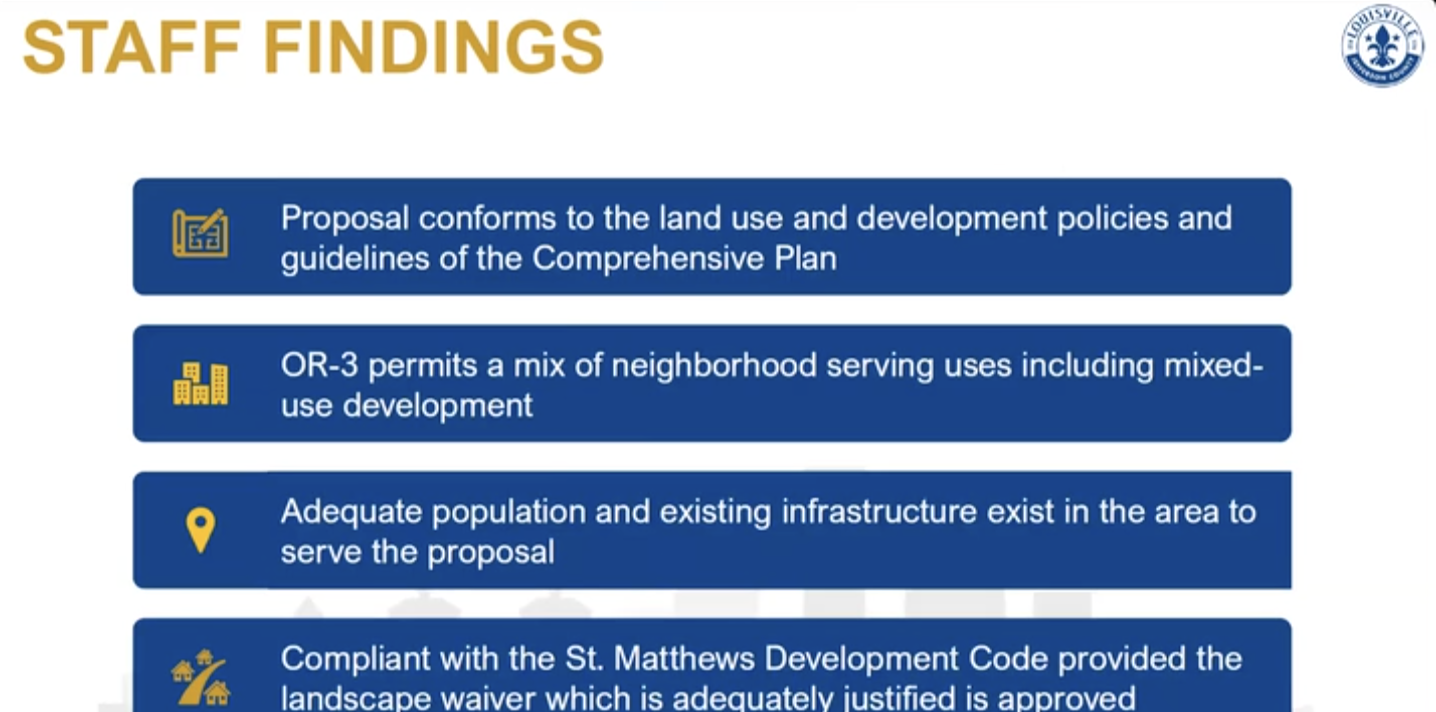
Where things stand: Planner Jude Mattingly presented the request to rezone 3947 Grandview Avenue, a 0.33-acre lot, from R-4 to OR-3 office residential. The property includes a single-family home and a detached carriage house that had been converted to a second dwelling unit — a use not permitted under R-4 zoning.
Steve Porter, representing the applicants, told commissioners the prior owner marketed the carriage house as a legal two-bedroom apartment generating $1,800 per month. "This young couple with their small children thought, well that's a good reason to buy this property. That makes the selling price, which was pretty high, reasonable and acceptable. And then they get in and find out that it's not zoned for a duplex or for two residences."
The carriage house also had code violations including an undersized egress window and a pass-through bedroom layout. A waiver was requested to omit the western property perimeter landscape buffer because the carriage house sits on the lot line.
Porter noted the neighborhood meeting drew two attendees, both supportive — with one saying they might want to do something similar with their own property.
Property owner John David Trentham described how the issue surfaced: his wife called the City of St. Matthews about a green-up program, and the city informed them they were aware of a second structure on the property.
Commissioner Mims connected the case to the broader Missing Middle housing policy discussion, noting that these streets were often cited by planning teams as examples of places where additional units would be desirable. He moved all three motions.
Decisions: Rezoning recommendation, landscape waiver, and detailed district development plan all passed 9-0 (For: 9, Against: 0, Absent: 1 — Commissioner Stuber). The recommendation goes to the City of St. Matthews.
Logan Street Continues Block-Wide Commercial Conversion
Why it matters: A 0.084-acre lot at 1107 Logan Street is the latest parcel on its block to flip from office residential to commercial zoning — a pattern that is steadily reshaping the corridor near Logan Street Market.
Planner Jude Mattingly showed commissioners a map of multiple recent rezonings on the same block, all following the same OR-2 to commercial path. The site contains an existing single-family structure and detached garage proposed for commercial repurposing with no new construction.
Nathan Grimes of Renaissance Design Build, speaking on behalf of the applicant, said the narrow lot makes compliance with landscape buffer requirements impossible. When Commissioner Mims asked about the intended use, Grimes said no specific commercial use is planned — the current residential tenant will remain until their lease ends.
Chair TeAndre Sistrunk noted the whole block appears to be trending commercial.
Decisions: Rezoning recommendation, waiver, and detailed district development plan all passed 9-0 (For: 9, Against: 0, Absent: 1). The rezoning recommendation goes to Metro Council; the waiver and development plan are final actions.
Historic Vine Street Grocery Building Returns to Commercial Use
Why it matters: A two-story corner building at 860 Vine Street that served as a grocery store from 1931 to 1996 is being rezoned to allow its return to commercial use — with a zoning classification that specifically bars liquor stores and bars.
Planner Mark Pinto explained that a 1996 Board of Zoning Adjustment ruling found the building's nonconforming commercial rights had been abandoned after the grocery closed. The site sits adjacent to the former Urban Government Center, which has been demolished and is under new construction. No new construction is proposed for 860 Vine.
Commissioner Mims praised the CR (commercial-residential) classification: "It seems like a more safe zoning classification for these in-town traditional areas because of limitations on things that we would consider potentially problematic."
A binding element requires a privacy screen if a rear concrete pad is ever improved. Staff confirmed no street tree requirements are triggered without new construction.
Decisions: All three motions passed 9-0 (For: 9, Against: 0, Absent: 1). The rezoning recommendation goes to Metro Council.
Minor Items
Webb's Market expansion (25-ZONE-0088): Three parcels at 940-944 E. Muhammad Ali Blvd in Phoenix Hill rezoned from OR-2 to C-1 to allow an existing corner market to expand into an adjacent one-story building. No construction proposed — interior renovation only. A binding element requires a six-foot privacy screen if a vacant paved area is ever improved for outdoor dining or parking. All three motions passed 9-0.
Eagle Tires compliance update (25-DDP-0081): Staff reported the Eagle Tires site at 5405 New Cut Road has met its binding element requirements — landscape plan approved March 11, KYTC permit bonds set with only the applicant's payment remaining. Commissioner Mims called it a model for how enforcement should work: "It's kind of the way this kind of enforcement process should work. So I feel pretty good that our team has done a great job." Final deadline for completion is July 15. No action required.
March 5 minutes approved 8-0, with Commissioner Cheek abstaining (she was absent from that meeting) and Commissioner Stuber not present.
Quote lightly edited for clarity. Review original transcript for full quote.