
Planning Commission - Mar 05, 2026 - Meeting

Planning Commission - Mar 05, 2026 - Meeting

Planning CommissionLouisvilleMarch 5, 2026

Sources:

Locunity is a independent informational service and is not an official government page for this commission.We use AI-assisted analysis and human editorial review to publish information.

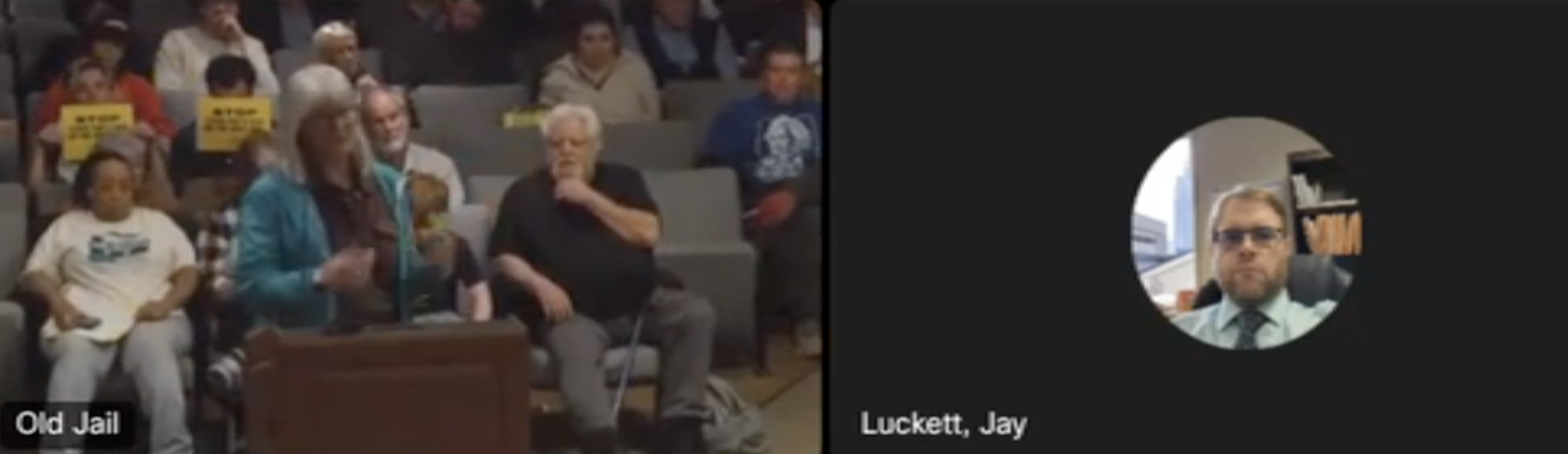
Commission Approves Hyperscale Data Center 7-1 as Rubbertown Residents Plead for Denial

Louisville's Planning Commission waded through a marathon four-and-a-half-hour hearing March 5, approving a 1.5-million-square-foot data center campus in the historically burdened Rubbertown area over fierce opposition from more than 25 public speakers — then denied a liquor store proposal that drew just one opponent but carried 30 years of neighborhood weight. The split decisions revealed the tension between the commission's narrow code-compliance mandate and the broader community concerns that increasingly arrive at its door.

  • Hyperscale data center approved 7-1 on 153 acres in Rubbertown as 25+ residents cite fire risk, diesel pollution, energy costs, and environmental justice

  • 30-year liquor store ban upheld 6-3 after District 12 councilmember argues binding elements "should not come with an asterisk"

  • 213-lot Heritage Creek subdivision greenlit with safety cap on occupancy until second entrance opens

  • South Point Commons Phase 2 cleared unanimously across five votes, unlocking 264,000 sq ft of retail near the Gene Snyder/Bardstown Road interchange despite unresolved sewer dispute


1.5 Million Square Feet in Rubbertown: Data Center Clears Code Review Over Massive Opposition

The longest and most contested item of the evening — consuming roughly two and a half hours — was a Category 3 development plan for a seven-building data center campus on approximately 153 acres of industrial-zoned land on Campground Road in the Rubbertown area.

The basics: A Category 3 review is not a rezoning. It is a code-compliance check — meaning the commission evaluates whether a proposed development plan meets the existing Land Development Code. The site is already zoned EZ1/M3 (enterprise zone/industrial), and the use qualifies as a "telecommunications hotel," which is permitted by right.

Why it matters: This would be Louisville's largest data center — seven two-story buildings totaling roughly 1.5 million square feet, plus a 32,500-square-foot office building and a dedicated electrical substation. It lands in a neighborhood already shouldering decades of chemical plant emissions, and it arrives before Metro Council has completed its own requested update to the Land Development Code for data centers.

Where things stand: Cliff Ashburner, attorney for PO Companies and Powerhouse Data Centers, framed the case as a narrow code question: "This is not a rezoning. A Category 3 review is really an opportunity for the planning commission to determine whether a plan does or does not comply with the Land Development Code." He noted the buildings exceed all setback requirements, preserve 19 acres of tree canopy, and add nearly 1,000 trees. The plan is a scaled-down revision of a roughly 2-million-square-foot proposal already approved by the Development Review Committee in June 2025, redesigned as two-story structures to reduce the overall footprint.

In rebuttal, Ashburner cited the American Planning Association's definition of telecommunications hotels as encompassing data centers: "There are other definitions. They include a building that is constructed or rebuilt for data centers, also known as a carrier hotel, colocation center, or Internet data center." He also stated that LG&E's new tariff requires high-load customers to pay for their own infrastructure and that diesel generators are backup only.

The other side: More than 25 members of the public spoke in opposition, making this the most heavily commented item the commission heard all evening. The arguments clustered around several themes:

Outdated classification. Multiple speakers argued the Land Development Code's "telecommunications hotel" label — which appears only twice in the code with no detailed definition for size, energy, or water use — was written for old switchboard-type facilities, not hyperscale campuses drawing hundreds of megawatts. Another speaker noted that the 120-day deadline for Metro Council's requested LDC revision had passed with no action.

Fire and chemical risk. Speakers pointed to the site's proximity to Rome Chemical and Marathon Oil petrochemical facilities. Eboni Neal Cochran cited a previous hearing where an employee of an adjacent hazmat facility warned a data center fire could "level everything." William Mays, a District 1 resident living about a mile from the site, focused on lithium-ion battery fire risk and the potential for catastrophic explosions affecting nearby schools.

Air quality and public health. Katherine Vining warned that diesel generators run the full length of each building and are commonly used around the clock at hyperscale sites elsewhere: "Memphis is now considered the asthma capital of the United States in large part because of hyperscale data center generators." She noted Louisville already sits in the Ohio River Valley with stagnant air and non-attainment ozone levels.

Energy costs and environmental justice. Erica Summer argued that the facility would draw roughly a third of current county energy use, impacting utility rates for all Louisville residents: "Over 80% of Louisvillians do not want any further data centers." Amanda Stahl, a disability justice advocate, warned the resulting rate hikes would devastate people on SSI receiving $1,000 a month. Kendra Isham argued millions in tax incentives flow to developers while basic needs go underfunded. Dakota Lewis called the Rubbertown siting a continuation of a legacy of redlining.

Water and soil. Alexis McFadden of the Jefferson County Soil Water Conservation District raised concerns about water pollution from cooling processes and sediment discharge to the Ohio River, urging that data centers be restricted to brownfield sites.

Nick Garner, an AI software developer, asked the commission to apply the same critical thinking to this case as to earlier ones on the agenda: "I was struck by a sense of that you care very deeply about whether the knowns and unknowns of a project will benefit the community that it sits in." He noted Habitat for Humanity neighborhoods sit within three miles of the site.

Decisions: Commissioner Jim Mims acknowledged the community concerns but said the commission's authority is limited: "A lot of the questions really surrounded a lot of things that really doesn't deal with the Land Development Code and the comprehensive plan, and that's the lane that we have to operate under." Commissioner Beth Stuber noted that the previously approved DRC plan would proceed regardless, making this a choice between two plans.

Chair TeAndre Sistrunk dissented, arguing the commission's responsibility includes health, safety, and welfare: "We do not have all the facts around data centers yet. That's why the Metro government has asked us to look at" updated regulations.

The plan was approved 7-1 (For: 7, Against: 1, Absent: 3). Chair Sistrunk cast the lone no vote. Commissioners David Steff and Mark Benitez had left before the vote; Commissioner Suzanne Cheek was absent the entire evening.

What's next: The approved plan moves to construction permitting. Metro Council's requested Land Development Code update for data centers remains incomplete — a gap that multiple speakers and the chair himself flagged as the central problem. Community organizers signaled continued opposition.


Bourbon Boutique Denied: Commission Upholds 30-Year Liquor Store Ban

A request to remove "packaged liquor store" from a list of 57 bound-out uses at an existing gas station site at 801 Valley College Drive became a test case for how much weight Louisville's binding elements carry decades after adoption.

Why it matters: Binding elements are restrictions attached to zoning approvals — essentially promises to the surrounding neighborhood about what will and won't happen on a property. This case asked whether a 30-year-old restriction should bend for a modern retail concept.

Where things stand: The applicant, represented by Sophia Mazzocco and Mark Madison of Milestone Design Group, proposed a "Bourbon Boutique" — a retail liquor store and deli as a second phase of the existing gas station. They had already removed a tasting bar component to address Development Review Committee concerns, making it strictly retail with no on-site consumption. Mark Madison argued the original binding elements were a product of 1990s legal strategy: "Package liquor stores these days are a retail environment. You see them in Springhurst or the Paddock Shops."

The other side: Metro Councilman Jonathan Joseph, District 12, was the sole public speaker — and he was unequivocal: "A bourbon boutique is just another name for a liquor store. The purpose of the binding element is not a restriction against the name. It's a restriction against the purpose." He argued the neighborhood — retirement homes, patio homes, JCTC — has not changed since the element was adopted, that a liquor store already exists less than a mile away, and that the restriction was known when the property was purchased.

"When we call something a binding element, that word should actually mean something. It is not a suggestion. It is not temporary. It should not come with an asterisk," Councilman Joseph said.

Commissioner Sharon Bond agreed the neighborhood composition has not changed. Commissioner Jim Mims noted that binding elements "become very focused to a neighborhood" and that the council member and neighbors' views carry particular weight. Chair Sistrunk stated he would vote against overturning it.

Decisions: An initial motion to approve failed 4-5 (For: 4, Against: 5, Absent: 1), with Commissioners Stuber, Mims, Bond, Lohan, and Sistrunk voting no. A subsequent motion to deny passed 6-3 (For: 6, Against: 3, Absent: 1), with Commissioners Benitez, Lannert, and Fischer dissenting. Commissioner Cheek was absent.


Heritage Creek Adds 213 Lots With Safety Cap on Single Entrance

The commission unanimously approved Heritage Creek Section 3, a 213-lot single-family subdivision — but only after adding a condition to address fire safety concerns about the development having just one way in and out.

Why it matters: Heritage Creek was created when Minor Lane Heights was relocated for Louisville airport runway expansion. This continues the community's buildout at below-maximum density — 3.18 units per acre versus the 4.84 allowed — with provisions for future street connectivity to adjacent undeveloped parcels.

Where things stand: Kelly Jones of Sabak, Wilson and Lingo presented for the applicant, explaining the development includes density transfer provisions and stub streets for future connectivity. Traffic engineer Diane Zimmerman reported excellent levels of service. The sticking point: all 213 lots would share a single entrance on Justice Way, exceeding the 200-unit threshold that typically triggers a second-access requirement.

The applicant agreed to cap certificates of occupancy at 199 until a second entrance is available — a condition the commission formally added to the approval.

Decisions: Approved 9-0 (For: 9, Against: 0, Absent: 1). Commissioner Cheek absent.


South Point Commons Phase 2 Wins Full Approval Despite MSD Sewer Standoff

A complex, five-vote package for South Point Commons Phase 2 — involving seven acres of new zoning plus 21 already-zoned acres along the Gene Snyder Freeway near Bardstown Road — cleared the commission unanimously after commissioners separated the land-use questions from an unresolved sewer easement dispute with MSD.

Why it matters: The approval opens the door for 264,000 square feet of retail and restaurant development at the Bardstown Road/Gene Snyder interchange, including what would be Hy-Vee's first Kentucky grocery location in Phase 1.

Where things stand: Attorney John Baker of Bricker, Grade and Wyatt, representing Southpoint Partners, detailed $4.6 million in roadway improvements already completed, including Leaders Lane construction, Bates Elementary traffic improvements, and the Wingfield Road/Bardstown Road intersection reconfiguration. The main controversy was an unresolved disagreement with MSD over three upstream sewer and drainage easements. Assistant County Attorney Laura Ferguson explained the dispute is technical, not a comprehensive plan issue: "It became clear that this wasn't a comp plan issue that the parties were in disagreement over. It was a construction-level issue."

MSD's Tony Kelly confirmed adequate downstream sewer capacity but wanted easements shown conceptually on the development plan. Staff recommended approving the zoning changes but found the development plan not adequately justified due to the lack of MSD approval and a planting waiver.

Neighbors raised separate concerns. Steve Maran and Don Nguyen described dangerous conditions on Wingfield Road — only 14.5 to 15 feet wide in places, with cars reaching 55 mph and no sidewalks. Ken Exley, a visually impaired resident, requested pedestrian access from Wingfield to South Point Boulevard, explaining the current closure forces him on a longer, more dangerous route to reach basic services.

Commissioner Mims led the deliberation, proposing to separate the land-use decision from MSD's regulatory requirements: "From the standpoint of the land use, the plan location, this all makes sense. This is an area that is ripe for regional center." The commission removed controversial Note 13 from the development plan, added binding element 33 requiring Gene Snyder buffer plantings to be placed elsewhere on the site, and approved all five components.

Decisions: Form district change (neighborhood to regional center), rezoning (R4 to C2), two waivers, and the revised development plan — all approved 9-0 across five separate roll-call votes (For: 9, Against: 0, Absent: 1 on each). Commissioner Cheek absent.

What's next: The applicant and MSD must resolve the upstream sewer easement dispute before construction permits can issue. The rezoning and form district changes go to Metro Council for final action.


Minor Items

  • Wilson Avenue right-of-way closure near 12th Street recommended to Metro Council, 9-0. The approximately 316-foot remnant between South 12th Street and Wilson Avenue is non-functional as a through street — the other half was already closed years ago. Applicant Zeocum LLC seeks to consolidate adjoining properties and improve security.

  • Minutes approved for both the Feb. 18 night hearing and the Feb. 19 regular meeting.