
Council Advances Citywide Design Standards After State Voids SB 9 Rules
Town Council • Los GatosOctober 20, 2026
Locunity is an independent informational service and is not an official government page for this commission. All information is sourced from public footage and an analysis of official agendas with the aid of responsible, fact-checked AI. to report an error or omission.
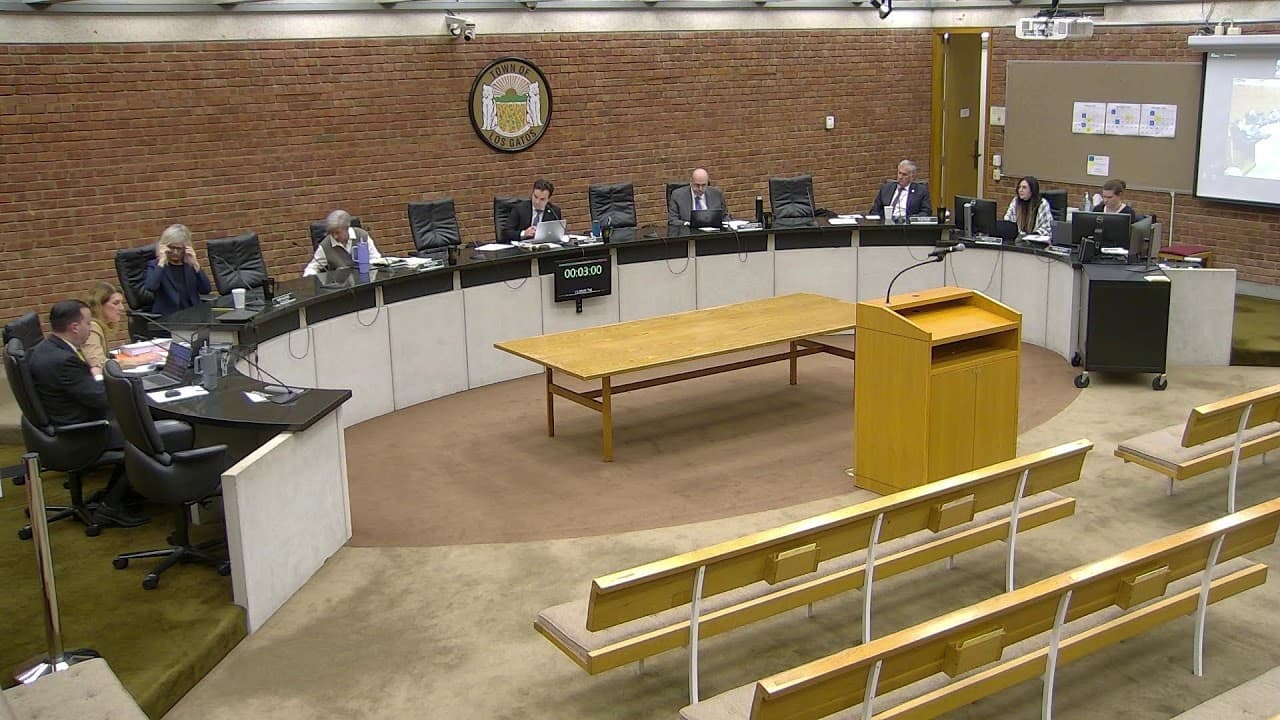
Los Gatos is rewriting the design rulebook for every single- and two-family home in town because a new state law, SB 450, wiped out the standards it had written only for SB 9 lot-split projects. The Town Council voted Oct. 20 to introduce a Chapter 29 ordinance. It also approved a contract worth up to $1.018M to speed stalled capital projects, delayed a North 40 senior living change and heard a sustained student-led push to cancel the town's Flock license plate reader contract.
- Objective design standards introduced for all single- and two-family homes after SB 450 voided SB 9-only rules
- Transtech contract up to $1.018M approved; Kennedy Road sidewalk and bike lanes jump to Tier 1
- Students and Safety Over Surveillance members dominate public comment urging cancellation of the Flock contract
- North 40 senior living amendment continued 4-1 over fears of losing state housing sites
- Council declines fee waiver and co-sponsorship for a multi-day winter display over church-state concerns
Design Rules Go Citywide After SB 450
The basics: SB 9 is the state law that lets owners split lots and add units in single-family zones. SB 450 now bars cities from applying design standards only to SB 9 projects.
Why it matters: Without enforceable standards, SB 9 projects would face only basic setback and height limits. The new rules restore privacy protections for neighbors. They also apply to every single- and two-family project and second-story addition in town, not just lot splits.
Where things stand: Associate Planner Ryan Safdie explained the legal shift. "The town is now prohibited from applying specific objective design standards for SB 9 projects that do not already apply uniformly to development in the underlying zone for all application types," said Safdie.
Staff's fix is to make the standards citywide, with exceptions available only through discretionary review. The Planning Commission recommended approval with two edits. Staff said state law prevents the town from changing the number of SB 9 units allowed, and that an amendment to the SB 9 ordinance will follow in about a month.
Councilmember Matthew Hudes asked about grading, driveways and whether SB 9 units could be made affordable. Staff said grading rules are now tighter. On affordability, "We don't believe that there is a mechanism that will pass state law muster," said Community Development Director Joel Paulson, referring to deed restrictions. Councilmember Rob Rennie flagged potential conflicts between the standards and wildfire Zone 0 rules for fences and landscaping.
The other side: Three public commenters pushed back from different directions:
- Austin, a Safety Over Surveillance Coalition member, called the standards a loophole that undermines SB 9 and the town's housing goals.
- Ivy Chang, speaking for the Watson family, raised state-law concerns about a 30% slope limit, uniform second-story setbacks and director discretion over visibility.
- Lee Quintana urged the council to take up the standards alongside the SB 9 ordinance. She also cited fire-code vegetation rules and AB 1061.
Decisions and stakeholder impacts: Hudes moved to introduce the ordinance and Vice Mayor Maria Ristow seconded. "It's another unfunded mandate, and it's very significant," said Hudes. The motion passed on a voice vote that Mayor Rob Moore declared unanimous; no individual tally was recorded.
Hillside neighbors gain enforceable privacy and design protections. Property owners pursuing SB 9 projects and ordinary remodels now face the same objective rulebook. Owners seeking flexibility must go through discretionary review.
What's next: Staff expects to bring the companion SB 9 ordinance amendment in about a month.
Engineering Help for a Stalled Project Pipeline
Why it matters: Staffing, not money, is what has stalled funded Tier 1 capital projects. Meanwhile, $2M in VTA grant money for Kennedy Road has sat unused for four years.
Where things stand: Director of Parks and Public Works Nicolle Burnham described a thin in-house bench: a vacant senior civil engineer position, one part-time engineer, one assistant engineer and a construction manager. Transtech Engineers, chosen through a request for qualifications, will supplement staff through task orders. "The intent is not to replace town staff," said Burnham.
The agreement is capped at $1,018,000, which Hudes confirmed equals roughly 1.5 full-time staff over two years. All of the money except $150,000 was already in the capital budget. That $150,000 pays for a feasibility analysis on Kennedy Road. Burnham said it comes from the general fund appropriated reserve because the grant covers only design and construction. The action also moves the Kennedy Road sidewalk and bike lane project from Tier 2 to Tier 1.
Hudes asked staff to reuse the Shannon Road design where possible. Rennie asked why the Lynn Avenue path and community gardens were not on the list.
The other side: Public commenter Gus Hu called the scope wasteful and criticized the lack of public involvement. The downtown restroom also resurfaced as a sore point. "I need to restate my concern about a custom-designed and constructed brick-and-mortar restroom facility in the town plaza," said Hudes. Councilmember Mary Badame shared his reservations. "I strongly support public restrooms in Town Plaza Park," countered Moore.
Decisions and stakeholder impacts: Ristow moved approval, and it passed on a voice vote declared unanimous. Cyclists and pedestrians on Kennedy Road get a funded first step. Residents waiting on Tier 1 projects should see added engineering capacity.
Flock Opponents Pack Public Comment
Why it matters: The turnout signals organized and sustained opposition to the town's automated license plate reader (ALPR) contract. The concerns center on privacy and federal immigration access to data. The contract could return to the agenda.
Where things stand: Flock dominated a public comment period crowded enough that the mayor cut speaking time to two minutes. Los Gatos High students led the charge:
- Louisa Horvath of the Los Gatos Deflock movement said public pushback is being ignored and cited minors' privacy.
- Caroline Noss of Deflocking Los Gatos cited false arrests and an untrustworthy vendor.
- Nova Jayraj said fear of federal immigration access to the data justifies removal and pointed to bans by other agencies.
Members of Safety Over Surveillance Santa Clara County followed. Cara Silver cited Fourth Amendment protections, vendor trust and the use of data to train AI. Hansel Aguilar, a former police officer and sociologist, said research finds license plate readers have equivocal effects on crime and urged evidence-based alternatives. Catwoman de Los Gatos, an Air Force veteran, cited the contract's cost and the density of cameras.
Speakers asked the council to agendize and cancel the contract, or at least publish usage data.
The other side: Public commenter Quint called Flock a tool that should be run by responsible people.
What's next: The council could not respond because the item was not on the agenda. Any action requires a future agenda item.
North 40 Senior Living Sent Back
Why it matters: Allowing senior living anywhere in the North 40 Northern District could take up sites the town needs for its Regional Housing Needs Allocation (RHNA), the state-assigned housing target.
Where things stand: Senior Planner Jocelyn Schupman said the amendment would add senior living as a permitted use in Table 1, apply it throughout the Northern District and require architecture and site review for any project. The Planning Commission recommended approval unanimously. Mikhail Williams, the applicant's architect, said senior living fits the North 40 vision and that units other than memory care would have full kitchens.
Hudes and Rennie worried the open-ended use could reduce units that count toward RHNA. "The specific plan feels almost defunct to me," said Rennie. Ristow's motion to adopt drew no second. Staff then outlined alternatives, including a conditional use permit or limiting the use to parcels abutting Burton Road.
The other side: "I'm not going to support the motion because I don't know what it will get us," said Ristow.
Decisions and stakeholder impacts: "I'm uncomfortable with it being open-ended," said Hudes, who moved to continue the item. Rennie seconded. The continuance passed (For: 4, Against: 1, with Ristow opposed). The applicant waits while staff defines the use and determines how many units, or what ratio, would count toward RHNA.
Winter Display Hits Church-State Wall
Why it matters: The legal line between multicultural and multireligious displays on public property limits what the town can sponsor. As a result, organizers lose town backing for their weeklong display.
Where things stand: Shonda Whitkin asked the council to waive a $696 Plaza Park fee for Dec. 1–8 and to co-sponsor a multicultural winter display. Doreen Castleman, president of California Jewish Democrats, backed the request for Congregation Shir Hadash.
Moore made the case for town involvement. "The best path forward is to agree to take on this event or to sponsor this event as government speech," said Moore. The Town Attorney drew a line: "The legal recommendation would be that it be focused on multi-cultures as opposed to religions."
The other side: The rest of the council raised Establishment Clause, California no-aid and precedent concerns. "I think we're conflating multireligious with multicultural," said Hudes. "I just fail to see why the town needs to go out on a limb on the risks that it could provide here," said Rennie. "I think it gets problematic if we start waiving fees," said Ristow. Badame shared those concerns.
Decisions and stakeholder impacts: The council declined the fee waiver and co-sponsorship by consensus. On a motion by Moore, seconded by Ristow, it voted unanimously by voice to have staff return at an unspecified date with options for a future multicultural event.
The Economic Vitality Manager said a Dec. 5 event can be permitted administratively and offered a stage. Town Manager Chris Constantin said the town should have no role in the Saturday event. "If we do have a role, we will be denying the permit," said Constantin.
Minor Items
- Consent calendar, items 1–11, passed unanimously by voice vote. One speaker questioned a $175,000 software item, and Leaf Ago asked for evening and weekend visitor-center hours under a $20,000 Chamber of Commerce contract increase.
- Loma Street water main: Nancy Walker, Carrie Lindholm and Rick Newell asked the council to summon San Jose Water Company over the unresolved Oct. 16, 2025, rupture that flooded homes.
- West Valley Recycles update: Batteries are sparking truck fires, and the new battery bag goes on the landfill cart. The service also offers on-call bulky pickup three times a year.
- Creekside Sports Park: Sean Blakeman of Los Gatos United Soccer Club asked to restore the closed field for 3,000 youth players, while Leanne warned about plastic turf pollution.
Looking Ahead
On a motion by Moore, seconded by Hudes, the council directed staff to bring a draft interim urgency ordinance on immigration detention facility land use to the Nov. 2 meeting. The draft is based on a toolkit that Rania Mohsin of Rep. Sam Liccardo's office presented.
The goal, Moore said, is to "temporarily pause any approvals for using property in Los Gatos for an immigration detention or processing facility." "We do not want to be the last people left without protection," said Ristow. Badame raised a process question about the vote, and no individual tally was recorded. The Town Attorney noted that a permanent Chapter 29 change would require Planning Commission review and two readings.