
Los Altos Hills Extends Olive Branch to Los Altos Over Volunteer Awards
City Council • Los Altos HillsSeptember 17, 2026
Locunity is an independent informational service and is not an official government page for this commission. All information is sourced from public footage and an analysis of official agendas with the aid of responsible, fact-checked AI. to report an error or omission.
A 43-year tradition honoring volunteers in Los Altos and Los Altos Hills is now in doubt, and the Los Altos Hills City Council spent its longest debate on Sept. 17, 2026, trying to save it. Council voted 5-0 to send Los Altos a conciliatory letter. Members also formed a Williamson Act committee, approved electric security patrols, set new false alarm fees and rejected funding for the Summerhill pathway design.
- Council votes 5-0 to send Los Altos a letter urging continued joint volunteer awards
- Williamson Act ad hoc committee formed after heavy public comment on property-tax breaks
- $17,000 Summerhill Pathway design add-on fails amid a projected $520,000 Pathways Fund deficit
- $325,000 private patrol contract approved with electric vehicles and a $5M liability cap
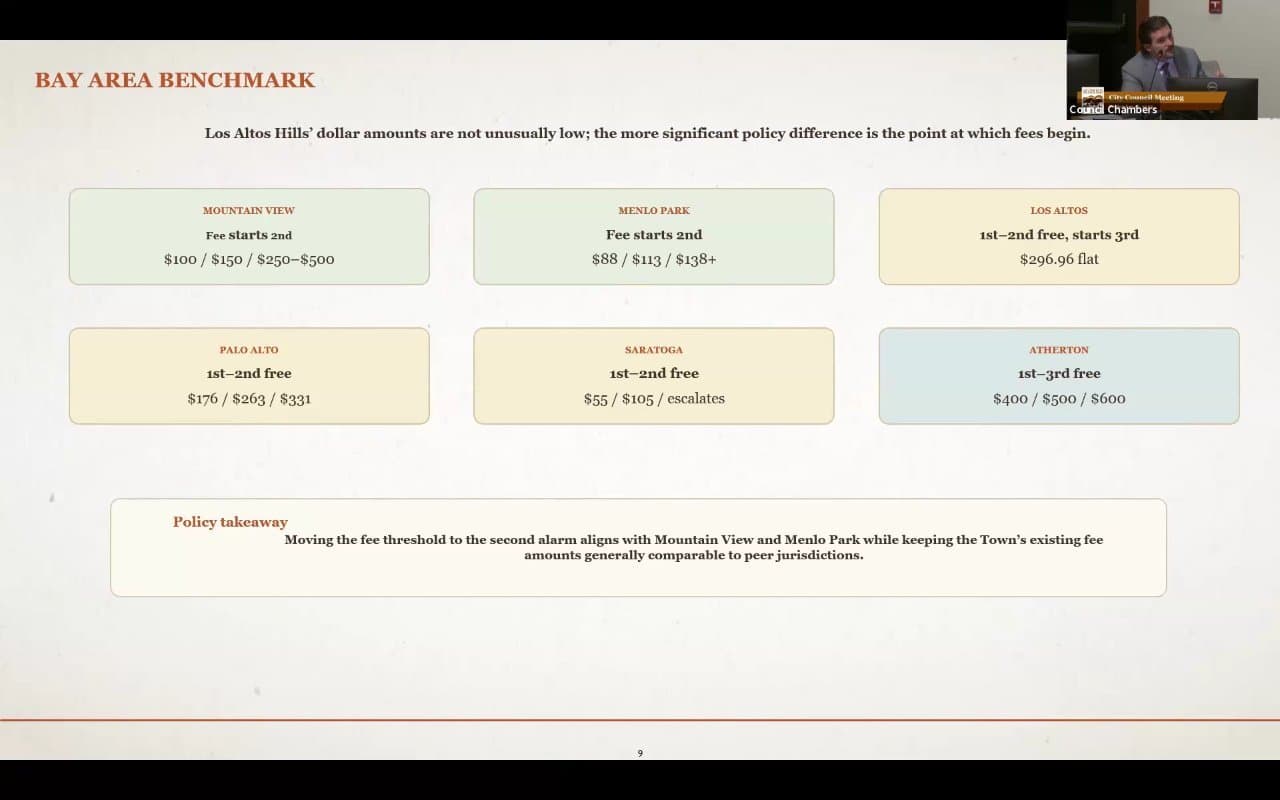
- New false alarm fees directed: two free warnings, then $250, $350 and $500
- Construction time limits overhaul draws feedback; staff report 1,600 expired permits
A Neighborly Rift Over a Volunteer Lunch
Why it matters: The joint volunteer awards event has run for 43 years. About $7,000 in shared funds and a caterer deposit are now tangled in a dispute between the neighboring towns.
Where things stand: Los Altos took action June 18 to withdraw from this year's joint volunteer luncheon. Los Altos Hills staff had expected bylaw changes to come later, after the Joint Volunteer Awards Committee (JVAC) stopped operating as a Brown Act body. The Brown Act is California's open-meetings law. Los Altos still treats JVAC as Brown Act-governed and expects a formal process.
“Now we're understanding it's a 3-step process,” said Cody Einfeldt, City Manager. A JVAC meeting on Sept. 14 failed to reach a quorum.
Mayor Rajiv Bhateja described a tense Los Altos council meeting. He disputed claims that Los Altos Hills skipped bylaw steps and listed open questions about the $7,000 in the joint account, invitations and the caterer. Councilmember Stanley Q. Mok called the Los Altos hearing an interrogation.
The other side: Several speakers urged quiet, behind-the-scenes talks instead of a formal council-to-council meeting. Public commenters largely pushed for reconciliation. Ms. Schmidt, JVAC chair, said she was disappointed by the Los Altos withdrawal and thanked the council for reaching out. Cindy Andrews, a Los Altos resident, apologized for how her council treated Los Altos Hills members. Indu Kadamby, public commenter, pointed to a shared library tax and downtown spending as evidence of a symbiotic relationship. Earlier, Ms. Singh, public commenter, asked the town to protect the senior partnership as Los Altos changes its Senior Commission into a committee.
Decisions and stakeholder impacts: Councilmember George K. Tyson moved to send the letter. “Let's clear the air. Let's do the letter. Let's see how they respond,” said Mok. Tyson later amended his motion to soften its tone. The amended letter encourages meetings in any mutually acceptable form rather than only a joint council session. Members rejected adding the Senior Commission to the letter. After the clerk restarted the roll call to clarify the motion, the letter passed: For: 5 (Bhateja, Swan, Tyson, Tankha, Mok), Against: 0, Absent: 0.
Volunteers and the JVAC chair gain a formal show of support. The status of the shared funds and the caterer deposit remains unresolved.
What's next: The letter goes to the Los Altos City Council. Any response will determine whether the joint event survives this year.
Williamson Act Tax Breaks Get a Closer Look
The basics: Williamson Act contracts sharply lower property taxes on land kept in agricultural or open-space use. In exchange, owners accept restrictions that renew on a rolling basis.
Why it matters: About 25 to 30 town properties hold these contracts. The town's 1972 policy treats any allowed use as compatible, a standard described as very permissive.
Where things stand: City Attorney Mattis said contracts carry a 10-year initial term and then renew yearly unless canceled or non-renewed. He said any changes should be prospective and policy-based, not tied to the pending La Branche appeal. He later clarified that the 90% benefit applies to land outside the home site. Staff suggested the committee focus on renewals, compatibility findings, commercial agriculture and non-renewals.
“I would also suggest to council that the item on your agenda tonight is whether or not to form a committee,” said Mattis.
Councilmember Kavita Tankha raised a threshold question: “Our town is zoned residential agricultural. So does that make our entire town agricultural?”
The other side: Six residents weighed in. John O'Connell, public commenter, backed the committee and proposed a moratorium on new contracts. He also asked that the committee operate openly, citing mistrust. Faye, a resident, cited Resolution 616 and asked the town to share its legal opinion and the assessor's response. Eric Evans, public commenter, read statutory language to argue the rolling 10-year term prevents use of the contracts as a tax haven. Ms. Karami, public commenter, warned that large estates of 5 to 6 acres could still pay very low taxes. Jasmine Pombra, public commenter, urged the town not to be more lenient than other communities.
Decisions and stakeholder impacts: Council formed a two-member ad hoc committee of Tyson and Bhateja: For: 5, Against: 0, Absent: 0. Current contract holders face no immediate change. Future renewals and new contracts could tighten.
What's next: Bhateja said he wants the committee to report back within 60 days. Mattis offered to help prepare a public version of his legal memo.
Summerhill Pathway Stalls Over County Rules and Cost
Why it matters: Residents call Summerhill Avenue dangerous. With no grant or county funding in hand, the road's long-planned safety path now has no funded way forward.
Where things stand: Phase 2 covers about 2,300 feet from Nicole Lane to Magdalena Avenue, mostly in county right-of-way. That requires a county encroachment permit. The county first recommended, then required, accessible materials under the Americans with Disabilities Act (ADA), including rubberized asphalt, curb ramps and a 2% cross slope.
“The county would not approve the town's standard of quarry fines for an accessible material for path,” said Asta Kunal, Associate Engineer. Construction is estimated at $806,000. “There would be a deficit of $520,000 in the Pathways Fund if the town were to complete all of the pathway projects,” Kunal added.
The Pathways Committee discussed dropping the project but did not decide. The county said no appeal is possible while the permit is pending.
The proposal was a second amendment to the Lea and Braze Engineering design contract. It would have added $17,000, brought the total to no more than $68,780 and extended the term to Dec. 31, 2027.
The other side: “I think that $17,000 is a relatively small amount to put into this and get the engineering done and look for grants,” said Linda G. Swan, Vice Mayor. Swan argued the design work would make the project shovel-ready for grants. Mok supported the $17,000 but not later construction spending.
“This whole thing strikes me as too expensive,” said Tyson. “I guess I am more in favor of not spending the money,” said Bhateja.
Carol Gottlieb, public commenter, called Summerhill dangerous. She said she could not ask the town to stop the project and proposed keeping existing paths, adding new segments only where needed. Another resident asked why county requirements were not considered during Phase 1.
Decisions and stakeholder impacts: The motion failed: For: 2 (Mok, Swan), Against: 2 (Tyson, Bhateja). Tankha's vote was not recorded, and official minutes should confirm the final tally. Pedestrians and cyclists on Summerhill are left without a funded plan, while the Pathways Fund is preserved for other projects.
Patrols Go Electric; False Alarms Get a Price
Where things stand: Council unanimously approved a nine-month private security agreement with Securitas, not to exceed $325,000 for fiscal year 2026-27. The contract covers three daily patrols between 3 and 11:30 p.m. Patrol officers observe and report only. Bhateja said George Lee will donate three extension cables so the electric patrol vehicles can charge at no cost to the town. Grid power for charging will come from Silicon Valley Clean Energy, at a cost not yet estimated.
The town's standard contract carries uncapped liability. “We came to a compromise about a $5 million cap on the liability,” said Einfeldt.
Why it matters: Residents tied the patrols to fewer burglaries. Still, the contract does not define how success will be measured. One councilmember asked for data on how often patrols call 911.
False alarms, finally billed: False alarm fees of $202, $303 and $405, starting with the third event, have not changed since 2006. They were rarely collected. In fiscal year 2025-26, the town logged 500 calls and 412 deputy responses but only 75 alarm cards. Thirty-one properties would have been billed. “So we only really captured 18% of what was happening,” said Einfeldt. Deputy response costs are estimated at up to $84,800 a year.
The other side: Jill Grunwald, public commenter, called current fees too low and urged escalating penalties because false alarms tie up deputies. Another commenter favored automated tracking and notices but said the goal is fewer false alarms, not revenue.
Decisions and stakeholder impacts: Both items passed 5-0, and Bhateja seconded the fee direction. Residents get two free false alarms with a warning letter each time. After that, fees are $250, $350 and $500 or more, tracked by calendar year using county dispatch data rather than cards.
What's next: The fee ordinance changes will return to council for adoption.
Rethinking How Long Construction Can Drag On
Why it matters: About 200 large projects, including 82 new homes, have expired permits.
Where things stand: Jay Bradford, Community Development Director, proposed a two-track system. Routine administrative extensions would be separated from nuisance projects. The town would collect a deposit of 10% or $50,000 at permit issuance and apply the rules to all projects. Escalation would begin after a single substantiated violation, with more decisions delegated to staff.
Bradford said most of the town's expired permits are small jobs. “We've got 1,600 expired permits for water heaters, HVACs, re-roofs,” he said, and suggested exempting them.
Council was generally supportive but split on timelines for projects over $5 million. Bhateja said he would “like to see $1 million and above at 48 months.” Others noted that large projects take longer and leaned toward 60 months.
The other side: A public commenter argued the real problem is weak monitoring and enforcement, not time limits. That commenter urged mandatory early intervention and opposed upfront deposits. Another commenter asked for a carve-out for historic homes. Earlier, Mr. Lind, Planning Commissioner, warned that staff growth lags application volume.
What's next: No vote was taken. Staff will use council's feedback to draft ordinance revisions.
- Pathway Committee: Betty Caton and Veronica Hull appointed 5-0.
- Community Fiber: Council commended the $800,000 project funded by the American Rescue Plan Act (ARPA). It finished under budget with 20% to 30% early uptake.
- Sewer agreements (Item H): Approved 5-0 from the sewer fund to cover a roughly $10,000 cost from a missed dedication process. Staff will draft a sewer main extension policy. The rest of the consent calendar passed 5-0.
- Donated engineering (Item J): Accepted with four recorded yes votes. A councilmember urged donating or deconstructing the Parks and Rec building rather than demolishing it.
- Wildfire warning grant: Bhateja said the Legislature approved $500,000 for the Emergency Preparedness and Response Committee's (EPRC) LRAD loudspeaker project after outreach to State Senator Mark Berman's office.
Looking ahead: The League of Women Voters hosts a candidate forum Sept. 30. The town's grading moratorium runs Oct. 1 through April 30 as staff prepare for El Niño storms. The History Committee presents the De Anza Trek 250th anniversary program Oct. 11 at 2 p.m. in council chambers.