
Council Approves La Barranca Home on Williamson Act Land, Eyes Rules Rewrite
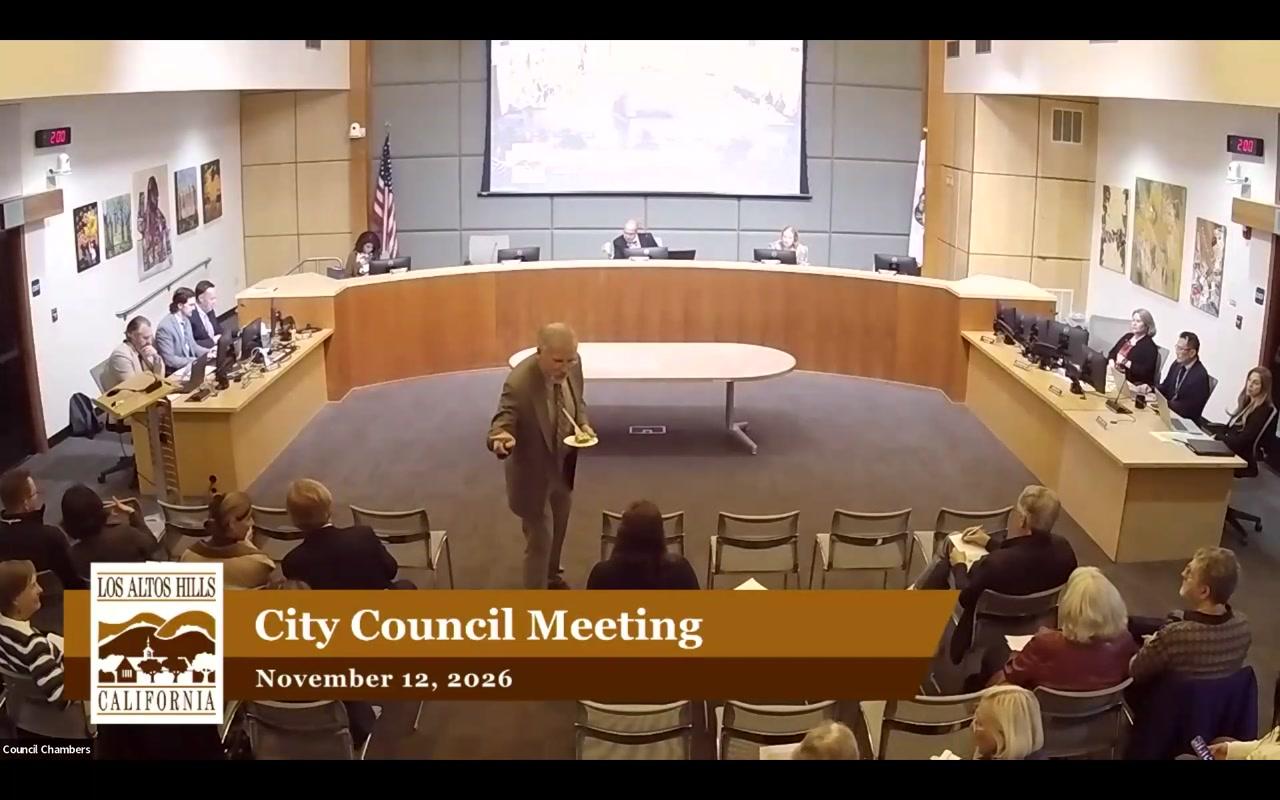
City Council • Los Altos HillsNovember 12, 2026
Locunity is an independent informational service and is not an official government page for this commission. All information is sourced from public footage and an analysis of official agendas with the aid of responsible, fact-checked AI. to report an error or omission.
The Los Altos Hills City Council on Nov. 12, 2026, approved a hillside home on La Barranca Road even though the land sits under a 1972 Williamson Act farmland contract. Resident opponents called the approval a penalty-free exit from that contract. The 5-0 vote included an order to begin non-renewal of the contract immediately, and council members conceded the town's contract language is badly written. Earlier, the council proclaimed a local emergency ahead of a forecast severe El Niño winter.
- La Barranca home approved 5-0 on Williamson Act land; contract non-renewal starts immediately
- Local emergency proclaimed 5-0 as forecasts point to the strongest El Niño since 1950
- Inclusionary housing ordinance introduced 4-0, requiring 10% affordable units in projects of 10 or more
- SHIELD settlement counteroffer rejected 5-0 in the O'Keeffe Preserve dispute
- $23,000 undergrounding design contract tied to a PG&E reply by Jan. 31
La Barranca: A Contract Too Loose to Deny
The basics: Under the Williamson Act, landowners keep land in agriculture or open space in exchange for lower property tax assessments. Canceling a contract triggers a 12.5% penalty. Non-renewal ends the contract without that penalty.
Where things stand: Applicant Naveen Vangala sought approval for a two-story home on a steep, vacant 1.1-acre parcel subdivided in 1961. The home would include an SB 9 unit and an attached ADU, plus a chicken coop and greenhouse for commercial eggs and plants. The request also included an open space easement, a driveway width variance and a grading exception.
The Planning Commission voted 3-1-1 to recommend non-renewal and a finding that the project is incompatible with the contract. "There's nothing that makes it unique," said a Planning Commissioner.
City Attorney Steven T. Mattas said the 1972 contract lists primary and secondary dwellings as compatible uses. He added that no local rule makes agriculture the primary use. "Los Altos Hills standards do not say that, nor does state law require that," said Mattas. He also noted that approval carries an applicant defense and indemnity provision if the town is sued. Denial would leave the general fund exposed.
The other side: Christopher Powell, an attorney with Hanson Bridget LLP representing Citizens of Los Altos Hills for Responsible Development, argued that a compatibility finding is a cancellation in substance that avoids the penalty. "Token agriculture bolted onto a residential estate is not the production of agricultural commodities for commercial purposes that the contract protects," said Powell.
The money at stake is significant. "You would probably be around $600,000 as a cancellation penalty," said Jay Bradford, Community Development Director, based on a $3 million to $4 million valuation.
A public commenter, Mr. O'Connell, said every other parcel in town left its contract through non-renewal and cancellation. He cited more than 20 parcels that paid cancellation fees. Brigitte Indico noted that the applicant renewed the contract in January for another 10-year cycle.
Vangala said he did not receive clear Williamson Act disclosure when he bought the property. "If you have approved previously houses with Williamson Act, then do the same," said Vangala. His attorney, Michael Patrick Durkee, told the council: "There is no substantial evidence" to support a denial.
Decisions and stakeholder impacts: Council members said the contract's own terms governed the outcome, even as they criticized it. "The contract actually says primary dwellings and secondary dwellings, plural. And that is really, really bad contract language," said Mayor Rajiv Bhateja.
The motion passed with Condition 17 amended so staff immediately start non-renewal. The applicant agreed not to protest. (For: 5 — Bhateja, Vice Mayor Linda G. Swan, Councilmembers George K. Tyson, Kavita Tankha, Stanley Q. Mok; Against: 0; Absent: 0.)
The applicant gains entitlements without paying the penalty. Opponents lose that revenue argument. Attorneys on both sides had warned of litigation, but the indemnity provision shields the town's costs.
What's next: An ad hoc committee of Bhateja and Tyson reported that the town holds 17 contracts covering 25 parcels. Four parcels are already in non-renewal. State law allows renegotiation only by mutual consent. The committee proposes:
- New eligibility criteria
- Revised compatible uses
- Renegotiated contracts, with non-renewal for owners who decline
The committee plans a resident listening session and will report back Dec. 14.
Bracing for El Niño: Powers, Sandbags, Phone Numbers
Why it matters: Los Altos Hills has a residential-only economy, a lean staff, remote roads and landslide risk. Mindy Shane, Assistant to the City Manager / Assistant Director of Emergency Services, cited a forecast of an 83% to 98% chance of the strongest El Niño since 1950. She also pointed to impacts from the 2023 storms.
Where things stand: The proclamation of a threatened local emergency lets the city manager act early. It also positions the town for Cal OES and FEMA aid. San Jose and San Mateo County had already acted. The proclamation requests no money, and the council must review it every 60 days. "There is no downside to doing this," said Shane. City Manager Cody Einfalt said he would return to the council for large purchases.
The Emergency Preparedness and Response Committee reported:
- A draft El Niño response plan and a vulnerability assessment
- A resident call-in line at the Heritage House
- Teen CERT and Ham Hustle youth communications programs
- A Sandbag Saturday that filled 500 bags for about 33 residents
Valley Water's limits: Valley Water manages about 350 of the county's 800 waterway miles. It has one flood project in town, Adobe Creek Reach 5, and inspected four of five town creeks this year. Typical response time is about five days. "We don't have extra time this year," said a Valley Water representative. Bhateja urged residents to call town Public Works first.
PG&E's playbook: PG&E pre-stages crews four to 10 days ahead of storms and gives critical customers priority restoration. "We have over 1,600 weather stations throughout our service territory," said Monica Faria, PG&E local government affairs liaison. Medical baseline enrollment affects restoration priority.
Decisions and stakeholder impacts: The proclamation passed (For: 5; Against: 0; Absent: 0).
What's next: The town will hold an emergency operations center exercise Nov. 18 and another Sandbag Saturday Nov. 21. Residents should sign up for AlertSCC and PG&E alerts.
Inclusionary Housing: 10%, Not 15%
Why it matters: The ordinance is required by Housing Element Program A-6. It sets deed-restricted affordability terms of 45 years for ownership units and 55 years for rentals, and it preserves the state density bonus.
Where things stand: The ordinance applies to multifamily projects of 10 or more units. It cuts the draft requirement from 15% to 10% and allows in-lieu fees. The changes followed comments from the League of Women Voters and CalHDF. Staff said feasibility problems stem from financing, insurance and materials costs. The council reviewed the measure April 16, and the Planning Commission reviewed it June 5 and Nov. 5, recommending it 5-0 at the November meeting.
Asked about rents, Mattas said affordability categories follow state law. A supporting study assumes about $2,000 for very low-income units, $2,300 for low-income units and $4,400 for moderate-income units. Market rents run $4,000 to $4,300, meaning the moderate-income assumption sits above market.
Decisions and stakeholder impacts: The council introduced the ordinance (For: 4; Against: 0; Absent: 1, Mok). The 10% rate and in-lieu option give developers flexibility. Fee levels, which matter most to project math, remain unset.
What's next: Fees come by resolution at second reading.
SHIELD Offer Rejected Over O'Keeffe Preserve
Where things stand: Mattas reported a 5-0 closed-session vote declining a counteroffer from SHIELD, a resident coalition. SHIELD alleges CEQA and Public Records Act violations tied to discussions of a potential ballot measure on the O'Keeffe Open Space Preserve. The town denies the claims.
Bhateja read the town's statement on SHIELD's terms. "The council unanimously rejected that as unnecessarily and inappropriately binding the hands of the current and future councils," the statement said.
Why it matters: The terms would have barred the council from considering the preserve for future housing. The town said no ballot measure or designation change has been approved, and the 2002 open space initiative still protects the property. The litigation remains unresolved.
Undergrounding Hinges on PG&E
Where things stand: Phase 1 of the Rule 20A undergrounding project finished in January after seven years. The town holds about $650,000 in unused credits, and the county reportedly holds $13 million and is willing to transfer credits if a feasible project exists. Phase 2 would exceed 800 feet. PG&E has more than 160 projects queued, and the program sunsets Dec. 31, 2033.
Decisions and stakeholder impacts: The council approved a $23,000 Sanibel design contract, but only if PG&E responds positively by Jan. 31 to a letter drafted by Tyson. The letter goes to PG&E's CEO and is copied to the CPUC chair. (For: 3; Against: 0; Absent: 1, Mok; one member recused, citing PG&E.)
Minor Items
- Backup generator: The council approved up to $100,000 (5-0) for a trailer-mounted Generac generator that integrates with the Town Hall microgrid. It carries about $10,000 to $15,000 in yearly software costs.
- Janitorial contract: Significant Cleaning won a three-year contract, not to exceed $194,937, covering seven facilities (4-0, Mok absent).
- Construction time limits: The council introduced an ordinance (4-0) merging the first two valuation tiers into 24 months. The extension deposit will be collected when permits expire.
- Green-ride travel policy: The council passed a policy preferring electric or green rideshare options, 5-0, despite one member's objection that its emissions impact is negligible.
- EPRC appointment: CERT volunteer and ham radio operator Michael Matter joined the Emergency Preparedness and Response Committee (5-0).
Looking Ahead
The town holds a planning listening session Nov. 16. The Housing Element Implementation Committee hosts its first resident session Dec. 3 at 6 p.m. at Town Hall. A new finance director starts Dec. 7. The council meets Dec. 14 at 5 p.m., and reorganizes Dec. 17. Item 7D and a planning survey report were continued.