
Livingston Planning Board Balks at 10-Foot Car Wash Fence
Planning Board • LivingstonNovember 11, 2026
Locunity is an independent informational service and is not an official government page for this commission. All information is sourced from public footage and an analysis of official agendas with the aid of responsible, fact-checked AI. to report an error or omission.
Livingston's Planning Board told a car wash operator on Nov. 10, 2026, that an 8- to 10-foot acoustical fence is not the answer to a noise problem neighbors have endured for more than a year. Facing a motion to disapprove, the applicant asked for a continuance. The board pushed the hearing to Feb. 2, 2027, so the applicant can return with a revised plan.
- Motion to disapprove stalls as the applicant seeks a continuance to Feb. 2, 2027
- Applicant's expert predicts a 62 dBA maximum, close to the 65 dBA state limit
- Five neighbors urge source-level fixes, not a taller wall
- Applicant offers post-construction noise testing at its expense and a 57 Hz fan cap
- Planner defends the fence variance; the code allows 5 feet in a side yard
Board Signals 'No' on the Wall
Why it matters: The board's position steers the applicant, EAS Livingston LLC, toward fixing noise at the source rather than building a barrier. Residents of the neighborhood around 107 East Mount Pleasant Avenue keep living with the noise in the meantime.
Where things stand: After the evidentiary record closed, board members lined up against Application No. 2024-54-PFSP, an amended site plan.
One member cited how close the predictions sit to the state limit and the prospect of uncertain monitoring. "I'll be saying no to this," the member said.
Another member said a smaller wall paired with operational changes could win support, but not the proposal on the table. "I can't support the 8 and 10-foot walls," the member said.
Other members objected to a fence that tall in a residential neighborhood. They said the burden should not fall on residents, and they were uneasy with predictions near 97% of the state limit. One member called 6 feet the maximum reasonable height.
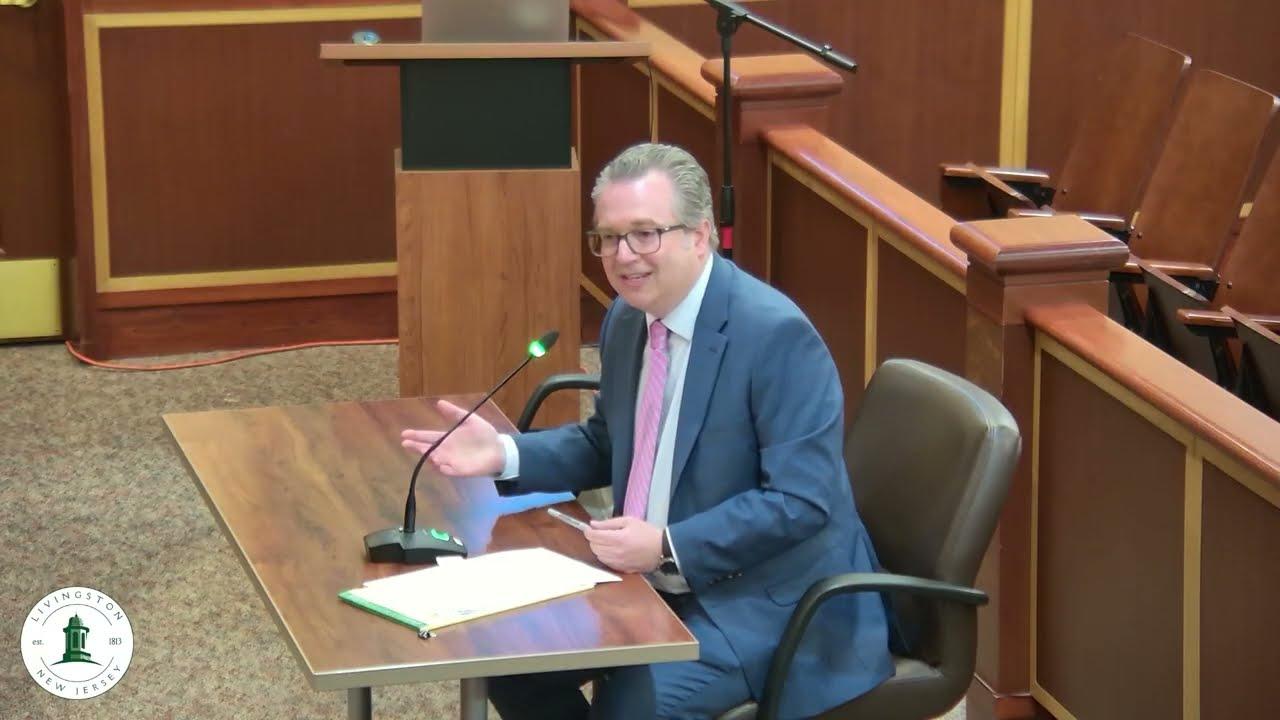
The other side: The applicant's attorney, Tom Troutner, opened the hearing by arguing the revised model settled the question. "So the fence, in short, works," Troutner said.
Decisions and stakeholder impacts: A member moved to disapprove the application. "I would move to disapprove, unless the applicant wants to go back to the drawing board," the member said.
Troutner then asked for a continuance to modify the application. "I'm thinking we probably need at least 60 days," he said.
The board's attorney explained that a denial would force a brand-new application with new plans. County enforcement of the noise violation proceeds on a separate track either way.
No formal tally was taken, and the motion to disapprove was not acted on. Members voiced agreement with the continuance. Members also warned the applicant against simply returning with a 9-foot version of the same wall.
What's next: The hearing resumes Feb. 2, 2027. The applicant must send new mailed notices to neighbors.
Revised Noise Model Lands Near the Limit
The basics: dBA is a decibel scale weighted to match how human hearing perceives sound. New Jersey's noise code caps residential exposure at 65 dBA in this case.
Where things stand: Acoustical consultant Joe Keefe of Ostergaard Associates presented a revised Oct. 29 model. He testified that current conditions violate the state noise code, with readings in neighbors' yards as high as 71 dBA.
With the proposed fences, he predicted a peak of 62 dBA in yards and 60 dBA at home facades. Octave-band limits, which measure noise across frequency ranges, were also met. "And now the highest result is 62," Keefe said.
The earlier model relied on a single air gun sprayed at a metal grate. Keefe returned Oct. 8 for after-hours measurements and modeled all 17 air guns, the tunnel blowers and the mat dryer. Fans were tested at 57 Hz, or about 95% speed. The vacuum turbines are now enclosed and no longer a factor.
The other side: Board members and the board's professionals pressed on several points:
- Why only one air gun was measured
- Whether the compressor's output varies
- Why the new numbers came in lower than last month's
Keefe said the grate was a misjudgment, not a data error. He added that landscaping would not reduce sound and that his firm offers predictions, not guarantees. "Nothing is soundproof," he said.
The trust problem: A member said repeated corrections to the data gave him pause. Members and residents also challenged the 38-decibel figure cited in the original approval.
Troutner said that figure was a true manufacturer specification for the vacuum turbine alone, measured at 30 feet. Keefe said his firm had no part in that representation.
Neighbors Want the Noise Fixed at the Source
Why it matters: Five residents argued that the equipment layout, not the lack of a barrier, is the real problem. Their testimony shaped the board's push toward operational changes.
Where things stand:
- Joyce Armando of Greenwood Court described a year of noise from vacuums, air hoses, a buzzer and blowers. She said earlier data misled the board. She urged members to set limits stricter than the state maximum, reject the 10-foot fence, and restore the original traffic flow or move or remove equipment.
- Michelle Campisi of Sparrow Drive said low-frequency turbine noise passes through vinyl. She cited the health effects of chronic noise and called the focus on meeting the legal limit a false dichotomy. Troutner objected that she was reading hearsay expert commentary.
- Anthony Armando of South Livingston Avenue said the noise sounds like an airport. He disputed the predicted levels and called the 38-decibel figure a misrepresentation.
- Heidi Shaw asked that any monitoring not fall on residents.
- Carol McInnis, a resident since 1961, said the noise is new and asked the board to act.
The other side: Keefe acknowledged that vacuum suction was not modeled. He said it is quieter and would be reduced by the fence, and that an 80 dB limit on impulsive noise may apply to the warning buzzer. Troutner disputed that a federal workplace safety rule (OSHA) requires an alarm. He later said the start-up beep can be eliminated or reduced.
Variance Case and Enforcement Safeguards
Where things stand: Professional planner Catherine Gregory testified that the fence qualifies for a height variance. Town code permits 5-foot side-yard fences, while 8- and 10-foot fences are proposed.
She argued the site is unique and that public health and safety benefits outweigh any detriments. She cited Goal 5 of the township's 2018 master plan. "I believe that we meet both the positive and the negative criteria for the granting of the fence height variance," Gregory said.
Under questioning, she conceded two points. Her last car wash testimony involved a site with no abutting homes, and 10-foot fences are more unusual in residential zones. She suggested gray coloring and landscaping on the residents' side of the fence.
Troutner noted no landscaping had been proposed. "We would agree to work with the board professionals, come up with a reasonable landscaping solution on the 10-foot fence section," he said.
Enforcement debate: Troutner agreed to noise testing at the adjoining property lines after construction, at the applicant's cost. He also agreed to cap the tunnel fans at 57 Hz.
Board Chair Rudy Fernandez floated a condition setting a firm decibel level, with the operator required to take whatever action is needed to meet it. He also wanted certification that the fans stay at the 57 Hz setting. He warned that any fallback must not force a new filing. "The residents can't keep living with the problem waiting for the next application," Fernandez said.
One participant cited another community that shut the stalls nearest homes when readings ran high. Keefe said closing arbitrary stalls may not help some neighbors and that a decibel-based requirement makes more sense.
Looking Ahead
The car wash hearing resumes Feb. 2, 2027, with new notices to neighbors. Watch whether the applicant returns with a lower fence, relocated equipment or a restored traffic pattern.