
Livermore's Downtown Hotel Deemed Infeasible as Approved; New Plan Due 2027
City Council • LivermoreNovember 24, 2026
Locunity is an independent informational service and is not an official government page for this commission. All information is sourced from public footage and an analysis of official agendas with the aid of responsible, fact-checked AI. to report an error or omission.
Eight years after approval, Livermore's downtown hotel is still unbuilt. City staff told the City Council on Nov. 23, 2026, that the project cannot work as designed. No vote was taken, but the update revealed a $200,000 city loan to the developer, a council subcommittee searching for a new model and a sharp public split over transparency. The council also unanimously approved the first package of code changes implementing General Plan 2045, which eases industrial limits and confirms that data centers remain off the table.
- Downtown hotel "not feasible" as approved. Costs are up more than 60% since 2018, and staff will return with options in early 2027.
- City loaned the developer $200,000 as bridge financing of about $2 million nears maturity.
- Downtown Coalition alleges omissions in the staff report, including a notice of default and unpaid property taxes.
- First General Plan 2045 code package passes unanimously. It removes a 20% warehouse cap and widens open-space fund use.
- Data centers are not permitted under Livermore zoning, staff said, while a resident urged a drone-delivery moratorium.
- Eden Housing says its 130 affordable downtown homes are fully funded, with construction starting in early 2027.
Hotel Hits a Wall, but the City Isn't Walking Away
The basics: The boutique hotel at Livermore and Railroad avenues was negotiated beginning in 2016 and approved in 2018. It then survived legal challenges, two referendums and an initiative. Economic Development Manager Jake Potter noted that Measure P passed with more than two-thirds of the vote. The pandemic followed, and the project was amended in 2022 and 2024.
Why it matters: The city's flagship downtown hospitality project is stalled. City money is now at stake, and critics are questioning how openly the deal has been handled.
Where things stand: "A feasibility study was completed earlier this year and demonstrates that the hotel, as currently approved, is not feasible," said Potter. He cited construction costs up more than 60% since 2018, along with lower occupancy and revenue projections. The developer needed roughly $2 million in bridge financing maturing early next year, and the city lent it $200,000. A council subcommittee formed in September is working with staff and the developer. Councilmember Evan Branning said "the subcommittee has been meeting very regularly, multiple times a month."
Rakesh Patel, representing developer Studio Companies, said, "We still are very committed and confident in the downtown hotel." Councilmember Ben Barrientos pressed him directly: "will you be able to build this Hotel in a timely manner?" Patel said he could not predict timing, but added, "We will build it as fast as we possibly can."
The other side: Greg Scott, a public commenter, read a response from a Downtown Coalition attorney. It alleged the staff report omits the developer's financial troubles, including a notice of default, unpaid property taxes on an offsite parking property and an unpublished $200,000 loan agreement. The letter also questioned whether the feasibility report had been made public. Supporters pushed back. Lisa Tromovich, founder and executive artistic director of the Shakespeare and Performing Arts Regional Company (SPARC), called a downtown hotel the missing piece for cultural tourism and wine country. Public commenter Mateusz Montreal blamed litigation for the lost years and asked the city to consider incentives for upgrading rundown motels near downtown.
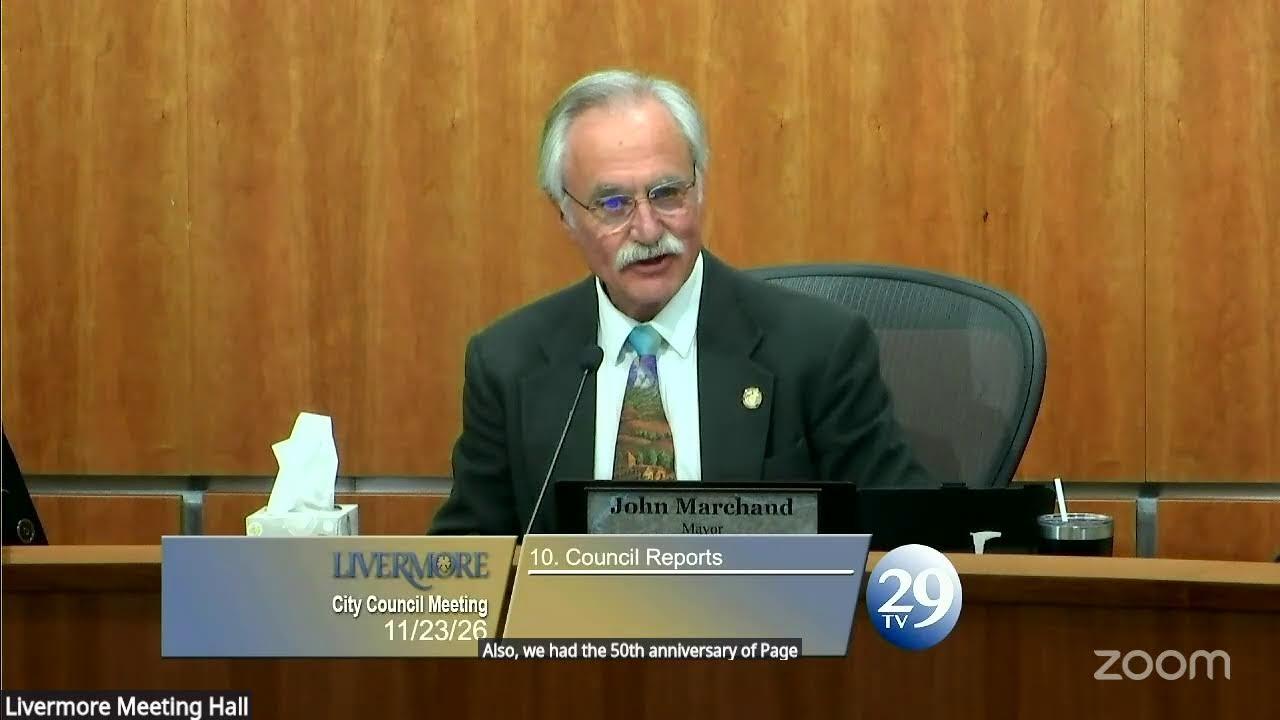
Mayor John Marchand disputed the coalition's claims, citing past polling and Measure P. He said "no one has ever submitted a proposal to the city for an L Street hotel." A side controversy surfaced when a private communication reached councilmembers during public comment. The city attorney said council rules discourage private communications during a public meeting.
Decisions and stakeholder impacts: "This is an update, so there's no vote required," said Marchand. The developer gets more time, and the city's $200,000 loan remains exposed. Downtown arts and tourism boosters still lack a hotel, and the coalition's transparency complaints remain unresolved on the record.
What's next: Staff and the subcommittee will return with a path forward in early 2027.
Code Overhaul Opens Industrial Land, Shuts Out Data Centers
Why it matters: This is the first of several packages translating General Plan 2045 into enforceable rules. It shapes where jobs, warehouses and open-space dollars go.
Where things stand: Item 7.1 fixed a long-standing mismatch at 4200 East Avenue, east of Rotten Robbie's. The site is designated medium-density residential but zoned professional office, and it has been used commercially since the 1980s. Assistant Planner Emily Ledoux said staff proposed a neighborhood commercial designation consistent with the zoning. The owner supports the change, and no physical development is planned.
Item 7.2 updates zoning districts, standards, permitting and definitions. In the SMP-39 and SMP-40 areas, it permits advanced manufacturing, removes a 20% cap on warehouse and distribution uses and allows uses already permitted at SMP-40. It also expands use of the Transferable Development Credit (TDC) fund beyond North Livermore to South Livermore and adjacent areas. "This package is the first in a series of amendments that staff anticipates bringing before the Planning Commission and City Council over the next 6 months," Ledoux said.
Data centers and drones: Branning asked whether the changes would open the door to data centers or a drone distribution facility. Ledoux said, "Data centers would not be allowed in our industrial districts because they're not expressly identified in the development code." A staff member said drone facilities are generally not permitted but that the code should be checked, and Branning asked staff to follow up. Councilmember Steven Dunbar pointed to the size of the SMP-39 property, saying, "I'm not particularly concerned, yet, given what I've heard here." Earlier, public commenter Kat Gaskins, a Compass real estate agent, opposed commercial drone delivery, citing noise, privacy and safety. She asked the city to disclose any pending applications and to adopt a public hearing, an interim moratorium and conditional use permits.
The other side: Public commenter Constance Kopp argued that the process sidelined public input and that her years of requests for maps went unanswered. She urged the council to slow down. Branning noted the general plan process took about five years. Dunbar confirmed that the Altamont Open Space Committee had reviewed the TDC change and that it has community support.
Decisions and stakeholder impacts: Item 7.1 passed on a unanimous voice vote, moved by Branning and seconded by Barrientos. Item 7.2, including an ordinance introduced with first reading waived, passed on a unanimous voice vote, moved by Vice Mayor Kristie Wang and seconded by Dunbar. Individual votes were not recorded. Industrial landowners and manufacturers gain flexibility, and South Livermore becomes eligible for TDC funds.
What's next: The ordinance returns for adoption, and more code packages are expected over about six months.
Eden's Downtown Housing Clears Its Last Hurdle
Where things stand: Vasco Yorgoff, project developer for Eden Housing, said the Eden Downtown Livermore Apartments are fully funded and fully approved. The project will deliver 130 affordable homes, with construction set to begin in early 2027.
The other side: The long-contested project still stirs heat. Public commenter Alan Marley argued that downtown has enough parks and that affordable housing is needed more. He also alleged that opposition groups are funded by specific individuals, a claim that went unverified at the meeting. Montreal said groups opposing housing do not truly represent balanced growth and urged the mayor to relax, arguing public sentiment has shifted toward affordability.
- Appointments: The council unanimously seated appointees to the Commission for the Arts, Human Services Commission, Livermore Housing Authority and Tri-Valley Conservancy Board. Appointees include Cindy Hagley, David Jonas and Lynn Monica.
- Retiree rehire: By unanimous voice vote, the council waived the 180-day wait so retired finance manager Eric Peterson can return to Administrative Services. One caller objected, saying the city needs new blood.
- FEMA shortfall: Dunbar said "FEMA changed the reimbursement from $5 million to $12,000 in their portal very recently" for a pipeline repair at an agency he referred to as LAVAMA. Marchand said the city would exhaust its options.
- Beautification: Committee Chair Tom Bradley reported that "An amazing 69 trees were donated by Western Star Nurseries and planted across 11 school campuses." The committee also gave six beautification awards and four community service awards.
- Senior workforce pilot: A resident identified as Akil proposed linking senior centers with college student jobs. Branning referred the idea to Human Services staff.
Looking ahead: Hotel options return in early 2027, alongside more General Plan code packages and the start of Eden's construction. Marchand adjourned the meeting in memory of former council member Tom Ryder.