
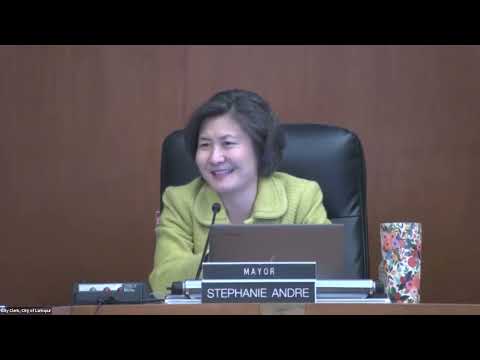
Larkspur Plans to Pay Its Own Way Through a Costly Flood Season
City Council • LarkspurOctober 21, 2026
Locunity is an independent informational service and is not an official government page for this commission. All information is sourced from public footage and an analysis of official agendas with the aid of responsible, fact-checked AI. to report an error or omission.
The Larkspur City Council spent nearly three hours on Oct. 21, 2026, preparing for winter king tides and El Niño storms, with the working assumption that the city will cover the bill itself. Members declared a local emergency by voice vote and directed staff, without a formal vote, to move ahead on barriers and pumps. Later that night, a council majority set aside a commercial vacancy tax, though the mayor still wants voters to decide.
- About $1.1M in flood costs is spent, anticipated or likely, with more than $800,000 in options still uncommitted
- Measure G storm drain money is the likely backstop, which could delay citywide drain work two to three years
- Larkspur Marina residents pressed for pumps, barriers and lagoon draining, citing sewage in their streets
- Resolution 7126 proclaims a local emergency to speed purchasing and preserve reimbursement eligibility
- Four council members declined to pursue a vacancy tax, while Mayor Stephanie Andre still favors a ballot measure
The Flood Bill Lands on Larkspur's Ledger
Why it matters: Staff and council members treated outside reimbursement as unlikely. The fallback is money voters set aside for storm drains, so this winter's preparation could slow long-term drainage fixes.
Where things stand: City Manager Dan Schwarz laid out four cost tables:
- Already spent: about $282,000 on a mobile generator, a 6-inch pump, sand and bags
- Anticipated staff overtime: about $430,000
- Likely costs: about $354,000, including a $50,000 tree allowance and a sandbag-filling machine shared with Corte Madera
- Uncommitted options: more than $800,000
Schwarz cautioned that an emergency declaration is not a blank check. He said FEMA reimbursement depends on the event window FEMA sets.
"I've seen a lot of chatter that folks sort of think once the city or the state declares an emergency, everything becomes reimbursable, and that's not how the system works," said Schwarz.
Asked how the city would fill the gap, Schwarz said the most likely source would be Measure G funds. That would postpone citywide storm drain investment by two or three years.
The county ask: Public Works Director Julian Skinner said staff sent Marin County's Flood Zone 9 engineers a funding request that matches the fourth table, and he expects a response. Councilmember Catherine Way said federal reimbursement is unlikely and that the county's $3 million may not go far against needs along the bay. Vice Mayor Gabe Paulson, who sits on the Flood Zone 9 Advisory Board, pointed to county reserves of about $10 million and offered to help lobby for a share. Schwarz said the county has probably already spent about half of the $3 million.
The other side of the ledger: Council members were blunt about who pays.
"If we're going to make a policy decision to purchase this, I think we have to understand it's going to come out of our budget," said Way.
"We should just assume that we're not going to get reimbursed," said Mayor Stephanie Andre.
Decisions and stakeholder impacts: The council did not vote, and staff said no vote was requested. Instead, the council reached a consensus directing Public Works to proceed on barriers and pumps, to hold off on $400,000 in pumps without more analysis, and to pursue county money. Councilmember Sarah Margulies pushed for speed.
"I would like to give him the authority to make that decision based on the conversations in a timely manner and not to have to come back to us for further meeting and discussion," said Margulies.
Skinner offered a check on that authority. "I'm not going to go tomorrow and sign a $300,000 contract," said Skinner, who said he would report back before committing to large contracts.
The trade-off is clear. Flood-exposed neighborhoods get faster protection, while residents citywide could wait longer for storm drain upgrades if Measure G covers the gap.
What's next: Staff awaits the county's response on Flood Zone 9 funding. Skinner will return before signing any large pump contract.
Marina Residents Demand Protection, Not Just Preparation
Why it matters: The Larkspur Marina neighborhood took the brunt of January's flooding. Residents told the council they have already spent their own money and now need the city to act.
Where things stand: Skinner ranked the options by how likely they are to attract outside funding:
- An $80,000 Redwood Highway barrier, which needs Corte Madera, the county, Caltrans and SMART to participate
- Barriers at Riviera Circle and Doherty Drive; the eastern one would close the street
- Up to 12,000 prefilled sandbags, which he described as a ceiling
- Wall repairs on Larkspur Plaza Drive
- Pumps for the Marina, estimated at about $400,000 in the homeowners association's Foth engineering report
"But the baseline that we're aiming for is elevation 9.0," said Skinner, describing the barrier design height.
Skinner said the lagoon is being drained passively and pumps may be staged in the Marina. He put the pump cost anywhere from $0 to $400,000, depending on the contract and service levels.
The residents' case: Nine people spoke on the item.
- Natasha Chalmers, head of the Larkspur Marina flood committee, described measures the neighborhood funded itself. She backed the Doherty barrier, asked the city to pre-drain the lagoon and provide pumps, and said the county flood fund has not returned money to the area.
- Louis Tannenbaum, president of the Larkspur Marina Property Owners Association, said the upgraded lagoon helps only if Public Works drains it, and that pumps are needed to clear the streets.
- Corey Birkin distinguished preparation from protection. He cited $50,000 in damage and asked for sandbag help for elderly Creekside owners.
- Sinead Cain, a physician and resident, called sewage-contaminated flooding a public safety issue that could recur monthly.
- Koji Felton, a Riviera Circle homeowner, urged the council to treat Marina taxpayers as a revenue center. He said he would seek a property tax reassessment if his home floods.
- Madeline Fendler asked whether drains on the 600 block of Riviera Circle and two flapper gates had been repaired.
- Catherine McConkey, a Greenbrae Boardwalk resident, worried a four-month barrier would block access and affect exposed utilities in the unincorporated area.
Former Mayor Joan Lundstrom recalled the 1997-98 El Niño rains and hillside landslides, and praised the city's flood mailer.
The other side: Council members agreed on urgency but not on scale.
"I don't think we have time to wait," said Way.
"I am in favor of getting some more pumps, but not $400,000 worth of pumps," said Andre.
Schwarz drew a firm line on the Redwood Highway barrier. "If the county and Corte Madera and SMART and Caltrans don't all agree to do their part, I'm not going to authorize an $80,000 expenditure that's meaningless, right?" said Schwarz.
Decisions and stakeholder impacts: Marina and Riviera Circle residents are likely to see barriers and some pump capacity, but the council approved no specific dollar figure. Paulson framed the pump spending as cleanup rather than prevention: "We're not keeping water out with this money," said Paulson. Greenbrae Boardwalk residents' access concerns remain open.
What's next: Whether the Redwood Highway barrier happens depends on commitments from neighboring agencies. The pump scope will be set after further analysis by Public Works.
Vacancy Tax Stalls Before Reaching the Ballot
Why it matters: To appear on the March 2027 ballot, a tax would need to be placed by Dec. 4. Without majority support, the idea is effectively shelved.
The basics: A vacancy tax charges property owners whose commercial space sits empty. In Larkspur, the conversation has centered on large, long-vacant sites such as the former Lucky site.
Where things stand: At the second workshop on the topic, the city attorney walked through the design choices: which properties to cover, how to define vacancy, the rate, exemptions, the start date and sunset, collection, and how to use the revenue. He flagged new legal risk.
"There is a very recent, since the last study session, appellate court decision that invalidated San Francisco's tax on vacant residential property," said Woodruff, City Attorney.
That decision rested on the Ellis Act. He advised against a "look-back" provision that would escalate rates based on past vacancy. He also cautioned that a tax class with only one actual taxpayer invites litigation. Councilmember Scot Candell pushed back on framing the debate around a single site: "We are not discussing any specific property. We're discussing a citywide ordinance," said Candell.
The other side: Property owners lined up against the tax. Jim Rosenfield, owner of Marin Country Mart, said repositioning a property takes time and that the problem lies with specific properties. Small commercial owner Thomas Young said small owners face vacancies they cannot foresee, while large chains can absorb a tax. A commercial manager named Reed warned that owners would pass costs to tenants, file reassessment appeals and contend with weak office demand, and he suggested incentives instead. James Holmes warned against using a citywide measure to target one property.
Conrad Gann argued the other way. He supported a narrow, legally defensible tax on large retail-facing vacancies and said about 50 letters to the council mostly favored action.
Decisions and stakeholder impacts: No vote was taken. Way, Candell, Margulies and Paulson said they did not want to pursue the tax.
"I think the tax is probably not the right thing right now," said Candell.
"I think we have other tools in the box," said Paulson.
"I'm still in favor of putting something on the ballot and letting the voters decide," said Andre. She acknowledged, however, that the council's direction does not support continuing.
The outcome protects owners of commercial property from a new tax. Residents frustrated with long-empty storefronts will need to look to the "other tools" members mentioned.
What's next: No further action is scheduled. The Dec. 4 deadline for the March 2027 ballot will likely pass without a measure.
Local Emergency Declared for Winter Storms
Why it matters: The declaration cuts procurement red tape and starts the reimbursement paperwork, but it does not unlock any automatic grants.
Where things stand: Assistant City Manager Shannon O'Hare said extreme high tides are expected in October, November, December and January. Gov. Gavin Newsom declared a statewide emergency on Sept. 21, and Corte Madera declared one the night before the meeting. Resolution 7126 suspends standard bidding, supports reimbursement requests, and lets the city manager sign agreements as emergency services director.
"The City Council will review the emergency status every 60 days, and we will terminate it as soon as the weather threat has safely passed," said O'Hare.
A council member asked whether the declaration would help homeowners with their insurers. Schwarz said he was not aware of any compelling benefit and advised owners to talk with their insurance brokers.
Decisions and stakeholder impacts: Resolution 7126 passed by voice vote, with no opposition or abstentions voiced. Individual votes were not recorded.
What's next: The council will review the emergency every 60 days.
Minor Items
- Consent calendar passed by voice vote with no items pulled.
- Rose Lane litigation settled: The city attorney announced a settlement of the easement dispute tied to the library access road.
- Alert Marin: The city urged residents to sign up for emergency alerts before the storm season.
- Serenity property back on the tax rolls: Andre said the council's investigation led Larkspur to leave a joint powers authority, which forced the property's sale. She put the value to the city at roughly $400,000 to $500,000 a year.
- Tree and pump station requests: Public commenter Arlene Fox asked the city to red-tag hazardous trees on Magnolia Avenue, add a backup generator at the Bon Air pump station, and write to MMWD about using Phoenix Lake as a retention basin.
Looking ahead: The emergency declaration comes back for review every 60 days. Watch for the county's answer on Flood Zone 9 money and for Public Works' report before any major pump contract is signed.