Land Use and Transportation Committee - Apr 20, 2026 - Regular Meeting

Land Use and Transportation Committee - Apr 20, 2026 - Regular Meeting

Land Use and Transportation CommitteeSan FranciscoApril 20, 2026

Sources:

Locunity is a independent informational service and is not an official government page for this commission.We use AI-assisted analysis and human editorial review to publish information.

SF Advances SB79 Housing Plan, Locks In Industrial Zone Protections

The Land Use and Transportation Committee's most consequential vote Monday wasn't the one that passed unanimously — it was the one that failed. Supervisor Matt Dorsey's bid to sunset permanent industrial zone exemptions from the state's transit-oriented housing mandate was defeated 1-2, setting San Francisco's compliance strategy on a path that shields SOMA, Mission, and Bayview production-distribution-repair zones from residential development for the foreseeable future. The committee also advanced 13 landmark designations, endorsed a state bill requiring speed-limiting devices for reckless drivers, and green-lit a new EV curbside charging permit program.

  • City's SB79 alternative plan advances with permanent industrial exemptions intact after a failed 1-2 amendment vote split the committee and drew 10 public speakers on both sides

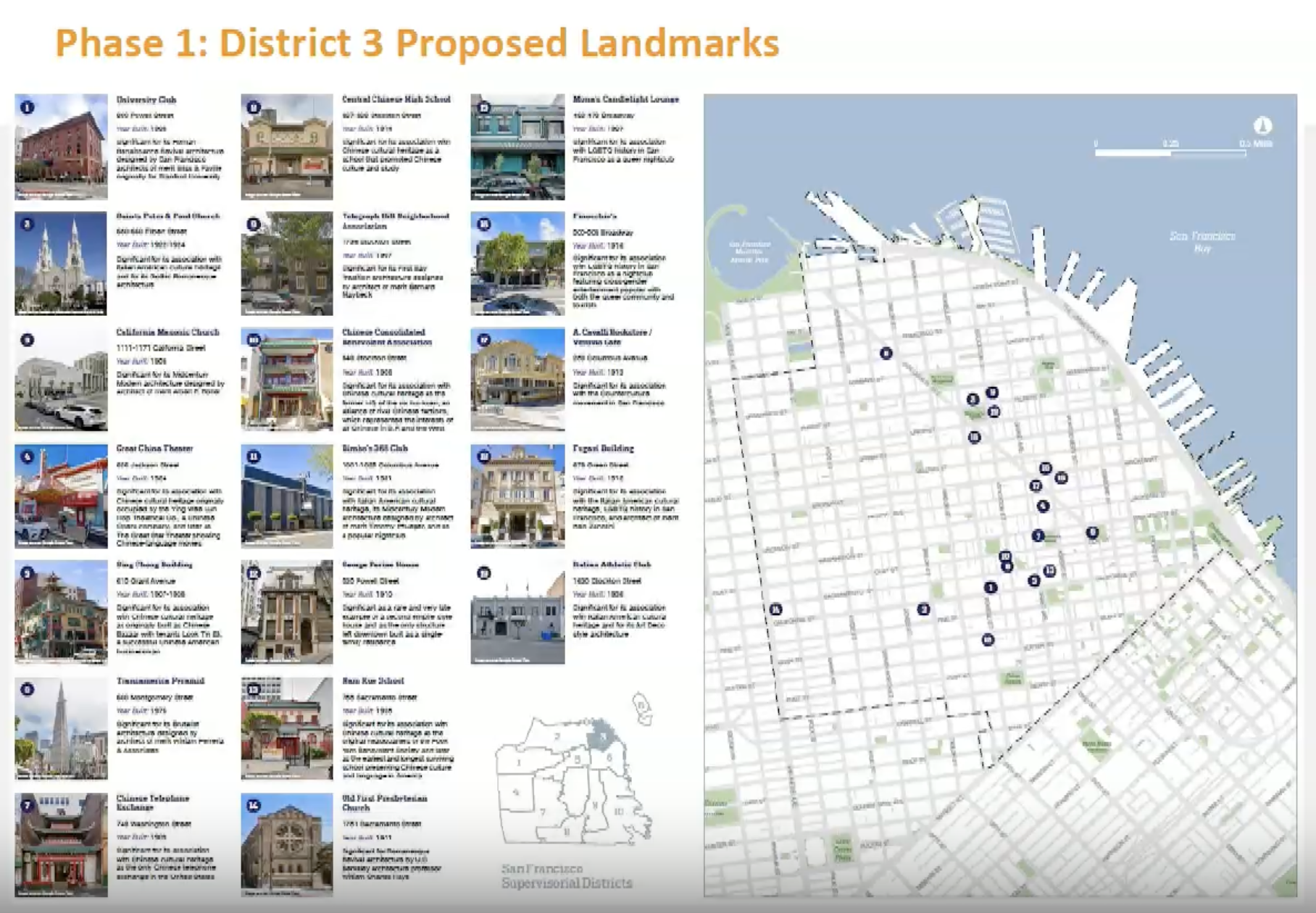
  • Thirteen District 3 buildings — including the Transamerica Pyramid and Vesuvio Cafe — move toward landmark status under the Family Zoning Plan's first large-scale preservation push

  • Committee unanimously backs AB 2276, which would require speed-limiting devices for drivers convicted of reckless driving, citing eight pedestrian fatalities in San Francisco so far in 2026

  • EV curbside charging ordinance clears committee, consolidating permitting under SFMTA


Industrial Zones, Housing, and the Fight Over SB79

The longest and most heated debate of the meeting centered on how San Francisco will comply with SB79, the state law requiring cities to allow residential development near transit stops. The city's alternative plan permanently exempts industrial employment hubs — zones classified as M, SALI, PDR, WMUO, and P — from the law's default housing requirements. That exemption became the flashpoint.

Why it matters: The permanent exemption effectively bars new housing on large tracts of transit-rich land in SOMA, the Mission, and Bayview. Critics say it blocks thousands of units the city needs to meet its housing element targets. Defenders say these zones are the last strongholds for blue-collar jobs and cultural districts serving communities of color — and that SB79 is the wrong tool to rezone them.

Where things stand: Planning Department staff Josh Switzky presented a technical amendment allowing the department to update parcel tables as the Metropolitan Transportation Commission finalizes eligible transit station locations. He noted that some planned stations — including a potential bust rapid transit (BRT) line on Geneva Avenue and a Caltrain station in Bayview — will be removed from the SB79 map.

"MTC has actually determined those are not actually eligible. They do not meet the standard to be considered planned transit stations under SB79. So those will be coming off the map," said Switzky.

Supervisor Matt Dorsey, who represents District 6 and much of SOMA, proposed amending the permanent industrial hub exemption to a temporary one with a sunset date, originally suggesting 2032 but expressing openness to 2028.

"I am uncomfortable with the position that these areas should never have Transit Oriented Development. We are a transit first city and we should be all be proud of that," Dorsey said.

He added that regardless of the amendment's fate, he would pursue separate policy changes to increase housing capacity in West SOMA.

Legislative Aide Ana Herrera, speaking for District 9 Supervisor Jackie Fielder, opposed the amendment, citing the Mission Action Plan and community engagement that shaped the current approach.

"Our office is in support of the legislation as is before you today, and we're grateful to the Planning Department for all the community engagement on this planning plan," Herrera said.

A Community Divided

Public comment was sharply split, with 10 speakers lining up on opposite sides of the industrial exemption question.

Residents of SOMA West argued the permanent exemption sacrifices their transit-rich neighborhood to protect wealthier parts of the city. A SOMA West resident who said they had lived in the neighborhood for 17 years described dead zones created by vacant commercial and industrial parcels. Leah Edwards, a District 6 resident, said 400 constituents signed a petition supporting a complaint filed with the state Department of Housing and Community Development alleging fair housing violations. Shaun Auckland, a SOMA West Neighborhood Association board member, argued the city artificially lowers its housing capacity requirement by exempting SOMA, and demanded at most a 2028 sunset as the maximum acceptable compromise. David Singer, a Western SOMA resident, called the exclusion cynical and urged a no vote. Griffin Lee of Connected SF supported Dorsey's amendment.

On the other side, community organizations representing Bayview, the Mission, and the Filipino Cultural Heritage District argued that PDR protections are essential for racial and economic equity. Teresa Dulalas of SOMCAN/SOMA Filipinas urged the committee to keep permanent exemptions, framing PDR protections as a pathway to higher-wage jobs for people with less educational opportunity. David Wu of SOMA Filipinas argued PDR zones provide economic diversity that buffers against boom-and-bust cycles. Zach Weisenberger of Young Community Developers in Bayview said permanent industrial protections are non-negotiable, noting these communities have already absorbed more than 80% of new housing production. J.R. Eppler, president of the Potrero Boosters Neighborhood Association, opposed the amendment, calling for a community-based planning process rather than a blunt-force sunset through SB79. Peter Papadopoulos of United to Save the Mission warned that market-rate housing near low-income workers increases displacement risk.

The Vote

Supervisor Bilal Mahmood supported a 2028 sunset, citing the housing element's 29,000-unit deadline as a forcing function.

"I have talked to Senator Wiener's team and they have informed me that when they authored SB 79, it was not their intention to offer a permanent exemption for PDR," Mahmood said.

Chair Myrna Melgar opposed the amendment, arguing the SB79 process is not the right vehicle.

"I do generally think that having permanent prohibitions on things is not a great planning thing because the world changes," Melgar said. "And so I am open to engaging in a conversation with all supervisors as to whether the definitions and the prohibitions are appropriate today."

She pushed back against claims the plan protects the west side, noting that they had just "up zoned" the area.

Vice Chair Chyanne Chen also voted no.

"I believe it's continued to be critical as of today to retain protection that don't further incentivize the displacement of PDI use that sustain our blue collar workforce," Chen said.

Decisions: The Dorsey amendment failed 1-2 (For: Mahmood; Against: Chen and Melgar; Absent: none). The committee then adopted the Planning Department's technical amendment and recommended the ordinance as amended to the full board 3-0.

What's next: The SB79 alternative plan heads to the full Board of Supervisors. The debate over industrial zone rezoning is far from over — Dorsey has signaled he will pursue housing capacity increases in West SOMA independently, and the HCD complaint filed by SOMA residents adds a state-level compliance pressure point.


Thirteen District 3 Landmarks Advance Under Family Zoning Plan

Supervisor Danny Sauter brought 15 resolutions to initiate Article 10 landmark designation for buildings across Chinatown, North Beach, Nob Hill, and Union Square — the first large-scale batch of the Family Zoning Plan's preservation effort.

The basics: The Family Zoning Plan paired ambitious housing upzoning with protections for the city's most significant historic buildings. San Francisco currently has 320 individual landmarks. This effort targets existing Category A properties — those already recognized as having the highest significance — outside of RH zoning districts.

Why it matters: The landmarking ensures that housing production goals don't come at the expense of iconic buildings. The properties include the Transamerica Pyramid, Vesuvio Cafe, Great China Theater, California Masonic Memorial Temple, Finocchio's Club (a historically significant LGBTQ entertainment venue), the Fugazi Bank Building, and others.

"These new Article 10 landmarks will bring well deserved recognition and protection to iconic buildings, including the California Masonic Memorial Temple, Vesuvio Cafe, Great China Theater and Transamerica Pyramid," said Sauter.

Senior Preservation Planner Shannon Ferguson explained that of 19 initially identified properties, four building owners requested removal, leaving 15 before the committee.

"This effort is unprecedented approach to expedite landmarking for properties which we already know have cultural, historical and architectural significance," Ferguson said.

Decisions: Sauter requested that two items — the Chinese Telephone Exchange Building and Mona's Candle Light — be continued to the call of the chair to allow more time for engagement with building owners. That motion passed 3-0. The remaining 13 were recommended to the full board 3-0.


Committee Backs Speed-Limiter Mandate for Reckless Drivers

Supervisor Danny Sauter presented a resolution supporting AB 2276, the Stop Super Speeders Act by Assemblymember Esmeralda Soria, which would establish a pilot program requiring drivers convicted of reckless driving, speed contests, or driving over 100 mph to install active intelligence speed assistance devices that physically prevent a vehicle from exceeding the speed limit.

Why it matters: Eight pedestrians have been killed in San Francisco in the first four months of 2026.

"A recent pilot of a similar program in New York City is showing us the promise of this with a 64% reduction in total time spent speeding," Sauter said.

The bill includes income-based fee structures for low-income drivers.

Where things stand: As the bill moved through the Assembly, the original statewide pilot was narrowed to seven counties.

"San Francisco is not currently one of the seven listed in the bill, but we have learned from the bill's author that they intend to add San Francisco to the list in the next phase of the assembly committee process," Sauter said.

Walk SF and Families for Safe Streets have been advocating for the legislation.

Decisions: Supervisor Bilal Mahmood moved to amend the resolution to reflect the bill's changes and recommend it to the full board. Passed 3-0.


Minor Items

  • EV curbside charging permit program: An ordinance authorizing SFMTA to administer curbside electric vehicle charging station permits — eliminating a separate sidewalk encroachment permit from the Department of Public Works — was recommended to the full board 3-0 without debate. The item had been continued from the prior week for amendments.