
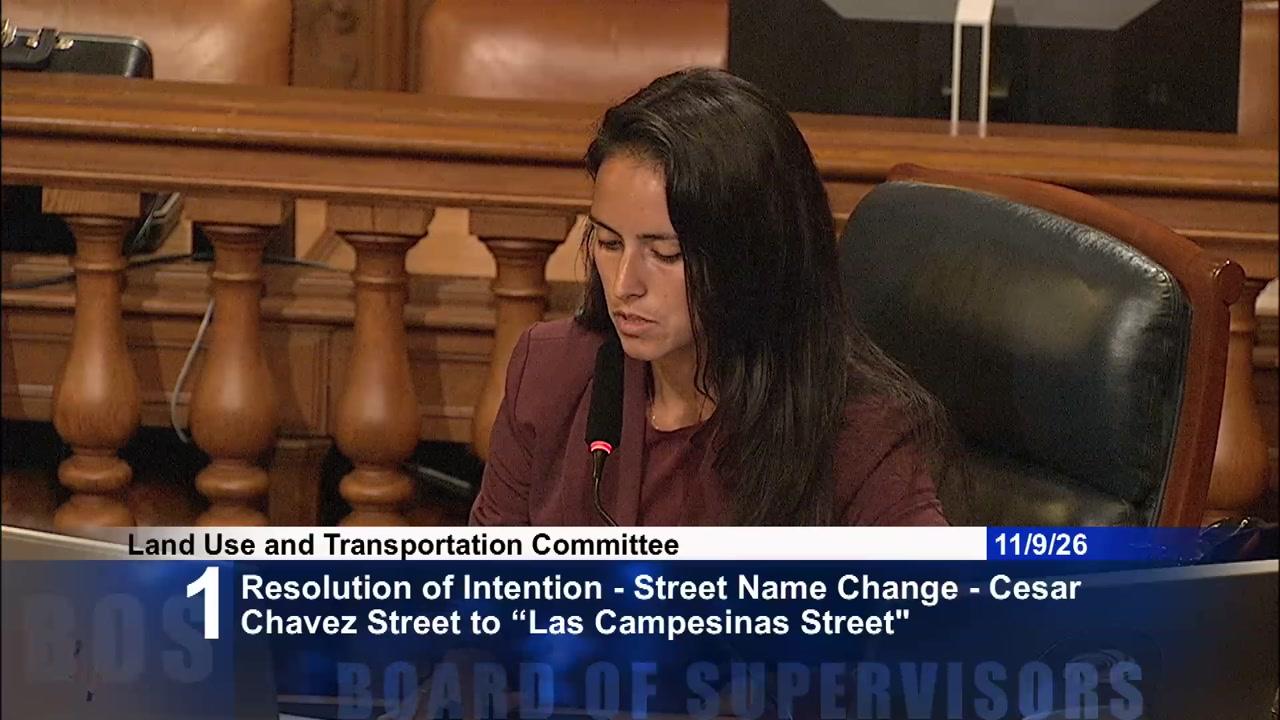
Las Campesinas Street Renaming Clears Committee as Residents Seek Delay
Land Use and Transportation Committee • San FranciscoNovember 9, 2026
Locunity is an independent informational service and is not an official government page for this commission. All information is sourced from public footage and an analysis of official agendas with the aid of responsible, fact-checked AI. to report an error or omission.
San Francisco took its first formal step toward renaming Cesar Chavez Street when the Board of Supervisors' Land Use and Transportation Committee voted 3-0 to back Las Campesinas Street, a name honoring women in the farmworker movement. The committee also unanimously advanced a 25% increase in relocation payments for tenants displaced by Ellis Act evictions. Both measures now head to the full Board, though residents of the street say they were left out of the renaming process and want more time.
- Las Campesinas resolution advances 3-0 after a working group recommended honoring women farmworkers rather than an individual
- Residents of Cesar Chavez Street ask for a pause, citing thin outreach, missing survey data and a long name
- Ellis Act relocation payments would rise 25% to $13,888 per eligible tenant, with a $41,664 household cap
- Tenant advocates call the increase a start, not enough, as vacancy falls to 2.6%
A Movement, Not a Man: Las Campesinas Advances
Why it matters: The vote begins the formal renaming of a major street that runs through three supervisorial districts. It reverses the city's 1995 Proposition O renaming after allegations of sexual abuse against Cesar Chavez.
Where things stand: Supervisor Jackie Fielder, District 9, the resolution's sponsor, said the original renaming honored immigrant farmworkers and that the allegations against Chavez required a new name. She tied the current effort to the original decision.
"At that time, it was essential to take a stand and recognize a symbol of the resistance, worker power, and the countless contributions of immigrant farmworkers…" said Fielder.
Assessor-Recorder Joaquín Torres co-chaired the 26-member working group convened by the mayor. He said the group chose to honor a movement rather than an individual, and that Dolores Huerta did not want her name used. Torres said the Department of Emergency Management told the group the name poses no addressing problems. He acknowledged the limits of consensus.
"A change like this is not something that can be done and please everyone," said Torres.
Oscar Grande of the Planning Department's Community Planning Team reported 771 survey responses. Las Campesinas led with 233 votes, about 30%. Bevan Dufty, a member of the Homelessness Oversight Commission, read a statement of support from working group co-chair Susan Leal.
Working group members Olga Talamante, John Trusvenia and Annie Rivera, executive director of Galería de la Raza, backed the name. Talamante said the group deliberated for six months, and Rivera cited a 2018 city ordinance on representing women in naming. Ernesto Cuellar, speaking for young Latino and Latina activists, and a statement from the Calle 24 Latino Cultural District also supported it.
The other side: Several speakers who live on the street said they support renaming but not this name. They said they learned of the process from the Chronicle. Scott Kravitz, a resident and business owner, asked for a pause. Zach Aaron and Olga Kaplan asked for survey results and a delay, and floated Esperanza and Dahlia as alternatives. Kaplan said Dahlia drew 16% as a write-in despite not appearing on the survey.
"Only about three percent of street names in San Francisco have more than fourteen characters," said Kaplan, a public commenter.
Andrew Boxley said he represented 220 residents who oppose the name. He requested a detailed survey breakdown by Nov. 16. Leon Spada, a resident and former bilingual teacher, raised concerns about the "othering" of the term and suggested Esperanza. Trusvenia, a supporter, urged the city to help residents and businesses with legitimate concerns.
Decisions and stakeholder impacts: Supervisor Chyanne Chen, District 11, asked to join as a co-sponsor. Supervisor Myrna Melgar, District 7, the committee chair, said the decision rests with the Board of Supervisors, not a vote of residents.
"I like the name Las Campesinas," said Melgar.
The vote was For: 3 (Chen, Dorsey, Melgar), Against: 0, Absent: 0. Farmworker and Latino cultural groups gain the recognition they sought. Residents and businesses on the street face the practical costs of the change and the unresolved transparency complaints.
What's next: The resolution goes to the full Board as a committee report. Public Works will then conduct outreach to street residents. A later ordinance would complete the renaming and waive the MTA requirement to keep old street signs posted for five years.
Ellis Act Payouts Get a 25% Bump
The basics: The Ellis Act is a state law that lets landlords evict tenants in order to exit the rental business. San Francisco requires landlords to pay relocation assistance to the tenants they displace.
Why it matters: Dan Adams, Director of the Mayor's Office of Housing and Community Development, said vacancy has fallen from 9% during the pandemic to 2.6%. He said rents have risen sharply and eviction filings are up, though they remain below the 2016 peak.
Where things stand: The ordinance amends the Administrative Code to raise payments 25%:
- Per eligible tenant: from a little over $11,000 to $13,888
- Per-household cap: $41,664
- Additional amount for elderly and disabled tenants: a little over $9,000
Adams said the 2022 study that set current amounts left out costs such as rental application fees and temporary housing, and that inflation has eroded the payments since. Chen backed the update, citing application fees, temporary housing, deposits and move-in costs.
"Evictions under Ellis Act can be traumatizing experiences for tenants," said Chen.
The other side: Two public commenters supported higher payments but questioned whether the increase goes far enough. John Ellis, a member of the Supportive Housing Providers Network Resident Advisory Board speaking for himself, asked whether payments would cover all expenses and whether support services would follow tenants to new homes. He urged the city to publish data on what happens to displaced tenants.
"The rent is too dang high and this is too little," said Charlie Bodkin, a public commenter who urged a higher figure.
Decisions and stakeholder impacts: The committee voted For: 3 (Chen, Dorsey, Melgar), Against: 0, Absent: 0 to send the ordinance to the full Board with a positive recommendation. Tenants facing Ellis Act evictions would receive more money, and landlords pursuing them would pay more. The ordinance does not address the commenters' concerns about support services after a move or tracking outcomes for displaced tenants.
What's next: The ordinance goes to the full Board as a committee report.
Looking Ahead
Both items reach the full Board of Supervisors as committee reports. Watch whether the city releases the detailed survey breakdown residents requested and how Public Works structures its outreach on Cesar Chavez Street before the final renaming ordinance comes forward.