
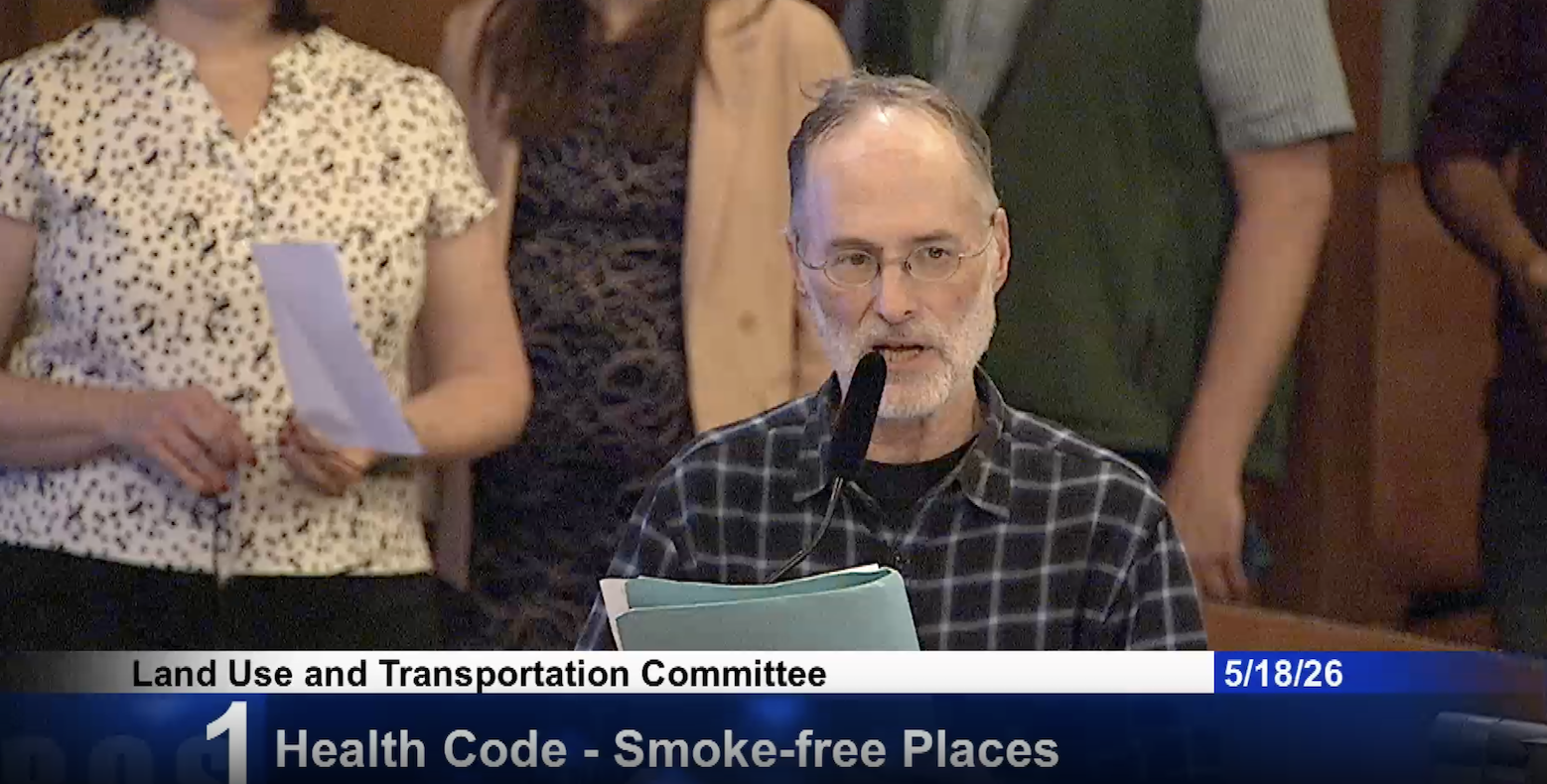
Land Use and Transportation Committee - May 18, 2026 - Regular Meeting
Land Use and Transportation Committee • San FranciscoMay 18, 2026
Locunity is a independent informational service and is not an official government page for this commission.We use AI-assisted analysis and human editorial review to publish information.
SF Committee Delays Bar Patio Smoking Ban as Bar Owners and Health Groups Square Off
The San Francisco Land Use and Transportation Committee heard more than 20 speakers clash over a proposed ban on smoking and vaping at bar patios before unanimously voting to continue the ordinance to June 8, 2026 — buying time for negotiations between the Mayor's office, committee members, and both sides of a fight that pits legacy bar culture against worker health protections.
Bar patio smoking ban heads to June 8 after marathon public comment and 3-0 continuance vote
Coalition of 20+ bars and Small Business Forward mobilize against ordinance, citing 2,496 petition signatures and post-pandemic financial strain
Health advocates — including ACS Cancer Action Network, SF Medical Society, and Americans for Non Smokers Rights — frame ban as urgent worker protection, backed by UCSF and CDC data
Chair Melgar defends ordinance as legitimate public health measure while acknowledging business concerns and opening door to amendments
The Last Loophole: SF's Smoke-Free Laws Meet the Bar Patio
The basics: The ordinance, authored by Chair Myrna Melgar, would amend San Francisco's Health Code to prohibit smoking and vaping on outdoor patios of bars and taverns, eliminate exceptions that currently allow indoor smoking in bars with no employees and bars with historically compliant semi-enclosed smoking rooms, and close a hotel room exception — aligning the city with California law. The item was the sole piece of business at the committee's May 18 meeting.
Why it matters: San Francisco's smoke-free laws currently carve out exceptions for bar patios, certain employee-free bars, and cigar lounges — the last major gaps in a regulatory framework that more than 120 other California cities, including San Jose and Oakland, have already closed. Passing this ordinance would reshape the business model of dozens of legacy bars while potentially protecting thousands of hospitality workers from secondhand smoke exposure in a city where bar employees cannot choose to avoid patio shifts.
Where things stand: Before opening public comment, Chair Melgar announced she would seek a continuance to June 8, revealing that the Mayor's office had offered to help negotiate amendments on timing, definitions, and enforcement. But Melgar made clear she wasn't backing down on the substance.
"I don't want to withdraw this legislation because I think it is a legitimate public health issue. I understand that it will affect the business plans of businesses, and I definitely don't want to harm businesses," said Chair Myrna Melgar.
She then made a pointed case for the density argument that supporters say distinguishes San Francisco from sprawling suburbs: "We live in a 7 by 7 square mile city that is very dense with rent controlled units above many of these patios where people really don't have a choice whether to move because we are in one of the most expensive cities in the country where giving up your rent controlled apartment is actually a big deal."
What followed was roughly 35 minutes of public comment that split sharply along predictable lines — bar owners, nightlife workers, and the Small Business Forward coalition on one side; health organizations and cancer survivors on the other — but with enough surprising crosscurrents to show this fight is far from settled.
Bar Owners Sound the Alarm: Leases, Loans, and Livelihoods
Opposition came from a broad coalition of bar owners, bartenders, and nightlife advocates who argued the ban would devastate small businesses still recovering from pandemic-era closures.
Sophie Lewis, manager at El Rio, a District 9 legacy business, said the patio has allowed smoking for more than 40 years and warned that enforcement would fall on workers already struggling with San Francisco wages. Sabatino Fusco, a nonsmoking bartender at El Rio, argued adults should be free to make their own choices in adult spaces and said the ban would add yet another policing burden on minimum-wage employees.
Dan Serot, co-owner of Finnegan's Wake, a 50-year-old bar, said the establishment has received zero complaints about smoking in its beer garden since 1989 and urged the committee to kill the measure outright.
The most visceral testimony came from Zach, owner of the Occidental Cigar Club, who warned the ban would destroy his 25-year-old business: "I just personally signed a six year lease. I've got another almost quarter of a million dollars in an SBA loan. The reality is I don't think you can say that you support small business and on the other hand have this thing go through."
Gwen McLaughlin, an organizer with Small Business Forward, cited the coalition's petition: "There are 2,496 signatures on that petition. So this is clearly something that San Franciscans are following, they're paying attention to, and they are not in support of." She also warned that banning patio smoking would simply push smokers onto public sidewalks — next to restaurant parklets.
Nicole Burnett and Peyton Daniel, both representing Zeitgeist, listed a coalition of 15-plus bars and organizations — including SF Dike March and the National Harm Reduction Coalition — opposing the ordinance. Daniel argued that existing smoking exceptions were deliberate accommodations, not loopholes, and that the hospitality industry hasn't recovered from pandemic-era losses.
Steven Torres, a nightlife worker and former Entertainment Commissioner, challenged the process itself: "I think if that was true, we would be having a hearing on the impacts of smoking or the state of the nightlife industry, not an ordinance. I think that is the work that we entrust for our representatives to do in advance of any legislation."
And Kristen Nevins of Small Business Forward landed what may have been the opposition's most politically potent argument — the contradiction of the city simultaneously moving to license cannabis cafes for indoor consumption while banning tobacco on outdoor patios: "On one hand, the city is saying let's discourage smoking, but on the other hand is also permitting and licensing smoking in cafes and indoor spaces. So I do think that there's a balance to be struck." Nevins also reported that the Small Business Commission had voiced concerns about a lack of outreach.
Health Advocates Push Back: Workers, Data, and 120 Cities That Haven't Looked Back
Supporters marshaled data, personal stories, and a worker-protection frame designed to recast the debate from personal freedom to labor rights.
Mary Kemp of the American Cancer Society Cancer Action Network, a former 10-year restaurant worker with asthma, delivered the health coalition's core argument: "Bar employees cannot opt out. Customers decide whether to sit on the patio. Workers don't get that choice. They go where the tables are. Right now, one in three young adults in San Francisco and Alameda counties are exposed to secondhand smoke at work. These workers are disproportionately low income and Latino."
Liz Williams of Americans for Non Smokers Rights countered the business-harm argument head on: "More than 120 other cities and counties in California, including San Jose and Oakland, already implemented smoke free bar patio laws. These laws work well in practice and cities have not rolled their laws back."
Liz Hendrix, government relations director for ACS CAN, cited a 2005 study showing that "the 1998 Smoke Free Bar law was associated with an increase in bar revenues. And additional studies have found similar results in other states."
Joseph Hayden brought air quality data into the discussion, citing a UCSF study: "Six out of the nine locations registered in the EPA's unhealthy air quality range, with one hitting the hazardous threshold."
Dr. John Maa, a surgeon at Chinese Hospital and past president of the SF Medical Society, testified as a medical society sponsor, quantifying the hidden healthcare costs of smoking at "$500 per resident and nearly $5,000 per smoker" annually.
Brian Davis, co-chair of the SF Tobacco Free Coalition, argued smoke-free areas help people quit and quoted an immunocompromised community member who was unable to attend. Brian Sawyer, a District 10 resident and former service worker, said he quit smoking after moving to San Francisco's smoke-free environment and submitted 13 signed support forms from patio bar workers and a co-owner. Bob Gordon, an Emeritus Chair of the SF Tobacco Free Coalition and ACS CAN volunteer from District 8, drew parallels to past indoor smoking bans that opponents had predicted would kill businesses — but didn't. And Amanda Webb, an ACS CAN volunteer and stage 4 cancer survivor from District 5, made the case that immunocompromised individuals deserve equal access to outdoor spaces.
Tatiana of the Youth Leadership Institute spoke to the pipeline effect, citing harms of secondhand smoke to young people who will become future hospitality workers.
Decision and What's Next
Decisions: The committee voted 3-0 to continue the ordinance to June 8, 2026. (For: Vice Chair Chyanne Chen, Supervisor Bilal Mahmood, Chair Myrna Melgar; Against: 0; Absent: 0.)
What's next: The two-week window is not a cooling-off period — it's a negotiation. The Mayor's office is now actively engaged, and amendments on implementation timelines, enforcement mechanisms, and potential exemptions are on the table. Both sides signaled they'll be back in force on June 8. Bar owners and Small Business Forward will push for carve-outs or a phased approach; health advocates will fight to keep the ordinance's scope intact. For residents living above bar patios and workers pulling patio shifts, the outcome will directly shape their daily exposure to secondhand smoke in one of the country's densest cities.