
Land Use and Transportation Committee - Jul 13, 2026 - Regular Meeting

Land Use and Transportation Committee - Jul 13, 2026 - Regular Meeting

Land Use and Transportation CommitteeSan FranciscoJuly 13, 2026

Sources:

Locunity is a independent informational service and is not an official government page for this commission.We use AI-assisted analysis and human editorial review to publish information.

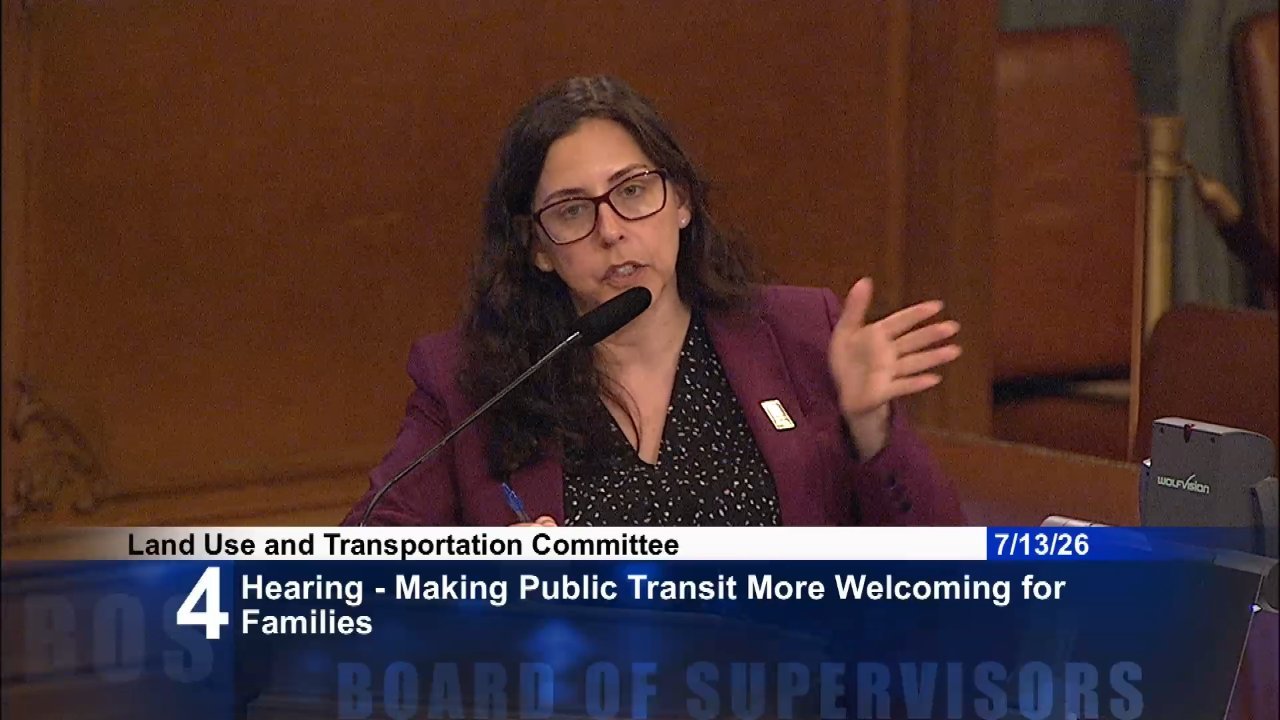
Supervisors Grill Transit Chiefs on Elevators, Strollers and Station Safety in Two-Hour Family Transit Hearing

San Francisco's Land Use and Transportation Committee turned into a transit accountability session Monday as supervisors pressed the heads of SFMTA, BART, and MTC on broken elevators, hostile stroller experiences, and deteriorating station plazas — extracting on-the-record commitments to fix specific gaps. The committee also unanimously advanced three ordinances to the full Board, including an expansion of the DBI corruption audit amnesty.

  • SFMTA, BART, and MTC face pointed questions on elevator access, stroller signage, and BART plaza conditions during a major hearing on family-friendly transit

  • BART GM commits on the spot to new wayfinding signs at Balboa Park station after supervisors flag a single-elevator bottleneck

  • DBI corruption amnesty expanded to cover fire and public works fees for affected property owners

  • Bed-and-breakfast guest room cap doubled from 5 to 10 in residential districts

  • Citywide banner fee waiver for nonprofits heads to full Board


The Stroller Act Hearing: Agencies Present Progress, Supervisors Want More

Supervisor Danny Sauter called this hearing as part of his "Stroller Act" initiative — a push to make San Francisco transit more navigable for parents with young children. What followed was more than two hours of presentations, pointed questioning, and public testimony that exposed gaps between agency aspirations and everyday family experiences on Muni, BART, and regional connections.

"This hearing request is part of the Stroller Act, my push to make life a little easier for young families in San Francisco," said Supervisor Sauter, District 3.

Why it matters: San Francisco's transit agencies are spending billions on infrastructure, fares, and technology — but families, seniors, and disabled riders still encounter broken elevators, confusing wayfinding, and hostile fellow passengers. The hearing forced agency leaders to answer for specific failures on the record.

What Each Agency Brought to the Table

SFMTA Director of Transit Julie Kirschbaum detailed the agency's existing family programs: Free Muni for Youth (covering riders 18 and under, plus special education students ages 19–22), the Clipper Start 50% discount for low-income riders, dedicated "school tripper" buses timed to school dismissal, transit ambassadors on high-school routes, and a stroller policy that does not require strollers to be collapsed. She also noted a $9 million capital project at Hallidie Plaza to build an accessible ramp, with construction expected from summer 2027 through spring 2028.

"We do not limit the number of strollers on our system, but we do give people using wheelchairs priority in the front of the vehicle and have created a designated stroller area in the middle of the vehicle with a special seat that flips up," said Director Kirschbaum.

BART General Manager Bob Powers led with numbers: record June ridership up 10–12% year-over-year, new fare gates installed four months ahead of schedule saving approximately $10 million per year, crime down 40% year-over-year, elevator attendants at eight downtown stations, and restroom attendants at four downtown stations. He announced an upcoming August schedule change adding train cars on crowded inbound morning and outbound evening lines.

"I'm going to be on record, I'll say it right here in front of everybody. BART is the most accessible public transit agency in the United States. And we have the data that supports that," said GM Powers.

MTC's Rebecca Long and Gordon Hansen presented the Clipper NextGen rollout: tap-and-ride functionality now accounts for 16% of trips, and free or discounted transfers have saved riders $7 million since December. They outlined a regionwide mapping and wayfinding project covering more than 200 hub stations and 21,000 bus stops with standardized colors, symbols, and signage. Prototypes have been tested at Santa Rosa, El Cerrito del Norte, and Powell Street.

"As long as they're within two hours of the first trip … this is a pretty big savings for San Francisco riders who are using more than one system. And since December, riders have saved $7 million," said Rebecca Long, MTC.

Balboa Park: One Elevator, Zero Access to Geneva

The hearing's sharpest exchange came when Supervisor Chyanne Chen, District 11 raised the single-elevator bottleneck at Balboa Park station — a facility in her district that serves thousands of daily riders transferring between BART, Muni, and bus connections.

"There's only one elevator and when it's out again it's really hard for seniors, families with children and people with disability to navigate a station," said Supervisor Chen. "The elevator does not go up to Geneva side of the station, only the San Jose side, which makes it very hard for people with disability or who uses strollers to navigate to Geneva Avenue transit connections."

GM Powers committed on the spot to action: "If it's a matter of a sign, I'm telling you right now, I'll get out there. I'll get somebody out there and put up a sign. I'll pull the data. But certainly we have the skill set to improve the wayfinding out there. So, absolutely, I'm committing to that right now."

He also pledged to walk Balboa Park station with Director Kirschbaum to assess the accessibility gaps firsthand.

Supervisor Chen also secured confirmation that SFMTA intends to continue fully funding its free and discounted fare programs. "In our recently adopted two-year budget, the SFMTA board did make the commitment to continue to sustain our free and discounted programs," said Director Kirschbaum. "And that was in part because of very, very strong advocacy from Youth Voices and the youth councils in the city."

Strollers on Buses: The Attitude Problem

Chair Myrna Melgar, District 7 brought personal experience to the stroller discussion, noting a gap between official policy and rider culture.

"I have never seen anyone give any kind of attitude for someone in a wheelchair coming in and lifting up the bench and strapping themselves in. But I have often seen attitude towards people with stroller, like, quite a bit," she said.

Director Kirschbaum acknowledged the issue and committed to a public education campaign targeting not just parents but other passengers: "What I'm hearing is that it's almost more important to let the other folks on the bus know what the expectations are and where the stroller space is so that they are yielding that space to the folks that need it."

BART Plazas: Popups Aren't Enough

Chair Melgar pressed GM Powers on the deteriorating conditions at BART's 16th Street and 24th Street plazas, arguing that periodic popup activations are not a permanent solution.

"I don't think just increasing the frequency of the popups, having them twice a month or even four times a month is going to fix it," she said. "I've actually been there on the day Mayor Lurie has been out there trying to get people to move on. And 20 minutes later it was full again."

Powers agreed a comprehensive solution was needed, acknowledging ongoing conversations with OEWD and DPW: "I'm not going to disagree with you. … That solution that you're articulating has got to be comprehensive. It's got to come with the safety and security. It's got to come with the O and M."

Escalators, Elevators, and Baby Changing Stations

Supervisor Bilal Mahmood, District 5 pushed on Halliday Plaza escalator reliability, questioning whether full replacement would be cheaper than constant repairs. "Isn't it cheaper just to replace the escalator? You're going to constantly be fixing it. Why not just replace the whole thing?" he asked. Director Kirschbaum confirmed the $9 million accessible ramp project is expected to begin construction in summer 2027.

Supervisor Mahmood also flagged BART's baby changing station shortage, asking how many exist systemwide and whether vandalism-resistant designs are being evaluated.

Supervisor Sauter highlighted a seemingly small but telling problem: BART elevator buttons and labels differ at every station. "Every single elevator … the buttons, the labels are different and it sounds really silly but once you're in there and you see the three and you see a C and a P and a Q, it's like, what do any of these mean because they're not standardized across any of the stations," he said.

School Transit and Crowding

Director Kirschbaum explained how SFMTA manages school-time surges by deploying empty "school tripper" buses timed to dismissal. "We recognize that when 100 kids get out of school and need to hop on a route, it's not good for the students if they're getting on a route that's already full of regular customers. And it's not good for the regular customers also," she said.

Public Comment: Bikes, Dogs, Boarding Islands, and Language Access

Four public commenters brought distinct perspectives:

Krissa Corbett Cavouras, San Francisco Bicycle Coalition, advocated for allowing bikes on all Muni modes including trains, better bike infrastructure connecting to transit hubs, cargo bike lockers at stations, and expanded Bay Wheels bike share near schools. She noted Bay Wheels would rank as San Francisco's fourth-largest transit agency by ridership.

Christy, speaking on behalf of John He of the Chinatown Transportation Research and Improvement Committee, emphasized transit's importance for Chinatown seniors and youth and urged dependable elevator and escalator operation along with multilingual SFMTA ambassadors.

Norma, a Tenderloin resident and mother, raised safety concerns about unleashed dogs on Muni buses, citing fear of bites and hygiene issues for mothers with strollers.

Brian Kwan, an Outer Richmond father, flagged that many boarding islands are still missing, making it difficult to get strollers on and off buses safely.

Decisions: The committee voted 3-0 to continue the hearing to the call of the chair (For: Melgar, Chen, Mahmood; Against: 0; Absent: 0), keeping it open so supervisors can follow up as agencies deliver on their commitments.

What's next: GM Powers will walk Balboa Park station with Director Kirschbaum and install wayfinding signage. SFMTA will launch a stroller education campaign. MTC's regionwide wayfinding project — covering 200+ hubs and 21,000+ stops — continues its pilot phase. The hearing can be recalled at any future committee meeting.


Round Two: DBI Corruption Amnesty Adds Fire and Public Works Fees

The committee unanimously advanced legislation closing a gap in the city's existing audit amnesty program for property owners affected by the Department of Building Inspection corruption scandal.

The basics: Former DBI permit expediter Rodrigo Santos and senior building inspector Bernie Curran pleaded guilty to falsifying inspections, approving unpermitted work, and concealing code violations. Most affected property owners purchased their homes long after the unpermitted work was completed, only to face fees when the fraud was uncovered.

Where things stand: Board President Rafael Mandelman's original amnesty legislation waived planning and building code fees for these owners but missed fees from the fire department and Department of Public Works. The new ordinance extends the same waiver to those additional charges.

Chair Melgar framed it plainly: "This is round two of helping people who had interaction with staff of the various departments to not penalize them for fixing the mess that our staff created."

Decisions: The committee voted 3-0 to recommend the ordinance to the full Board of Supervisors (For: Melgar, Chen, Mahmood; Against: 0; Absent: 0).

What's next: The ordinance goes to the full Board for final approval.


Minor Items

  • B&B guest room cap increase: The committee voted 3-0 to recommend an ordinance (File 260282) doubling the conditional-use guest room cap for hotel uses in RH, RM, and RTO residential districts from 5 to 10 rooms. Each new establishment still requires Planning Commission approval with neighborhood notification. Heads to full Board.

  • Citywide banner fee waiver: The committee voted 3-0 to recommend an ordinance (File 260683) expanding an existing banner fee waiver — previously limited to District 5 and some District 6 cultural districts — to all neighborhood commercial districts citywide. The permit fee is $375 for 20 banners, and Public Works reports minimal fiscal impact due to historically low permit volume. Heads to full Board.

Supervisors Grill Transit Chiefs on Elevators, Strollers and Station Safety in Two-Hour Family Transit Hearing | Land Use and Transportation Committee | Locunity