Land Use and Transportation Committee - Apr 13, 2026 - Regular Meeting
Land Use and Transportation Committee • San FranciscoApril 13, 2026
Locunity is a independent informational service and is not an official government page for this commission.We use AI-assisted analysis and human editorial review to publish information.
SF Moves to Shield Local Zoning as State Transit Housing Law Looms
San Francisco's Land Use and Transportation Committee tackled some of the biggest forces shaping the city's housing future on April 13 — asserting local control over a sweeping new state law, advancing a long-stalled 541-unit tower at Market and Van Ness, and laying the groundwork for a permanent network of curbside electric vehicle chargers. All three items passed unanimously, though pointed questions from supervisors and divided public testimony signaled that the real debates are far from over.
SF drafts its own playbook for California's landmark transit housing law, exempting industrial zones and low-resource neighborhoods while claiming local zoning already exceeds state requirements by 170,000 units
541-unit One Oak tower clears committee with wall-to-wall union support, sending the long-delayed Mid-Market project to the full Board of Supervisors
Permanent curbside EV charging program amended to prioritize residents over commercial fleets, continued to April 20 for final vote
City Claims Local Zoning Trumps State Density Mandates
California's Abundant and Affordable Homes Near Transit Act — SB 79 — takes effect July 1, and without local action, it would impose mandatory minimum heights of five to nine stories and densities of 80 to 160 units per acre within a half mile of qualifying transit stops. In San Francisco, that covers roughly 120,000 parcels — more than three-quarters of the city.
The basics: The committee took up File 260132, an ordinance introduced by Mayor Daniel Lurie on Feb. 10 and recommended 5-1 by the Planning Commission on March 19. Rather than accept SB 79's default standards, the city is adopting a four-part "alternative plan" that argues San Francisco's own zoning already exceeds what the state requires — by approximately 170,000 net housing units and 230 million net square feet, largely due to the recently passed Family Zoning Plan.
Where things stand: The ordinance's four components would: (1) permanently exclude about 2,000 parcels in three industrial employment hubs — in SOMA, Mission Bay/Central Waterfront, and Bayview — from SB 79's residential requirements; (2) temporarily exempt roughly 32,000 parcels in low-resource census tracts south of 16th Street and Mission Bay until 2032; (3) add a Planning Code density exception allowing up to 50% of SB 79 density on transit-adjacent parcels; and (4) formally adopt the citywide alternative plan demonstrating that local zoning capacity exceeds SB 79 thresholds. Planning Department staff Sarah Richardson and Joshua Switzky told the committee that under this framework, no parcel would be subject to SB 79's default heights and densities.
The other side: Supervisor Bilal Mahmood pressed staff on whether the city was being too conservative, noting ongoing housing element litigation.
"We're currently under litigation for multiple lawsuits that's saying we don't do enough to meet the requirements of the housing element," he said. "My understanding is this would put us basically at the minimum allowed by state law. So why shouldn't we be going a little bit above?"
He also questioned whether the permanent industrial hub exemptions made sense for zones that conditionally permit affordable housing and ADUs.
Switzky pushed back:
"No, this is not the minimum. As we stated, our local zoning exceeds SB 79 requirements by hundreds of thousands of units."
He added that the exempted industrial districts do not principally permit housing and that the Board of Supervisors retains authority to change zoning at any time.
Vice Chair Chyanne Chen supported the ordinance but focused on equity.
"For neighborhoods facing displacement, we must prioritize anti-displacement strategies, robust tenant protections, protection for our stock of rent-controlled housing and significant investment in truly affordable housing," she said.
Chair Myrna Melgar asked about environmental review implications; Switzky confirmed that SB 79 itself provides a CEQA exemption for local zoning changes within its parameters. Melgar also noted the city is being sued from both sides on housing policy:
"Yes, we can always do better. I'll just point out that we're being sued by both sides."
Public testimony was split. Zach Weisenburger of Young Community Developers backed the ordinance, arguing that without the exemptions SB 79 would accelerate development concentration in low-income communities of color. But Shaun Aukland of SOMA West Neighborhood Association opposed the permanent industrial hub carve-out, calling it a barrier to mixed-income housing near Civic Center and disclosing that his association has an active fair housing complaint with the state Department of Housing and Community Development.
Decisions: The committee voted 3-0 on four separate motions: amending the ordinance for clerical corrections (replacing "WMUG" with "WMUO" and updating parcel tables); creating a duplicate file incorporating HCD review language; continuing the duplicate to the call of the chair; and continuing the original file as amended to April 20 (For: 3 — Chen, Mahmood, Melgar; Against: 0; Absent: 0).
What's next: Both the original and duplicate files return April 20, with the July 1 state deadline providing the hard backstop. HCD's ongoing review of the alternative plan could shape final language.
One Oak Tower Gets Green Light After Years of Delays
A 400-foot residential tower at the corner of Market Street and Van Ness Avenue cleared the committee unanimously after a parade of union speakers urged San Francisco to prove it can still build.
The basics: File 260083 amends the zoning map to raise the allowed podium height at 1500 Market Street — the One Oak Street project — from 120 feet to 140 feet, matching the neighboring 30 Van Ness building. The tower height stays at 400 feet. The change enables 541 residential units, an increase from prior designs, on a transit-rich site in the Market and Octavia Area Plan that displaces no existing housing. Madison Tam from Supervisor Matt Dorsey's office presented the item, and Planning Department staff Joseph Sacchi reported the Planning Commission voted 5-1 to recommend approval on March 19.
Why it matters: The project, developed by Emerald Fund, has been in the pipeline for years, and supporters cast it as a test of whether Mid-Market can recover. Rudy Gonzalez of the San Francisco Building and Construction Trades Council told the committee:
"This vote is important for this project, but it's also very symbolic in terms of how the city is going to take action with urgency in the Mid-Market span."
Where things stand: Twelve public speakers — representing eight building and construction trade union locals, an investment fund, and a neighborhood resident — all spoke in strong support. J'Anthony Menjivar of Carpenters Local 22 highlighted Emerald Fund's commitment to union labor and pathways for women and minorities. Sean Whitfield of Washington Capital, the fund managing the project's ownership, said Northern California projects in their portfolio have generated over 4 million union labor hours since 2002. Brandon Bracamonte of Sprinkler Fitters Local 483 argued that moving projects forward sends a signal that San Francisco is still a place where things can get built. No one spoke in opposition.
The other side: Vice Chair Chyanne Chen expressed support but raised concerns about the developer's decision to pay approximately $24 million in affordable housing fees rather than build on-site affordable units.
"I'm also disappointed by the developer. It's opting to fee out for affordable housing for the proposed 541 residential units," she said. "I strongly believe that it is better for our city to have on-site affordable housing with real mixed-income communities."
She also asked about financial benefits the project received from recent Market and Octavia plan fee reductions. Chair Myrna Melgar noted the project's long history:
"This project has been around for a very, very long time. I think I voted on the first iteration many years ago when I was on the Planning Commission, and here we are still without a project."
Decisions: The committee voted 3-0 to send the ordinance to the full Board of Supervisors with a positive recommendation (For: 3 — Chen, Mahmood, Melgar; Against: 0; Absent: 0).
What's next: The ordinance goes to the full Board of Supervisors for final approval.
Curbside EV Chargers Target Renters, but Fleet Concerns Prompt Amendment
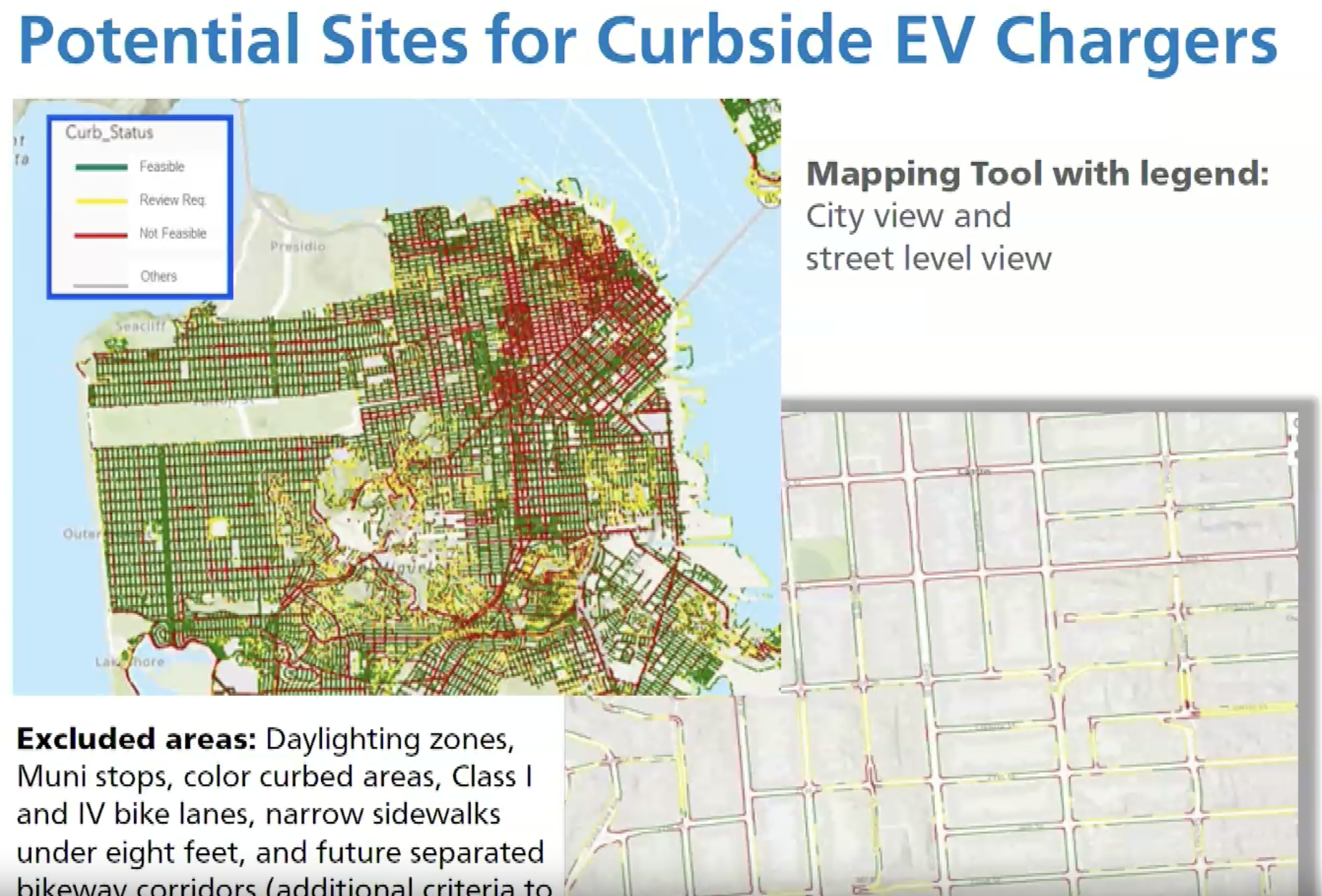
The basics: File 260238 would authorize SFMTA to establish a permanent curbside EV charging permit program on city sidewalks, replacing a pilot that tested three vendor models: Its Electric (tapping building power), UrbanEV (new PG&E connections), and Volt Post (mounting to utility poles). The program targets approximately 100 Level 2 chargers at no cost to the city — vendors own, install, operate, and maintain the equipment.
Why it matters: San Francisco needs roughly 450 more public chargers to hit its 2030 EV goals, and the program is specifically designed for renters and residents in multifamily buildings who lack garage access for home charging. SFMTA Director of Taxis, Access and Mobility Services Kate Toran and Parking Curb Management Group staff Broderick Paulo detailed lessons from the pilot, including challenging site selection, grid access hurdles, and the importance of community engagement. The program is designed to be technology-agnostic, letting the market compete.
Where things stand: Two amendments shaped the discussion. The City Attorney's office proposed a technical amendment granting SFMTA administrative penalty authority for permit violations. Separately, Renil Bejoy from Board President Rafael Mandelman's office introduced an amendment urging SFMTA to design the program to discourage commercial fleet vehicle charging and maximize access for private individuals.
"We believe it important that the benefits of these added curbside chargers through this new permitting process flow directly to the San Franciscans who need them most," Bejoy said.
Vice Chair Chyanne Chen praised the equity focus:
"I'm pleased to see the focus on strategies to serve residents in multifamily buildings without garage access. This is a critical need for residents who cannot charge at their residence."
Chair Myrna Melgar drilled into how SFMTA maps feasible sites, asking whether the city's own utility — SFPUC — could speed grid connections compared to PG&E. Mark Gleason of the Teamsters spoke in support and backed the Mandelman amendment, expressing concern about large commercial companies exploiting city infrastructure.
Because the MTA amendment was substantive, Deputy City Attorney Brad Russi advised the item needed to be continued.
Decisions: The committee voted 3-0 to accept both amendments and continue the item as amended to April 20, 2026 (For: 3 — Chen, Mahmood, Melgar; Against: 0; Absent: 0).
What's next: The amended ordinance returns April 20 for a final committee vote before heading to the full board. If approved, SFMTA could launch a competitive vendor application process this summer.