
SFPD Traffic Company Down to 20 Officers as Supervisors Press for Rebuild
Land Use and Transportation Committee • San FranciscoNovember 16, 2026
Locunity is an independent informational service and is not an official government page for this commission. All information is sourced from public footage and an analysis of official agendas with the aid of responsible, fact-checked AI. to report an error or omission.
San Francisco's police traffic unit has about 20 officers, down from more than 80 at full staffing, and the department offered no timeline to rebuild it. The Land Use and Transportation Committee heard that update on Nov. 16, 2026, in a hearing that ran longer than any other item. The committee also voted 3-0 to advance a 10-month data center moratorium extension, tightened a nuisance-eviction bill and shelved a landmarking reform.
- Traffic Company down to 20 officers; SFPD gave no rebuild timeline as supervisors and advocates pressed for one
- Speed cameras cut severe speeding nearly 84%; SFMTA plans to seek state approval to expand the program
- Data center moratorium extension advances 3-0; many speakers pushed for a permanent ban
- Nuisance-eviction bill amended 3-0 after tenant groups cited a 41% rise in petitions
- Landmarking streamlining bill shelved as Supervisor Mahmood signals a housing-capacity fight
Traffic Enforcement Hearing Exposes a Hollowed-Out Unit
Why it matters: Traffic enforcement remains far below 2014 levels. Only a minority of citations target the most dangerous driving violations, the behaviors most likely to kill or injure people on city streets.
Where things stand: Commander Brian Hu, Special Operations Bureau, San Francisco Police Department, laid out the staffing gap.
"We currently have approximately 800 officers on patrol, and I have 20 officers in the traffic company," said Hu.
Full staffing for the unit is 80 or more officers. Thirteen part-time solo response officers work out of district stations. Hu said citations are rising, but he also gave a blunt assessment of the unit itself: "Traffic Company is a shell of its former self."
Supervisor Matt Dorsey placed the problem in department-wide terms. He noted that "the full-duty staffing shortfall department-wide is 720 officers."
Supervisors questioned several points:
- The low share of citations under Focus on the Five, SFPD's priority list of the most dangerous violations
- Disparities between police stations, including Ingleside
- Whether crash and enforcement data feed back to SFMTA for street fixes
Cameras are doing the heavy lifting: Talia Lang, Program Manager, Speed Camera Program, SFMTA, reported results from the state-authorized pilot under AB 645.
"This is a nearly 84% decrease across camera locations in the city," said Lang. She was describing the drop in vehicles traveling 10 mph or more over the limit.
All 33 camera locations met reduction criteria at 18 months. Other key details:
- Relocations: A review of camera relocations runs into 2027.
- Revenue: Net revenue of about $2.2M funds traffic calming.
- Sunset: The pilot ends around 2030, so expansion requires state action.
Supervisors asked about expansion, red light cameras, scooter issues and coverage near schools.
The other side: Advocates split on how much to lean on police versus automation.
- Jody Medeiros, Director, Walk San Francisco, said citation numbers fall short. She noted Focus on the Five accounts for under 50% of citations.
- Sam Greenberg, Advocacy Director, Walk San Francisco, urged state legislation in 2027 to expand speed cameras. He also called for a faster move to SB 720 red light cameras.
- Micah, a District 9 resident, criticized SFPD's explanations. He urged investment in street redesign and automated enforcement over police funding.
- Griffin Lee of Connected SF took a different view. He defended SFPD given its understaffing and urged the city to double down on enforcement.
Decisions and stakeholder impacts: Board President Rafael Mandelman, District 8 Supervisor, asked that the hearing be filed.
"It does seem to me like traffic company needs to be rebuilt, and that that should be an important priority for the next year or two," said Mandelman.
The vote to file was For: 3 (Chen, Dorsey, Melgar), Against: 0, Absent: 0. For now, pedestrians and cyclists depend mostly on cameras and stretched station officers.
What's next: SFMTA's push for expanded camera authority now shifts to Sacramento. No SFPD staffing plan was committed.
Data Center Pause Moves to the Full Board
Why it matters: Planning's report flags unresolved electricity, water, air and noise impacts. Bayview residents carry an outsized share of those burdens.
Where things stand: The committee took up two linked items:
- A motion adopting Planning's report on the 45-day interim moratorium on data centers
- An urgency ordinance extending that moratorium by 10 months and 15 days
Supervisor Shamon Walton, District 10, summarized the report's findings. The report cites a regulatory framework dating to the 2000s and five Air District notices of violation at 200 Paul Avenue. Walton then went further.
"The city also needs to consider a permanent ban," said Walton.
Lisa Gibson, Environmental Review Officer, Planning Department, called the document an initial assessment. She noted that "the report, of course, doesn't recommend any particular policy outcome." Gibson also said there are no pending applications for new standalone data centers.
Community voices: Most public commenters backed the extension or wanted more.
- Glenn Rogers, a landscape architect, described Paul Avenue data centers near schools and homes. He reported measuring 80-decibel noise.
- Dr. Ahimsa Porter-Sumchai, founder and CEO, Hunters Point Biomonitoring Foundation, proposed a comprehensive monitoring program. She also called for separate electricity rate categories for high-load users and disputed the city's count of data centers.
- Zach Weisenburger of Young Community Developers cited Bayview health burdens and the loss of industrial land and housing capacity.
- Mark Schlossberg, Managing Director, Food and Water Watch, and Peter Belden, Political Chair, Sierra Club San Francisco, strongly backed the pause.
- Honest Charlie Bodkin, co-founder, San Franciscans for Social Housing, asked the committee to make the ban permanent.
Vice Chair Chyanne Chen, Supervisor, District 11, framed the issue as one of environmental justice.
Decisions and stakeholder impacts: One motion covered both items. It passed For: 3 (Chen, Dorsey, Melgar), Against: 0, Absent: 0.
The pause blocks new projects while the city studies impacts. That benefits Bayview residents and environmental groups. Data center operators face a longer wait and a possible permanent prohibition.
What's next: The full Board could take up the extension Nov. 17.
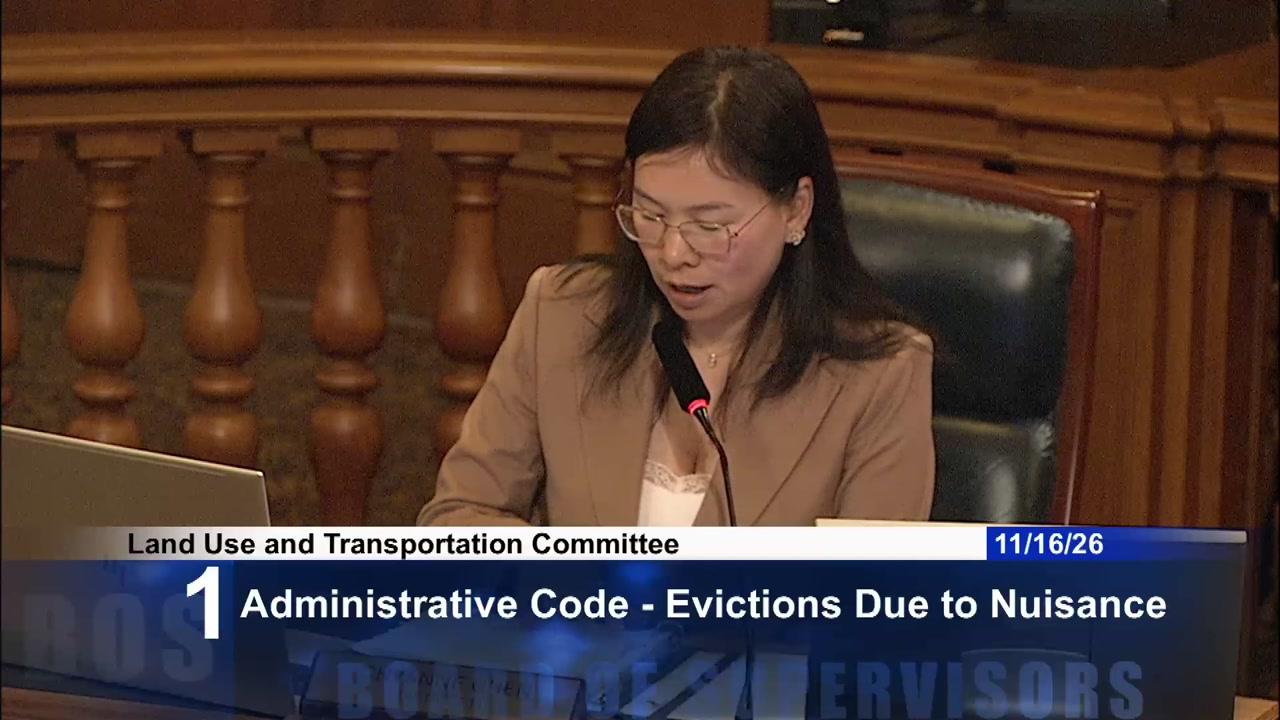
Nuisance-Eviction Bill Tightened, Not Finished
Why it matters: Nuisance notices are the fastest-growing category of at-fault evictions. They are also straining the city's Right to Counsel program, which provides lawyers to tenants facing eviction.
Where things stand: Chair Myrna Melgar, Supervisor, District 7, said she developed the bill with the Anti-Displacement Coalition and the Apartment Owners Association. She cited a Chinatown building where tenants received six notices.
"In one year's time, there has been a 41% increase in nuisance petitions," said Melgar.
The ordinance does three things:
- Narrows the nuisance standard for evictions
- Addresses property-damage evictions
- Extends the statute of limitations for wrongful-eviction lawsuits
Vice Chair Chen argued the bill keeps a path open for landlords facing real problems. "Under this legislation, landlords can continue to evict tenants who are causing genuine nuisances," said Chen.
Tenant groups described seniors receiving hasty or exaggerated notices, with 1120 Jackson St. at the center of the testimony.
- Shelby Nacino, Managing Attorney, Asian Law Caucus, described those cases among seniors.
- Haley Meyerhoff of the Housing Rights Committee said corporate landlords use vague nuisance claims to get around just-cause protections.
The other side: Landlord groups pushed back on two fronts.
- Justin Goodman of the Coalition for Better Housing opposed removing landlords' standing to pursue nuisance behavior. He also opposed the longer statute of limitations, citing stress in the insurance market.
- A San Francisco Apartment Association representative said nuisance filings cover 0.14% of units. The representative cited a destructive-tenant case and noted the 1120 Jackson tenants remain housed.
- Gen Fujioka of the Chinatown Community Development Center countered that those tenants stayed only because of pressure from the community, the media and supervisors.
Decisions and stakeholder impacts: Melgar's amendment was adopted For: 3 (Chen, Dorsey, Melgar), Against: 0, Absent: 0. It allows eviction when a tenant causes substantial damage, or is so disorderly that it destroys the peace and quiet of others in the building or in adjacent buildings.
"I think this is an ordinance that will protect tenants without unintended consequence, so I support it as amended," said Supervisor Dorsey.
A duplicate file was continued to the call of the chair on another 3-0 vote.
What's next: The amended bill remains in committee. The clerk's recap referenced continuing the amended version to Nov. 30.
Landmarking Reform Shelved Amid Housing Debate
Why it matters: As the city upzones, how it weighs historic preservation against housing capacity will shape what gets built.
Where things stand: Board President Mandelman said his ordinance would remove one Board step from the landmark designation process. He acknowledged the bill lacked support and asked to continue it.
"But it is incredibly modest legislation," said Mandelman.
Supervisor Bilal Mahmood, District 5, said landmark designations, "while having merit on their own right, are a government constraint." He cited Housing Element Action 4.5.12. He also said he had planned amendments requiring a housing-capacity analysis before designations.
The other side: Preservation groups backed the bill.
- Catherine Petrin of San Francisco Heritage argued that adaptive reuse lets preservation and housing coexist. She cited New York's higher share of designated parcels.
- Leslie Dickey of Neighborhoods United San Francisco cited the tourism value of landmarks.
- Peter Dworkin, a resident, urged a transparent, objective process. He objected to setting a numeric landmark target.
Decisions and stakeholder impacts: The bill was continued to the call of the chair. The vote was For: 3 (Chen, Dorsey, Melgar), Against: 0, Absent: 0.
What's next: Mahmood's housing-capacity amendments signal the debate will return.
Minor Items
- Anderson J.B. Williams Way: The committee voted 3-0 to send this commemorative name for the 0 block of Peabody Street to the full Board. The name honors a District 10 barber of more than 40 years. The full Board takes it up Nov. 17.
- Jace Young Way: The committee voted 3-0 to name the 1700 block of Yosemite Avenue for a 6-year-old killed in 2020. Committee members signed on as co-sponsors, and his father thanked the committee.