
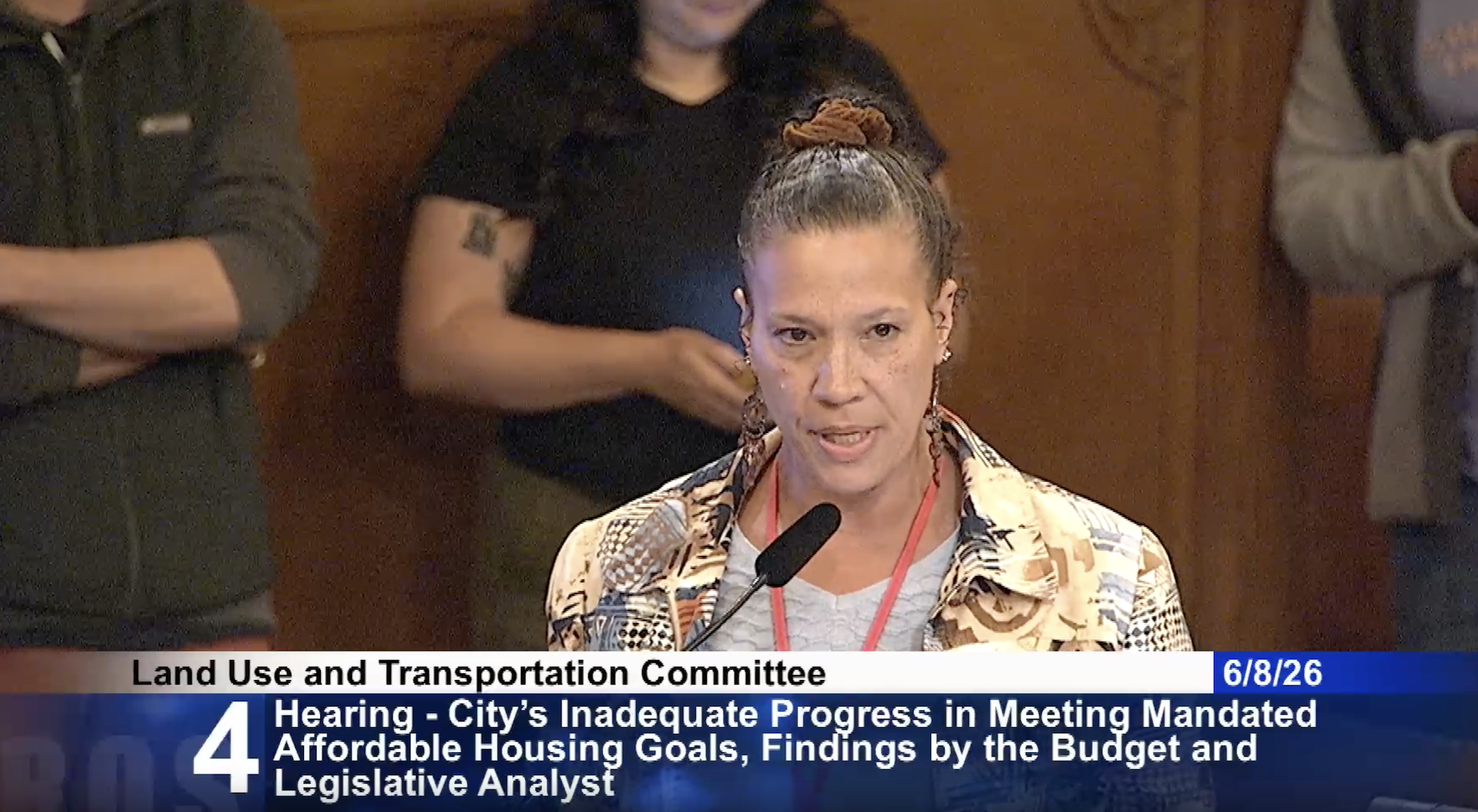
Land Use and Transportation Committee - Jun 08, 2026 - Regular Meeting

Land Use and Transportation Committee - Jun 08, 2026 - Regular Meeting

Land Use and Transportation CommitteeSan FranciscoJune 8, 2026

Sources:

Locunity is a independent informational service and is not an official government page for this commission.We use AI-assisted analysis and human editorial review to publish information.

SF's $17.9 Billion Housing Gap Laid Bare as Committee Eyes New Funding Tools

The Land Use and Transportation Committee spent the bulk of its June 8 session confronting the math behind San Francisco's affordable housing crisis — and the numbers were sobering. A Budget and Legislative Analyst report pegged the city's funding shortfall at $17.9 billion, while staff warned current bond money runs dry by 2029. The committee also advanced a ban on uncertified lithium-ion batteries and put a smoke-free bar patio proposal on ice.

  • BLA estimates $17.9 billion needed to meet SF's state-mandated affordable housing goals; MOCD warns funding drops to near-zero by 2029

  • Committee unanimously advances ban on uncertified lithium-ion batteries after 120+ fires in five years displaced vulnerable Tenderloin residents

  • Smoke-free bar patio ordinance paused as health advocates and small-business groups clash over implementation

  • Over 20 organizations and residents testify on housing, urging dedicated Prop I revenue, social housing investment, and equitable geographic distribution

  • Conditional use authorization overhaul and Compton's Cafeteria Riot landmark amendment both continued for further work


The $17.9 Billion Question: Can SF Close Its Affordable Housing Gap?

The basics: The state requires San Francisco to plan for 82,069 new housing units by 2031 under the Regional Housing Needs Allocation, or RHNA. The city has authorized roughly 10,000 units — just 31% of the pace needed with 37% of the cycle already elapsed. All seven market-rate housing prototypes studied by the Planning Department are financially infeasible under current conditions.

Vice Chair Supervisor Chyanne Chen commissioned the BLA report that anchored the hearing, telling colleagues:

"I asked the BLA to conduct an independent analysis in February of this year because it was clear to me that the city had been marching full speed ahead without a coordinated strategy to fund our affordable housing goals."

She underscored the structural problem:

"A new study concluded that it could take between 18 to 124 years for unsubsidized housing production to stabilize rents for the medium wage earner in San Francisco."

The Funding Cliff

Mayor's Office of Housing and Community Development (MOHCD) Director Dan Adams walked the committee through a portfolio of roughly 35,000 existing affordable units and a 66-project pipeline of about 7,000 units — of which only around 1,000 are fully funded. The city's per-unit subsidy runs $250,000–$300,000, meaning roughly $1.5 billion to $1.8 billion is needed just for the existing pipeline.

Adams delivered the most urgent warning of the day:

"We anticipate making about $270 million in loans in this fiscal year. Our current fiscal year, next fiscal year, about the same amount of money."

After that, MOCD projects a steep decline to near-zero funding by 2029 as bond balances are exhausted. He noted that affordable housing accounted for two-thirds of all residential production in San Francisco in 2025 — meaning a funding collapse would hit total housing output, not just subsidized units.

Adams praised the proposed expansion of the Housing Trust Fund from $50 million to $125 million annually and flagged that the state is consolidating its funding rounds to accelerate project timelines.

The BLA's Strategy Menu

Fred Brousseau, Director of Policy Analysis, at the Budget and Legislative Analyst's Office, put the full deficit in stark terms:

"It's a kind of a wild number of this $17.9 billion in city subsidies needed, or $2.9 billion a year."

The BLA found that the city's 2023 temporary fee reduction program saved developers only 0.44%–1.83% of total project costs and did not meaningfully boost housing production — a finding that challenged one of the board's recent policy bets.

Brousseau laid out a menu of financing strategies: a revolving loan fund modeled on Montgomery County, Maryland's $100 million fund; a joint powers authority combining MOCD and the Housing Authority; an open indenture bonding authority; enhanced infrastructure financing districts; SB 593 bond authority; dedication of Prop I transfer tax revenue to affordable and social housing; and raising the general obligation bond debt ceiling.

Asked to name his top pick, Brousseau didn't hesitate:

"If I had to pick one right off the top of my head right now, it would be revolving loan fund just for the reasons I was saying."

Supervisors Push on Equity and the West Side

Chair Supervisor Myrna Melgar brought personal urgency and policy specifics. She argued that without affordable housing, San Francisco's promise of opportunity rings hollow:

"Without affordable housing, it is an empty promise. We are only foicing off our externalities onto other places and losing the fabric of being otherwise very vibrant communities."

Melgar pressed on geographic equity, noting the city's west side has historically resisted affordable development:

"I supported the family zoning plan because the west side has fought building affordable housing for decades."

She also pushed back on skepticism about long-term models like Vienna's social housing system:

"If we had started 100 years ago, we would be where Vienna is now. My point is that it requires the political will to actually naturally act today."

Supervisor Bilal Mahmood focused on transparency and funding allocation:

"I'm more interested today in how we raise funding for building affordable housing and how that money helps house San Franciscans, because this is the question that should be driving the conversation."

Supervisors also pressed staff on Section 8 voucher tracking, rent-control unit losses, homeownership vehicles for middle-income workers, and the city's land-banking strategy.

A Broad Coalition Demands Action

More than 20 public commenters testified, representing an unusually wide coalition — from CCHO, Somcan, and the Chinese Progressive Association to SPUR, the Housing Action Coalition, SF YIMBY, and Small Business Forward. The breadth of the turnout underscored how the housing crisis cuts across traditional political lines.

Quintin Mecke of the Council of Community Housing Organizations urged the board to treat the Housing Trust Fund expansion as a floor, not a ceiling, and cited Philadelphia's $2 billion housing initiative as a model.

Theresa Dolalas of Somcan asked whether the city expects communities to wait 115-plus years for 45,000 affordable units to become available, demanding equal urgency for affordable and market-rate production.

Tiffany of the Chinese Progressive Association read testimony from a member describing a family of five living in a 10-square-foot SRO room for 10 years, sharing a kitchen and bathrooms — a visceral illustration of who the funding gap hurts most.

Zachary Frial of Somcan/REPSF cited BLA data showing less than a 1% acceptance rate for affordable housing applicants, with 70% of applicants being Latino, Asian, or Black, urging the city to plan specifically for those populations.

Rebecca Jackson of the Women's Housing Coalition called for including domestic violence survivors as a named vulnerable population in housing policies, noting DV remains the leading cause of homelessness for women and children.

On the market side, Lori Droste of SPUR warned against undermining overall housing production while searching for affordable funding solutions. Christin Evans of Small Business Forward connected the crisis to small-business viability, noting employees earning $30,000–$80,000 cannot afford to live in the city.

Jugal Patel of Abundant San Francisco, who shared his own experience with homelessness, shelters, and transitional housing, supported reducing inclusionary requirements paired with a stronger Housing Trust Fund, arguing the current system is not producing units at any income level.

Decisions: The hearing was heard and filed 3-0 (For: 3, Against: 0, Absent: 0).

What's next: The BLA's financing recommendations — revolving loan fund, joint powers authority, Prop I dedication, EIFD expansion, and a higher GO bond debt ceiling — will inform upcoming board budget deliberations and potential ballot measures. The 2029 fiscal cliff creates a narrow window for action.


Uncertified Battery Ban Advances After 120+ Fires

Why it matters: Uncertified lithium-ion batteries in e-bikes and powered mobility devices have caused more than 120 fires in San Francisco over five years, disproportionately hitting dense residential buildings in the Tenderloin. A December fire at 50 Golden Gate Avenue displaced 130 residents despite a three-minute response time from Station 1 — the battery's thermal runaway had already spread fire to hallways, walls, and the attic.

Supervisor Bilal Mahmood, the ordinance sponsor, framed the issue as one of equity:

"Uncertified batteries are not a bargain. They are a hidden cost being born disproportionately by the very communities least able to absorb it."

Fire Chief Dean Crispin described the 50 Golden Gate fire and the broader pattern of battery-caused blazes. The ordinance bans the sale, offer, and delivery of lithium-ion batteries and powered mobility devices that lack UL or equivalent safety certification, giving the Fire Department direct enforcement authority.

Vice Chair Supervisor Chyanne Chen added herself as co-sponsor, praising the consumer-protection approach. Chair Supervisor Myrna Melgar also co-sponsored, citing fires at Park Merced.

A floor amendment requested by the Small Business Commission adds recognition of the EN15194 international safety standard for e-bikes, broadening compliance pathways for sellers. Joel Koppel of the SF Electrical Contractors Association testified in support, emphasizing life safety and first-responder protection.

Decisions: The ordinance was amended and forwarded to the full Board of Supervisors 3-0 (For: 3, Against: 0, Absent: 0).

What's next: The full board will take up the ordinance for final passage.


Smoke-Free Bar Patios Put on Hold

Why it matters: The ordinance, sponsored by Chair Supervisor Myrna Melgar, would extend San Francisco's smoke-free laws to bar patios — a move already adopted by more than 400 U.S. cities. But Melgar announced the item would be continued to the call of the chair to allow further work with stakeholders after receiving input from colleagues and the mayor.

Where things stand: Public comment split sharply. Health advocates cited decades of research showing smoke-free laws do not harm bar revenue. Bob Gordon of the American Cancer Society Cancer Action Network noted the historical pattern of bar-owner panic that never materialized. Liz Williams of Americans for Non Smokers Rights framed it as a worker health issue, noting bartenders and musicians feel they cannot speak up, and cited San Jose's 15-year track record with no rollbacks. Alex Marinkov, a Berkeley resident with asthma, described being excluded from socializing at Castro bars due to heavy patio smoking, framing the issue as disability access.

The other side: Christin Evans of Small Business Forward opposed the legislation as currently written, arguing it was introduced without adequate collaboration with affected businesses and would burden employees with enforcement responsibilities. The Council of District Merchants and the Small Business Commission also opposed the current draft.

Decisions: Continued to the call of the chair, 3-0 (For: 3, Against: 0, Absent: 0).

What's next: Melgar committed to further stakeholder collaboration before bringing the ordinance back. Bar owners and health advocates will negotiate in the interim.


Minor Items

  • Transportation Code cleanup: A non-substantive ordinance reorganizing provisions on temporary street closures and removing outdated school-use sections passed 3-0 with no public comment and was forwarded to the full board.

  • Conditional use authorization overhaul: An ordinance modifying how nonconforming uses and conditional use permits are handled was continued to the call of the chair at the Planning Department's request for potential amendments.

  • Compton's Cafeteria Riot landmark amendment: A Planning Code amendment related to the landmark designation was continued to the call of the chair.

SF's $17.9 Billion Housing Gap Laid Bare as Committee Eyes New Funding Tools | Land Use and Transportation Committee | Locunity