Land Use and Transportation Committee - Sep 21, 2026 - Regular Meeting
Land Use and Transportation Committee • San FranciscoSeptember 21, 2026
Locunity is an independent informational service and is not an official government page for this commission. All information is sourced from public footage and an analysis of official agendas with the aid of responsible, fact-checked AI. to report an error or omission.
Power Station Amendments Strip Data Centers, Add Height as Community Groups Clash Over Housing Rules
The San Francisco Board of Supervisors' Land Use and Transportation Committee tackled one of the city's most consequential waterfront development projects Monday, adopting a package of amendments to the Potrero Power Station development agreement and zoning that remove a controversial data center provision, add building height, and loosen land-use restrictions — but a fight over short-term housing exemptions is far from settled. The committee also advanced a Bayview landmark renaming and cleared the path for a new Transbay park.
- Potrero Power Station amendments remove data center use, raise office tower from 160 to 190 feet, and add residential-commercial flexibility across the 29-acre site
- Community groups split: labor, nonprofits, and neighborhood allies back project momentum; housing advocates warn proposed intermediate-length occupancy exemptions could erode long-term housing protections
- Supervisor Walton rebukes developer for originally proposing data center language "without community input," but acknowledges amendments address the concern
- Both Power Station ordinances continued one week to Sept. 28 after City Attorney flags a substantive amendment requiring layover
- Bayview's Sylvester House to be renamed in honor of Linda Blackettier, the public health nurse who spent decades restoring the rare 1860s Italianate villa
- Transbay Under Ramp Park ordinance heads to full Board after clearing final legal prerequisites
Power Station Overhaul: Data Centers Out, Height and Flexibility In
The committee spent the bulk of its session on two linked ordinances reshaping the development agreement and Special Use District for the Potrero Power Station, a 29-acre mixed-use waterfront project that ranks among San Francisco's largest housing pipelines. The amendments, introduced by Supervisor Shamann Walton and Mayor Daniel Lurie, received Planning Commission approval with modifications in July.
Why it matters: The changes are designed to improve the project's financial viability in a post-pandemic market — but they also triggered a sharp policy debate over whether the developer should be exempt from the city's intermediate-length occupancy (ILO) framework, a safeguard meant to prevent residential units from becoming de facto short-term rentals.
Where things stand: Staff from the Office of Economic and Workforce Development and the Planning Department walked the committee through a wide-ranging set of changes:
-
Data center use eliminated. The introduced ordinance would have allowed internet service exchanges — including data centers — as a conditional use on Block 5. The amendments strip that possibility entirely. Deputy City Attorney Brad Russi confirmed: "The amendments that are under consideration today would remove that conditional use possibility and make data centers and other internet exchanges not permitted."
-
Height increases. Block 15's planned office tower rises from 160 to 190 feet. Senior Planner Monica Giacomucci explained the rationale: "Increasing the height of Block 15 allows a slightly larger square footage total that makes this particular building more competitive in the office leasing market without dramatically impacting the overall urban design vision for this site." Residential buildings also gain an additional 8 feet.
-
Land-use flexibility. Blocks 5 and 12, previously restricted to single uses, can now be developed with both residential and commercial. Public facilities are permitted sitewide. Rooftop bars — previously limited to Block 9 — are allowed anywhere on the site, capitalizing on bay and skyline views.
-
Affordable housing alignment. Controls for 100% affordable buildings are updated to match the citywide family zoning plan.
-
Transportation and parking. Modifications include a new above-grade circulation structure for parking access, TDM plan changes regarding a shuttle bus and vehicle trip reporting, and a Muni bus shelter at Block 12.
John Lau, staff with the Office of Economic and Workforce Development, framed the amendments as a necessary response to market shifts, noting that "with that incredibly robust public benefits package that we negotiated in 2020 and changing economic conditions such as the world has not seen for decades, the developer came to us a little over a year ago asking to work in partnership to identify areas where we might be able to pull some additional levers to introduce flexibility."
Walton's Warning on Data Centers
Supervisor Walton made clear his displeasure that data center language had appeared in the first place, even as he acknowledged the fix: "I am not happy about the fact that these sites were listed and were proposed in the first place, particularly without community input, without conversations with leadership of this city."
He pressed the City Attorney on whether any waivers in the amendments could open a back door for data centers, and received confirmation that they do not. He also used the moment to deliver a broader message about the stakes of legislative drafting: "Words do matter in documents, and we need to make sure that when we prepare documents, particularly documents that are going to affect community for obviously the entire future, that we do get them right and try to get them right the first time."
The ILO Fight: Housing Advocates vs. Project Supporters
Public comment revealed a sharp divide over the developer's request for exemptions from the city's intermediate-length occupancy framework — the regulatory system that caps, distributes, and monitors units rented for 30-day-plus stays that fall short of traditional leases.
The other side — opponents: Two community organizations pushed back hard.
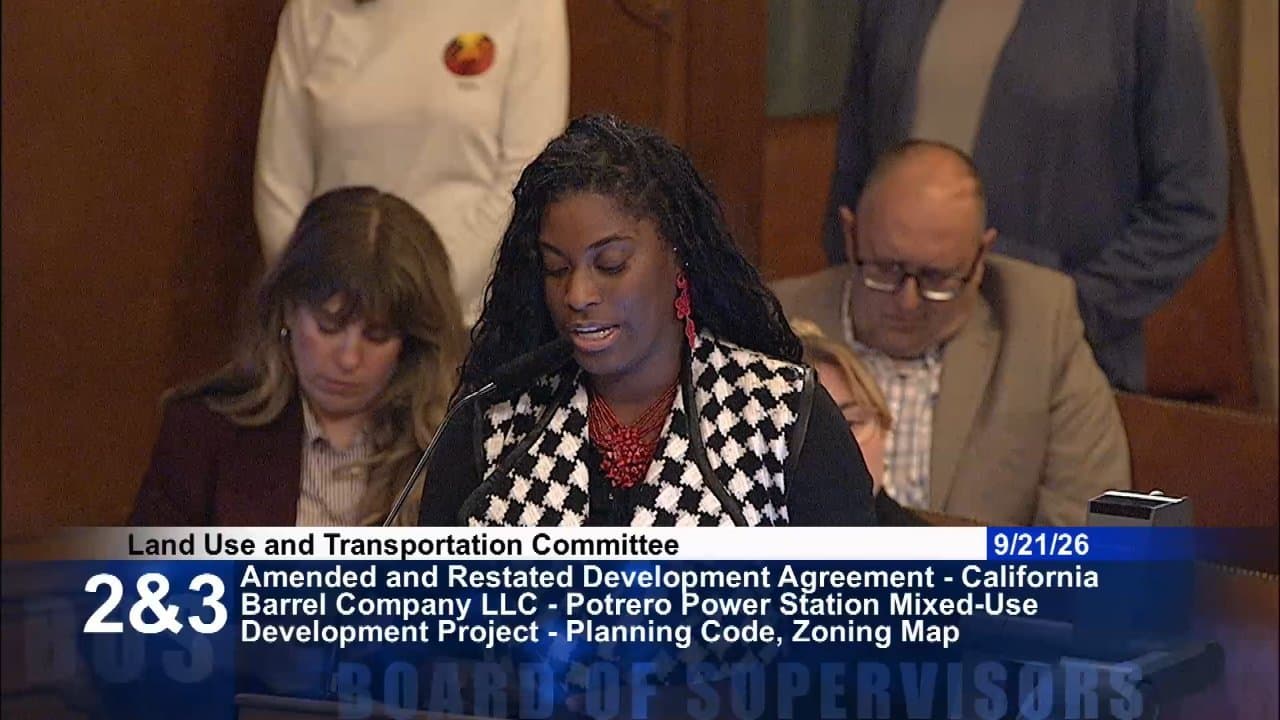
Zach Weisenberger, representing Young Community Developers, thanked Walton for removing data center language but drew a line on ILOs. He warned that 200 ILO units at the Power Station would consume 20% of the citywide 1,000-unit cap and called the proposed exemptions from geographic caps, compliance requirements, and annual reporting a "dangerous precedent."
Chantel Labarinto of Rep SF (Race and Equity in All Planning Coalition) echoed the concern, emphasizing that the development sits in a sensitive community and arguing that ILO caps, geographic distribution controls, and reporting requirements are critical safeguards. She urged that ILO units be converted to long-term housing once they are no longer needed.
The other side — supporters: A broad coalition of labor, nonprofit, and neighborhood voices backed the project's overall direction.
Bill Blackwell of Local 38 Plumbers and Pipefitters praised the project's commitments to workforce housing, job training, and local contractor participation, urging the committee to keep the project moving.
Shelina Eskridge, Executive Director of the Homeless Prenatal Program, shared her personal story as a former program participant and noted that six families from her organization have already been housed at the Power Station site. She urged urgency, emphasizing that every month of delay leaves families without homes.
Jamie Breen Miles, President and CEO of the YMCA of Greater San Francisco, supported the amendments' flexibility around childcare and community facility locations, arguing they allow programs to be placed where families can best access them.
Rashida Nairobi, Director of Sisters with Tools, highlighted the project's impact on construction job opportunities for Black and Latina women, calling it the first time women have had the opportunity to work on an active construction site in the city.
Bruce Huey, a Dogpatch business owner and board member of the Dogpatch Art and Business Association, supported ILO units, arguing that getting more housing delivered sooner brings neighbors who support existing businesses along the 3rd Street corridor.
Elaine Sprague-Stube, President of Friends of Jackson Park and a 24-year Potrero Hill resident, praised the developer's community engagement and called the Power Station a model for how the family zoning plan should work citywide.
Decisions: The committee voted 3-0 to adopt the departmental amendments for both ordinances (For: Walton, Dorsey, Chen; Against: none). A second 3-0 vote continued both items as amended to the Sept. 28 Land Use and Transportation Committee meeting, after the City Attorney determined one element of the changes was substantive, triggering a mandatory one-week layover.
What's next: The ILO exemption question remains unresolved and will be a flashpoint when the ordinances return. Community groups have signaled they will continue to organize against the exemptions, while the project's labor and nonprofit coalition appears ready to push for approval.
A Bayview Landmark Gets a New Name
The committee unanimously recommended an ordinance renaming Landmark No. 61 — the Sylvester House at 1556 Revere Ave. in the Bayview — to the Blackettier Sylvester House, honoring Linda Blackettier, a public health nurse who purchased the neglected building in 1978 and spent decades restoring the rare Italianate-style villa.
The basics: The building, constructed between 1865 and 1870 by builder Stephen L. Piper, is one of San Francisco's few remaining Italianate villas. Planning Department staff Alex Westhoff told the committee that Blackettier's preservation work earned the 2005 Robert C. Fries Preservation Award from San Francisco Beautiful. The Historic Preservation Commission unanimously recommended approval in May via Resolution 1562.
Vice Chair Chyanne Chen praised the Bayview's heritage and added herself as a co-sponsor: "Bayview is rich with so many cultural and architectural resources. The Sylvester House is such a beautifully restored home, and it has such a fascinating story."
Decisions: Recommended to the full Board, 3-0 (For: Walton, Dorsey, Chen; Against: none). No public comment.
Minor Items
-
Transbay Under Ramp Park: The committee sent an ordinance to the full Board as a committee report (3-0) completing street vacations, sidewalk narrowing, easement acceptance, and traffic signal infrastructure transfers needed to deliver the new public park in the Transbay area. The item, sponsored by Supervisor Matt Dorsey, had been continued from the prior week for minor technical amendments. The full Board is expected to consider the item on Sept. 22.
-
Procedural: Chair Myrna Melgar was excused from the meeting by a 3-0 vote. Vice Chair Chyanne Chen presided.