Land Use and Transportation Committee - Apr 06, 2026 - Regular Meeting
Land Use and Transportation Committee • San FranciscoApril 6, 2026
Locunity is a independent informational service and is not an official government page for this commission.We use AI-assisted analysis and human editorial review to publish information.
SF Codifies Net-Zero-by-2040 Climate Targets as Budget Cuts Threaten Implementation
The San Francisco Board of Supervisors' Land Use and Transportation Committee locked legally binding climate targets into city law on April 6 — then spent more than an hour hearing from a dozen advocacy groups warning that the mayor's proposed 80% general fund cut to the Environment Department could make those targets meaningless. The committee also advanced 14 historic landmark designations protecting LGBTQ, Indigenous and architectural heritage sites in District 8, and named a Tenderloin block for a police officer severely injured in the line of duty.
Climate plan codified into law, but 12 speakers warn proposed budget cuts would gut the department tasked with delivering it
14 culturally significant District 8 properties win landmark protection — including what would be the city's first American Indian-associated landmark
Tenderloin block named "Officer Lewin-Tankel Way" to honor SFPD officer who suffered traumatic brain injury on bicycle patrol
Climate Goals Meet Budget Reality
The committee unanimously approved amendments to Environment Code Chapter 9, codifying San Francisco's targets of a 61% sector-based emissions reduction by 2030 and net-zero emissions by 2040. But the vote was overshadowed by an urgent question: who will do the work?
The basics: Chapter 9 provides the legal foundation; the Climate Action Plan is the implementation roadmap; and a new governance strategy assigns departmental accountability. Key changes include replacing the city's mode-shift transportation goal with a vehicle-miles-traveled target, expanding EV adoption requirements to heavy-duty vehicles, aligning housing goals with the Housing Element's 82,000-unit target, and adding embodied-carbon targets for construction.
Why it matters: The ordinance transforms aspirational climate goals into legal obligations — but the mayor's proposed budget would eliminate approximately eight Environment Department positions, threatening the very staff capacity needed to track, coordinate and deliver on those obligations.
Where things stand: Director Tyrone Jue, Department of the Environment, told the committee the legislation "codifies all of our climate goals into law. It provides the legal foundation for our Climate Action Plan, and it gives those goals durability and continuity and accountability."
Climate Program Manager Cyndy Comerford walked through the technical changes, including a new framework for twice-yearly mayoral reviews of departmental progress. But when Supervisor Bilal Mahmood pressed on enforcement, Comerford acknowledged the gap:
"I don't know if there's any penalties, but hopefully having stronger executive accountability from the mayor's office will help keep departments accountable."
Mahmood also questioned the plan's shift from carbon sequestration to biodiversity in its healthy-ecosystems section, asking Comerford to explain why:
"My understanding was carbon sequestration is necessary to get to negative, and without that investment, we're not going to be able to really meet that goal."
Supervisor Chyanne Chen raised concerns about implementation capacity, noting the Climate Equity Hub — a centerpiece program that installs free all-electric appliances in environmental justice communities — is directly at risk. Chen pressed on governance:
"There are questions about who has the authority to implement the actions needed to achieve some of the goals. We talked a little bit about executive accountability, but I don't really see that addressed in the legislation."
Consumption Footprint Debate
Chair Myrna Melgar zeroed in on the removal of a 2030 consumption-based emissions target — the measure that captures pollution driven by what San Franciscans buy, not just what they produce locally.
"I know that people who have higher incomes consume more than low-income people, when it's low-income people who suffer more from climate change," she said.
Melgar urged the department to quantify environmental externalities from city activities, arguing that the Environment Department should collect fees currently held by other agencies. Comerford offered to return to the board with a circular economy roadmap and potentially restore an interim consumption goal.
Public Comment: A United Front on Funding
Twelve speakers — representing SOMCAN, Sierra Club, IFPTE Local 21, Food and Water Watch, Climate Reality Project, 350 San Francisco, 1000 Grandmothers for Future Generations, and Fairtrees.org — all supported the plan but delivered a coordinated warning about funding.
Public commenter Juliana, Sierra Club SF Bay Chapter, warned that the proposed 80% general fund cut "would destroy the city's core capacity to coordinate and track the Climate Action Plan." Public commenter Dave Rhody, Climate Reality Project, put numbers on it: the cuts would eliminate nearly eight staff positions, and "formal adoption means nothing without proper funding."
Public commenter Sean Auckland, Fairtrees.org, brought a specific amendment request, calling for binding geographic equity language for urban tree canopy. He cited SOMA's 2.7% canopy coverage and noted the neighborhood had lost over 300 trees, arguing that Public Works has acknowledged environmental justice goals are not independently enforceable.
Public commenter Peter, Sierra Club SF Bay Chapter, detailed that building operations and transportation account for 88% of city emissions and that the department has secured $14 million in U.S. Department of Energy grants and $640,000 in state grants that could also be jeopardized.
Multiple speakers urged preserving the Commission on the Environment in the city charter, with public commenter Ronnie, 1000 Grandmothers, warning that reducing it to an advisory role would strip its authority over climate action, waste contracts and pesticide regulations.
Decisions: The committee voted 3-0 (For: Melgar, Chen, Mahmood; Against: none; Absent: none) to send the ordinance as a committee report to the full board.
What's next: The ordinance heads to the full Board of Supervisors on April 7. Melgar signaled the budget fight is just beginning:
"Our budget challenges are not going to be rectified for a little bit, and we absolutely must preserve the capacity of this department to help us collectively achieve these goals."
14 District 8 Landmarks Win Protection
The committee advanced 14 ordinances designating properties in District 8 as Article 10 landmarks — the first batch under the city's Family Zoning Plan landmark program, which proactively shields culturally significant buildings from demolition as San Francisco accelerates housing production.
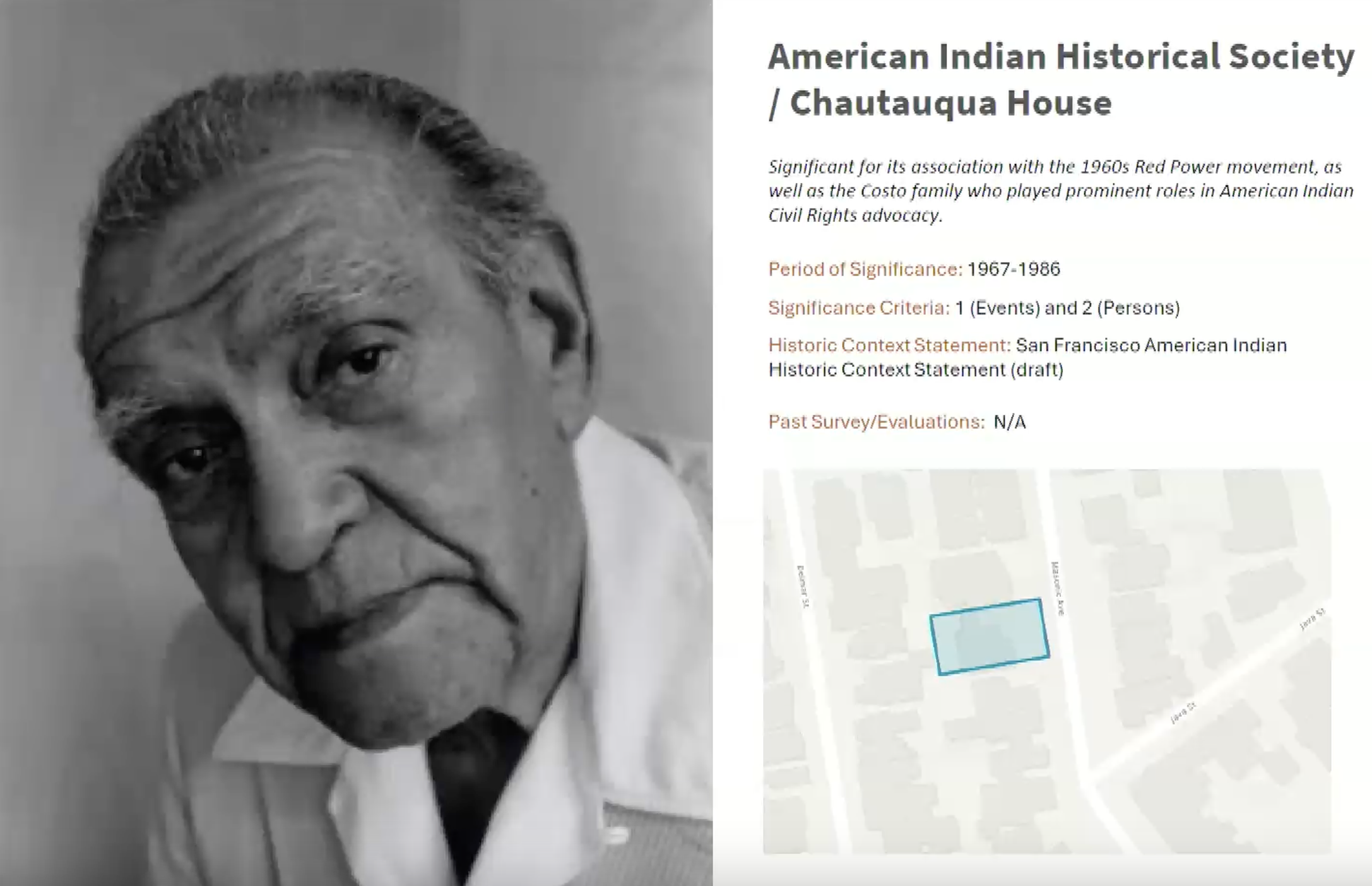
Why it matters: The designations span LGBTQ history, Indigenous heritage, architectural significance and religious life, creating legal protections for sites that define District 8's cultural identity. One designation — the American Indian Historical Society/Chautauqua House — would become the city's first landmark with an American Indian association.
Where things stand: Renil Bejoy from Supervisor Mandelman's office introduced the batch. Planning Department staff member Alex Westhoff presented each property.
The 14 sites include the Bob Ross House, Sha'ar Zahav, Castro Rock Steam Baths, Full Moon Coffeehouse, Maud's, SF AIDS Foundation, Bank of Italy Branch, Engine Company No. 13, Hose Company #30, Geilfuss on Guerrero, Mission Folk Victorian Home, St. Matthew's Church, and St. Nicholas Cathedral. The Historic Preservation Commission had previously recommended approval of all 14.
Public commenter Woody LaBounty, President and CEO of San Francisco Heritage, endorsed the batch and encouraged other districts to pursue similar designations, highlighting the intangible heritage represented by LGBTQ, American Indian and religious congregations.
Decisions: The committee voted 3-0 (For: Melgar, Chen, Mahmood; Against: none; Absent: none) to send all 14 ordinances to the full board.
What's next: The ordinances head to the full Board of Supervisors for final approval.
Minor Items
Officer Lewin-Tankel Way: The committee unanimously recommended naming the 300 block of Eddy Street in the Tenderloin "Officer Lewin-Tankel Way," honoring the SFPD officer who suffered a traumatic brain injury after being struck by a suspect's vehicle while on bicycle patrol. Commander James Ahern, SFPD, described the officer's immediate response to a call involving an armed suspect. Supervisor Mahmood spoke in support, and Supervisor Chen and Chair Melgar both joined as co-sponsors. Vote: 3-0 (For: Melgar, Chen, Mahmood; Against: none; Absent: none). The resolution heads to the full board.