Land Use and Transportation Committee - Apr 27, 2026 - Regular Meeting

Land Use and Transportation Committee - Apr 27, 2026 - Regular Meeting

Land Use and Transportation CommitteeSan FranciscoApril 27, 2026

Sources:

Locunity is a independent informational service and is not an official government page for this commission.We use AI-assisted analysis and human editorial review to publish information.

No Single Agency Owns Market Street's Future as Committee Advances Five Bills

San Francisco's Land Use and Transportation Committee spent more than two hours on a sweeping hearing that laid bare a stark reality: no city department owns a unified vision for Market Street's recovery. The hearing, called by Supervisor Bilal Mahmood, drew testimony from four departments and more than a dozen members of the public — transit advocates, neighborhood groups, small business owners, and labor — who split sharply over whether to close a loophole allowing ride-hail and Waymo on the car-free corridor or reopen the street to private vehicles. Before that marathon session, the committee unanimously advanced five pieces of legislation touching housing, electrification, street permits, building inspections, and indigenous cultural recognition.

  • No unified plan for Market Street: Four departments acknowledged no single entity coordinates the corridor's transportation, economic, and public realm strategy

  • 20+ organizations demand TNC loophole closure on car-free Market while SOMA residents push to bring private cars back

  • SFPUC gains authority to buy developer-built electric infrastructure, unlocking Cordia's gas-to-electric conversion heating 185 downtown buildings

  • 80–90% of block party permits will skip ISCOT hearings under new Permit SF streamlining law

  • "Helen Waukazoo Way" advances to honor the founder of Friendship House after emotional testimony from alumni, staff, and advocates

  • 335 units of 100% affordable housing clear their final infrastructure hurdle in the Transbay district


The Fight for Market Street's Soul

Why it matters: Market Street carries tens of thousands of daily transit trips and anchors San Francisco's entertainment and tourism economy — but the corridor's recovery from the pandemic remains stalled, and this hearing put on the public record that the city has no coordinated plan to change that.

Supervisor Bilal Mahmood opened the hearing by framing Market Street as "the backbone of the city's transportation network". Use multiple modes of transportation, commuters use Market both below and above ground. He organized testimony around three questions: the future of transportation on Market, the city's public realm investment plans, and small business activation.

Departments Reveal Fragmentation

Four agencies presented — Municipal Transportation Agency (SFMTA), Public Works, the Office of Economic and Workforce Development (OEWD), and the Planning Department — and the picture they painted was one of piecemeal effort.

Jeremy Shaw of the Planning Department described zoning reforms, adaptive reuse programs, and the Reimagined Market Street design competition but conceded no single department owns the corridor vision. Chava Cronenberg of SFMTA reported that the Transportation Network Companies (TNC) and Waymo loading evaluation shows transit travel times and crash rates remain below established thresholds, but utilization is strikingly low — roughly 250 trips per day, mostly Uber Black, with Waymo not yet conducting pickups in the zones.

Mahmood pressed on the data:

"Is it safe to say that maybe there hasn't been because the utilization is so low that we haven't seen any potential disruption that could have been possible as well?"

SFMTA acknowledged the low volume complicates any conclusions.

Jessica Garcia, a Transit Planner with SFMTA Service Planning acknowledged the 5 Rapid bus line is experiencing overcrowding after local service cuts, with a fix expected in June.

Diana Ponce de Leon of OEWD detailed entertainment zones, storefront opportunity grants, and Mid Market Foundation partnerships but acknowledged budget constraints are limiting public investment west of Powell Street. Mahmood pushed back:

"Why aren't we seeing the same level of public realm enhancement infrastructure investment?"

He noted that the Embarcadero and Powell Street areas have received the bulk of Downtown Development Corporation funding.

"What Is the Plan?"

Chair Myrna Melgar delivered the hearing's sharpest challenge. She pressed Planning directly:

"What is the plan? What is the overall plan? What is the vision that we have for Market Street?"

She argued that all the departmental sub-plans lack an overriding corridor strategy. Melgar framed Market Street's challenge as fundamentally about perception and safety, not just traffic engineering.

"It's not fun on Market Street, it's fun at Stonestown," she said, citing District 7 youth who avoid the corridor because it doesn't feel safe or interesting.

She also acknowledged SFMTA's impossible position:

"I think the MTA is in just a tricky position because everyone blames you for everything."

Cronenberg agreed the problem extends beyond transportation. She shared that no one parades on South Van Ness, underscoring that Market Street must function as both a transit artery and a destination — and that SFMTA cannot solve the revitalization challenge alone.

Public Comment: Two Camps, Sharp Divide

The public testimony split cleanly.

The Keep Market Street Moving Alliance — a coalition of more than 20 organizations including the SF Bicycle Coalition, Walk San Francisco, SF Transit Riders, Streets for All, and the SF Taxi Workers Alliance — demanded that the city close the commercial vehicle loophole allowing TNCs and autonomous vehicles on the car-free stretch, invest in transit, and implement Better Market Street's original vision. Jodie Medeiros of Walk San Francisco reported a 40% drop in fatalities and injuries since the car-free policy took effect. Rachel Clyde of the SF Bicycle Coalition said loading bays are regularly blocked by private vehicles exploiting the TNC policy.

On the other side, Sean Aukland of the SOMA West Neighborhood Association argued the corridor is being managed as a de facto area for homeless:

"Market Street is currently being managed as a containment zone. Tenderloin to the north, SOMA to the south, and Market Street as part of it in the middle."

He called for deconcentrating homeless services, bringing private cars back, and distributing city grants more equitably.

Kash, owner of Warm Planet Bikes since 1986, described how street conditions — not the absence of cars — are destroying the business environment:

"My landlord is dead desperate to rent. He brings prospective tenants every couple of months. They tour the property, they walk outside, they look at the shit show of drinking, drug dealing, and bad behavior, and they walk away."

Fernando Pujols of the Mid Market Foundation praised incremental progress but called for a coordinated, unified public investment plan commensurate with Mid Market's needs. Tracy Everwine, Executive Director of the Mid Market Community Benefit District, representing more than 1,000 property owners, noted that neither the Real Estate Department nor the Department of Public Health were even represented at the hearing. Mark Gleason of Teamsters Joint Council 7 advocated for expanded commercial loading zones on Market and adjacent streets to support delivery workers.

Vice Chair Chyanne Chen questioned whether the city's economic strategy has been too focused on large corporate anchors:

"From the little time that I'm the supervisor at the board, I find it sometimes focusing on larger corporation as an anchor for economic revitalization of the area hasn't always been pay off."

Decisions: The hearing was filed 3-0 (For: 3 — Melgar, Chen, Mahmood; Against: 0; Absent: 0).

What's next: Mahmood signaled follow-up on the TNC loophole and Mid Market investment. Expect future legislative action on the commercial vehicle policy and pressure on departments to return with a unified Market Street plan.


New Law Lets SFPUC Buy Developer-Built Electric Grid

Why it matters: Cordia Energy Center operates a district steam loop heating 185 buildings across 37 million square feet of downtown San Francisco — including City Hall. The company is ready to transition from gas-fired boilers to clean Hetch Hetchy hydroelectric power and construct a new electric substation, but SFPUC lacked the authority to purchase infrastructure built by large-load customers outside formal development agreements.

Board President Rafael Mandelman sponsored the ordinance extending a 2021 law that allowed SFPUC to contract with developers building electric infrastructure. The new legislation expands that authority to large-load customers with major construction projects underway.

Catherine Spaulding of San Francisco Public Utilities Commission Power Enterprise warned that without the new authority, the city risks losing customers to PG&E or other jurisdictions entirely.

All prevailing wage, local hire, non-discrimination, and first-source hiring requirements are preserved.

The other side: Labor was fully aligned. Brendan Greene of IBEW Local 6 testified in strong support, emphasizing skilled electrical work and city oversight. Rudy Gonzalez of the SF Building and Construction Trades called it a model public-private partnership and linked it to apprenticeship opportunities. Mike Yerkes, Cordia's general manager, described the scale of the conversion: a steam system serving 37 million square feet across 185 buildings.

Vice Chair Chyanne Chen supported the bill but flagged her deliberation:

"I don't take any policy decision that streamline public procurement process lightly, such as exempting agreements from Chapter 6 and 21."

Decisions: Recommended to full Board of Supervisors, 3-0 (For: 3 — Melgar, Chen, Mahmood; Against: 0; Absent: 0).

What's next: The ordinance goes to the full board. If approved, SFPUC can immediately begin contracting with Cordia and similar large-load customers to build electric infrastructure, accelerating the city's gas-to-electric transition.


80–90% of Block Parties Skip Hearings Under Permit SF

Why it matters: Community block parties and small street festivals have long faced weeks of permitting delays, including mandatory hearings before the Interdepartmental Staff Committee on Traffic and Transportation (ISCOT). Mayor Daniel Lurie's legislation allows SFMTA to administratively issue temporary street closure permits for events that span three blocks or fewer, keep intersections open, and don't reroute Muni — eliminating ISCOT hearings for an estimated 80–90% of applicants.

Ben Van Houten of OEWD Nightlife, Chava Cronenberg of SFMTA, and Katy Tang of Permit SF presented the ordinance. The Permit SF digital platform, launched months ago, gives all departments real-time visibility into applications and lets organizers learn upfront what permits and fees they need.

Jill Linwood of the Yerba Buena Partnership testified in support, saying the streamlining will encourage more events downtown. Simon Bertrang of SF New Deal cited $58.8 million dispersed to 2,400 small businesses through the organization and called the bill a dramatic reduction in bureaucracy. Griffin Lee of Connected SF also testified in favor.

Vice Chair Chyanne Chen added herself as co-sponsor.

Decisions: The original ordinance was recommended to the full board, 3-0. A duplicate version with technical ISCOT amendments was also approved and continued to the call of the chair, 3-0.

What's next: The original ordinance heads to the full board. If approved, the new administrative permit process takes effect citywide across all 11 districts.


"Helen Waukazoo Way" Advances After Emotional Testimony

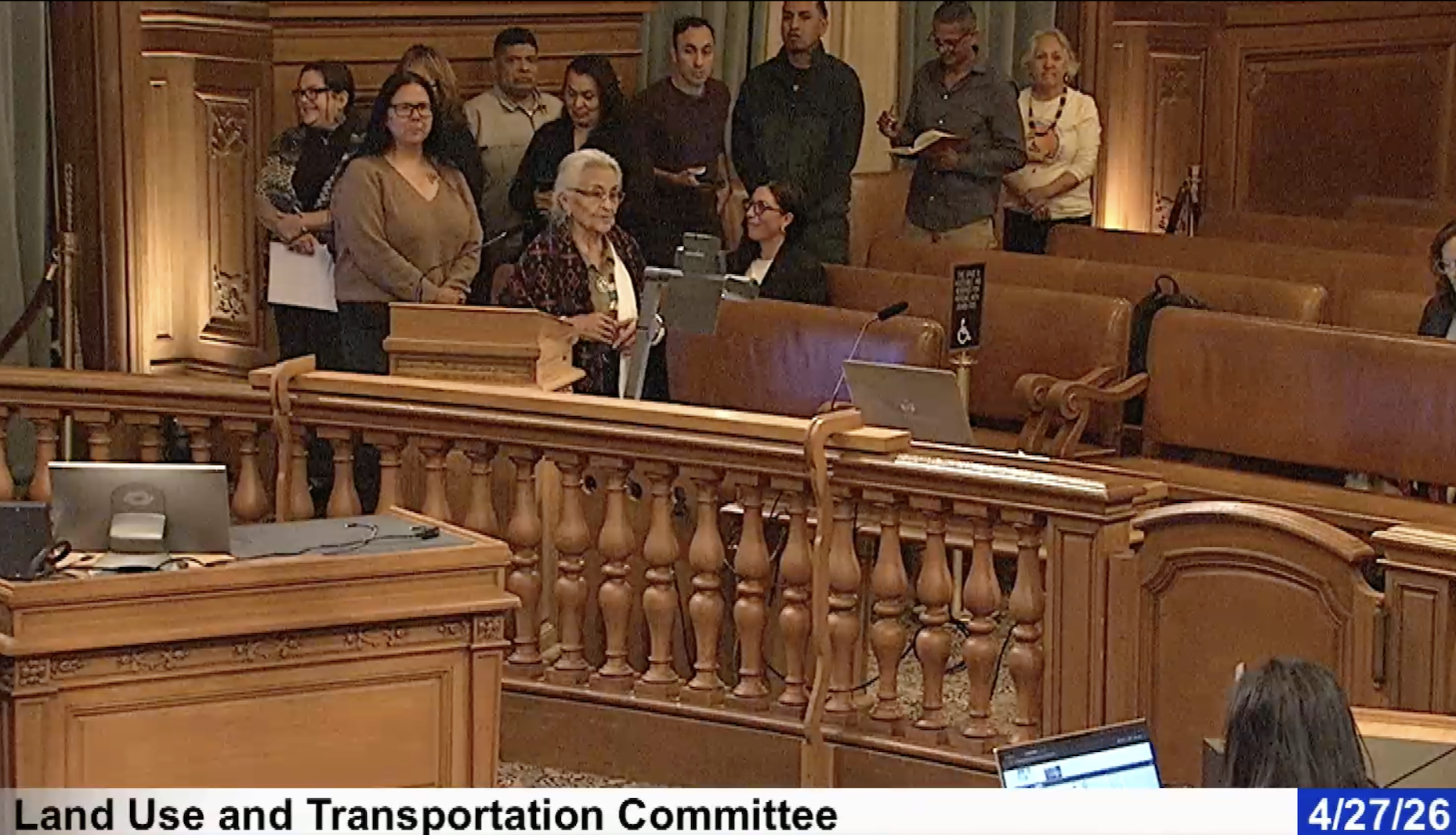
Why it matters: Helen Waukazoo, born on the Navajo reservation and forcibly removed to a federal boarding school at age 13, founded Friendship House Association of American Indians in 1963 as a substance recovery center integrating traditional Native healing with evidence-based treatment. The organization has served more than 6,500 clients. This summer, Friendship House breaks ground on Village SF, a Native-led wellness and economic center — Helen's long-held dream.

Sasha Gaona, aide to Supervisor Jackie Fielder (District 9), presented the resolution to add the commemorative street name "Helen Waukazoo Way" to Julian Avenue in the Mission District's American Indian Cultural District.

Eight community members testified. Patricia Shirley, a Navajo elder, described meeting Helen at boarding school at age 8 and how Helen comforted displaced children before co-founding Friendship House after they arrived in San Francisco. Kathryn Collins, a Friendship House alumna and now certified counselor, testified the program saved her life 14 years ago.

Peter Bratt, a filmmaker leading the Village SF project, described Waukazoo's reach across decades of city leadership:

"She was a remarkable human being who made everyone feel welcome. When you walked in through the gate, she called you nephew, grandson, granddaughter, daughter, niece, nephew."

Chair Myrna Melgar noted that Waukazoo died during COVID shelter-in-place and the community never had a proper celebration of her life. All three committee members added themselves as co-sponsors.

Decisions: Recommended to full Board of Supervisors, 3-0 (For: 3 — Melgar, Chen, Mahmood; Against: 0; Absent: 0).


Minor Items

  • Carlos Santana commemorative plaque at 205 Mullen Avenue continued to the call of the chair at the sponsor's request for additional community discussion (3-0).

  • East Clementina Street right-of-way acceptance and Folsom Street sidewalk easements approved for Transbay Block 2's 335 100% affordable housing units — 151 senior units already receiving residents, 184 family units expected to open this summer. Recommended 3-0.

  • Building inspection alignment with state law: DBI ordinance harmonizing San Francisco's five-year building appendage inspection requirement with a 2018 state law requiring inspections every six years. Two amendments adopted: reinserting fire escapes that were inadvertently removed during drafting, and clarifying that the extended synchronization timeline is a one-time allowance. Recommended as amended 3-0.

No Single Agency Owns Market Street's Future as Committee Advances Five Bills | Land Use and Transportation Committee | Locunity