
SF Committee Advances 45-Day Data Center Moratorium, Tenant Protections
Land Use and Transportation Committee • San FranciscoOctober 5, 2026
Locunity is an independent informational service and is not an official government page for this commission. All information is sourced from public footage and an analysis of official agendas with the aid of responsible, fact-checked AI. to report an error or omission.
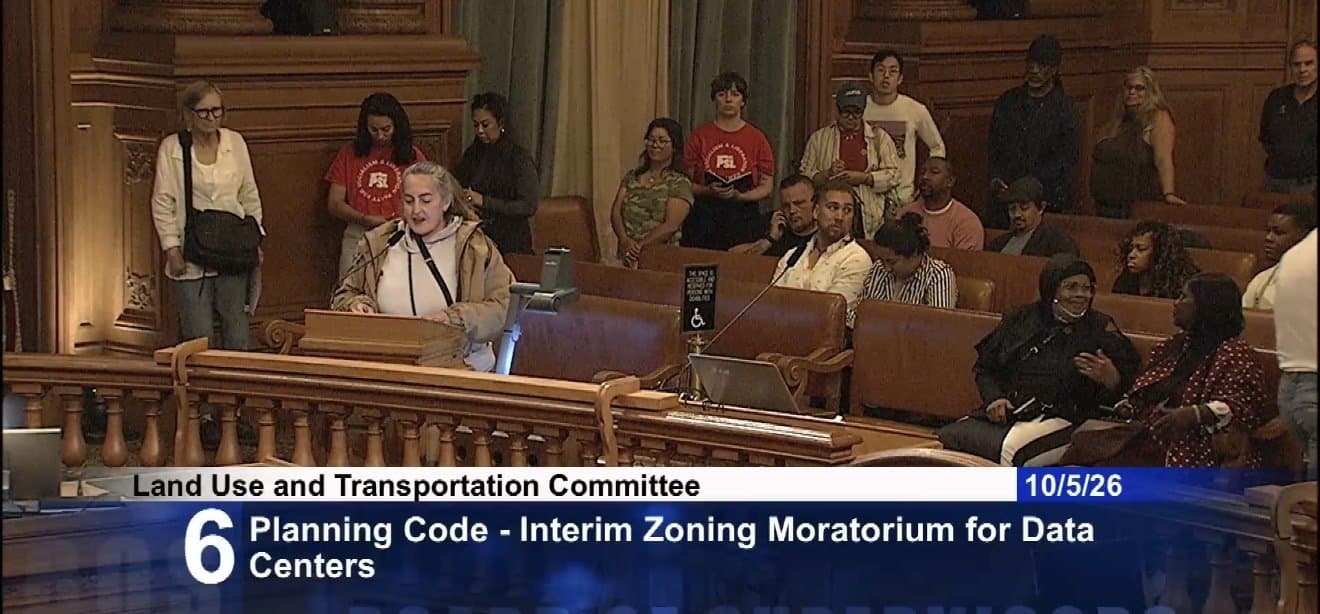
San Francisco could freeze new data center approvals for 45 days while it rewrites a zoning definition dating to 2001, after the Land Use and Transportation Committee unanimously sent an amended urgency moratorium to the full Board on Oct. 5, 2026. The same 3-0 majority also advanced two tenant protections, two housing code fixes and an expanded Compton's Cafeteria landmark. Together, the votes show a committee using land use tools to protect neighborhoods already under pressure, from Bayview-Hunters Point to the Tenderloin.
- 45-day citywide data center moratorium advances 3-0, amended to spare office server rooms
- Evictions over debts below one month's fair market rent would be barred; landlords signal a lawsuit
- Compton's Cafeteria landmark expands to the full building exterior, but the interior fight continues
- Ceiling minimum drops to 7 feet in existing buildings, aimed at legalizing in-law units
- No Hidden Rent Act would require one all-in monthly price in listings and leases
A Pause on Data Centers, and a Rewrite of the Rules
Why it matters: San Francisco still regulates data centers under the Planning Code's "internet service exchange" definition, adopted in 2001. Existing and proposed facilities cluster in Bayview-Hunters Point and SoMa, neighborhoods that speakers described as already environmentally overburdened.
Where things stand: Supervisor Walton (District 10) brought an urgency ordinance under Government Code Section 65858. It would impose a 45-day citywide interim moratorium and require the Planning Department to report within 25 days, with a hearing within 35 days. The study would cover energy, water, air quality, land use and community impacts.
Walton noted that the Nova Data Center facilities at 200 and 400 Paul Avenue were approved in 2016. He cited moratoria in other jurisdictions and research on siting in low-income communities of color. "I want to be clear: the moratorium is not opposition to technology or innovation, but a call for balance," said Walton.
Overbreadth fix: Matt Dorsey, Supervisor, District 6, backed the intent but warned that the language could sweep in ordinary businesses and routine permits. "Many offices, hospitals, and banks have server rooms and onsite computing equipment that supports their day-to-day operations as an accessory use," said Dorsey. His amendments exempt accessory computing facilities and repair or maintenance that does not increase a data center's size or capacity. Walton welcomed them.
Calvin Welch, board member, Haight-Ashbury Neighborhood Council, urged speed: "I would hope your concerns do not stand in the way of adopting immediately this moratorium."
Public pressure: Public comment strongly favored the pause, and many speakers pushed further. Party for Socialism and Liberation organizers and several residents called for a permanent ban. Others criticized the mayor's private meetings on a proposed Dogpatch data center. Arianne Harrison, executive director, Marie Harrison Community Foundation for Social and Environmental Justice, tied the issue to Bayview health: "We have a 98th percentile infant mortality rate." Speakers also raised PG&E costs and the city's reliance on Hetch Hetchy water.
The other side: John Paulson, a data center industry veteran, acknowledged the industry's failures. He described renewable, zero-water and no-diesel projects and pointed to the fiscal stakes. "The tax revenue that is generated from the personal property tax on the servers will be in the millions, if not tens of millions of dollars," said Paulson.
Decisions and stakeholder impacts: The amendments passed, followed by a recommendation as a committee report. Both votes were For: 3 (Chen, Dorsey, Melgar), Against: 0, Absent: 0. Supervisor Myrna Melgar (District 7), the committee chair, framed the question as "just old school highest and best use" of city land and infrastructure. Southeast residents gain a study window. Data center developers face a pause, while businesses with in-house servers are carved out.
What's next: The full Board takes up the moratorium Oct. 6. If it is enacted, the Planning Department's 25-day report clock starts.
Small Debts, Big Evictions: Fair Market Rent Threshold Advances
Why it matters: "Today in San Francisco, landlords can evict tenants for being short any amount in rent," said Jackie Fielder, Supervisor, District 9, the sponsor. Evictions are at a 10-year high.
Where things stand: The ordinance would bar evictions for unpaid rent below HUD's fair market rent for an equivalent-sized unit. Fielder said Los Angeles, Oakland and Berkeley already use the same standard. "In a representative sample of nonpayment evictions in San Francisco last year, around 25% of tenants were evicted for less than one month of the fair market rent for their unit," said Fielder.
Co-sponsor Bilal Mahmood, Supervisor, District 5, warned that "a few hundred dollars after a rough month can cost someone their home." Chyanne Chen, Supervisor, District 11, stressed that landlords keep their remedies for significant arrears.
A large, organized bloc of tenant groups backed the bill, including the SF Anti-Displacement Coalition, SOMCAN, the Eviction Defense Collaborative, the Race and Equity in All Planning Coalition, Young Community Developers and DSA SF. Tuesday Rose Thornton, attorney, Eviction Defense Collaborative, cited a former client "who was evicted for $650 just this year."
SOMCAN tenant counselors directly asked Dorsey to co-sponsor, and he did. He recalled tenant harassment cases from his time in the City Attorney's office and warned of new pressure: "We will likely see it again as we have AI companies and IPOs coming."
The other side: Landlord groups argued that state law preempts the measure. Justin Goodman, attorney, Weigel Law Group, representing the Coalition for Better Housing, said that argument was "the basis of the recent successful challenge to former Supervisor Preston's 10-day cure notice requirement." He asked for a trigger clause tied to the California Supreme Court's review of a challenge to Los Angeles' ordinance and said the industry would otherwise sue.
Charlie Goss, San Francisco Apartment Association, asked the committee to wait for the court's ruling. Griffin Lee, Connected SF, opposed the bill outright. He noted that HUD's one-bedroom fair market rent of $2,977 could leave a landlord with roughly three months unpaid on a $1,000 unit.
Decisions and stakeholder impacts: The committee recommended the bill without amendment and without a trigger clause, For: 3 (Chen, Dorsey, Melgar), Against: 0, Absent: 0. Tenants with small balances gain protection. Small landlords with low-rent units bear the most exposure.
What's next: The bill heads to the full Board. Litigation risk hinges on the pending California Supreme Court case.
Compton's Cafeteria Landmark Grows, Interior Still Locked Out
The basics: The 1966 Compton's Cafeteria riot is widely cited as the start of San Francisco's trans activism. Landmark No. 307, designated in late 2022, covered only a small ground-floor portion of 101-121 Taylor St. and the adjacent sidewalks.
Where things stand: The Compton's X Coalition applied in December 2025 to expand the landmark to the entire four-story building. The Historic Preservation Commission initiated the amendment on Jan. 21, 2026, and recommended approval on April 1, 2026, but limited protection to the exterior. Planning staff member Pilar Lavallee said interior spaces "could be the subject of a future designation amendment, but that at that time there was not enough evidence of current integrity and condition."
Mahmood, the sponsor, explained why that evidence is missing. He described the owner, GEO Group, as an ICE contractor that operates a halfway house at 111 Taylor. "However, Geo Group has refused entry into the facility to advocates and to the city, even after a request from our office," said Mahmood.
The other side: Chandra Laborde, representative, Compton's X Coalition, said GEO's counsel had asked to exclude the interior. She argued that "the city should not allow a private prison corporation to determine the boundaries of transgender historic preservation." David Blackwell, speaking for the owner, supported the exterior designation. Malik Washington, a former 111 Taylor resident, called for GEO Group's removal.
Decisions and stakeholder impacts: The committee adopted clerical amendments and sent the original file to the full Board as a committee report. It also duplicated the file, added a finding urging reconsideration if new interior evidence surfaces, and continued the duplicate to the call of the chair. All votes were For: 3 (Chen, Dorsey, Melgar), Against: 0, Absent: 0. Melgar joined Chen and Dorsey as co-sponsors.
What's next: The full Board considers the landmark Oct. 6. "I want to reiterate to the community that this is just a first step," said Mahmood.
Inches Matter: Ceiling Rule Eased for Existing Homes
Where things stand: Alan Wong, Supervisor, proposed lowering San Francisco's 7-foot-6-inch ceiling minimum in existing buildings to 7 feet for habitable rooms and 6 feet 8 inches for other rooms. New construction stays at 7 feet 6 inches. "In some cases, a matter of inches can determine whether otherwise usable space can legally become housing," said Wong.
Tate Hannah, Planning Department staff, said the Building Inspection Commission unanimously approved the change July 15, 2026, and that the department supports it. When Melgar asked why the change hadn't been recommended earlier, Hannah said he couldn't speak for prior staff and cited misalignment with state code. He added that "excavation is really the only option."
Why it matters: Homeowner Paul Ray said excavation "costs at least $90,000." Catherine Roberts, a Cole Valley owner whose submission to Wong's "Dumb Laws" contest prompted the bill, described 20 years of violation notices. Connected SF, the Housing Action Coalition and the SF Apartment Association all backed the change.
Decisions and stakeholder impacts: The committee amended the bill to apply explicitly to existing buildings and advanced it, For: 3, Against: 0, Absent: 0. Chen joined as co-sponsor, saying the change would make "hundreds of existing spaces instantly eligible for legalization."
One Number Upfront: No Hidden Rent Act
Where things stand: Mahmood's bill would require a "total estimated cost" figure in every online listing and lease. Tenants could end leases early without penalty if disclosures were inadequate. Undisclosed fees could not support evictions or late penalties. "These charges can add 10 to 30% on top of the advertised rent," said Mahmood. He said San Francisco would be the first California city to require all-in rental pricing.
Mahmood said the bill was negotiated with tenant advocates and the SF Apartment Association. He offered four amendments he described as non-substantive, including limiting early termination to the lease term.
The other side: Goodman asked that the termination right apply only to the initial lease term. Commenter Mike Knorr warned that estimating rising utility costs could push landlords to raise upfront rents.
Decisions and stakeholder impacts: The committee adopted the amendments and advanced the bill, For: 3, Against: 0, Absent: 0. "This legislation ensures that what you see is what you pay," said Chen.
Minor Items
- Mezzanine fix: The committee voted 3-0 to align Planning Code mezzanine rules with the Building Code; there was no public comment.
Looking Ahead
The full Board takes up the data center moratorium and the Compton's Cafeteria landmark Oct. 6. The fair market rent, No Hidden Rent, ceiling-height and mezzanine ordinances also head to the full Board.