Land Use and Transportation Committee - Mar 23, 2026 - Regular Meeting

Land Use and Transportation Committee - Mar 23, 2026 - Regular Meeting

Land Use and Transportation CommitteeSan FranciscoMarch 23, 2026

Sources:

Locunity is a independent informational service and is not an official government page for this commission.We use AI-assisted analysis and human editorial review to publish information.

SF Committee Advances 18 Historic Landmark Designations Tied to Family Zoning Plan

San Francisco's Land Use and Transportation Committee unanimously approved 18 resolutions to initiate landmark protections for historically and culturally significant buildings across District 2 — the first concrete preservation actions under the city's Family Zoning Plan. The vote locks in safeguards for properties ranging from civil rights landmarks to Julia Morgan designs as the city gears up for aggressive housing production.

  • 18 District 2 properties advance toward landmark status in unanimous 3-0 committee vote, headed to the full Board of Supervisors

  • Family Zoning Plan's first preservation wave targets buildings most vulnerable to demolition pressure under new density rules

  • Civil rights, African American, and Jewish heritage sites among those shielded, including Mel's Diner and the oldest Prince Hall Freemasonry lodge in the West

  • Vice Chair Chen calls for broader anti-displacement strategy beyond landmarking, urging small business protections and affordable housing investments


Preservation Meets Density: 18 Buildings Get a Shield

The basics: Article 10 of San Francisco's Planning Code allows the city to designate individual buildings as landmarks, restricting demolition and major alterations. The 18 resolutions heard Monday initiate that process for properties across Pacific Heights, the Western Addition, Upper Fillmore, Cow Hollow, the Marina, and the Inner Richmond — all in Supervisor Cheryl's District 2.

Why it matters: The Family Zoning Plan, adopted late last year, rezones large swaths of the city to allow denser housing. That means buildings once insulated by low-density zoning now face new development pressure. These landmark designations are designed to ensure that the push for housing production doesn't erase buildings with deep architectural, historical, and cultural roots.

Where things stand: Alex Westoff, Planning Department staff, walked the committee through each property's significance, describing the effort as "part of the city's commitment to ensuring that growth associated with ambitious housing production goals is aligned with San Francisco's long standing dedication to preserving historic places deeply embedded in San Francisco's unique cultural identity."

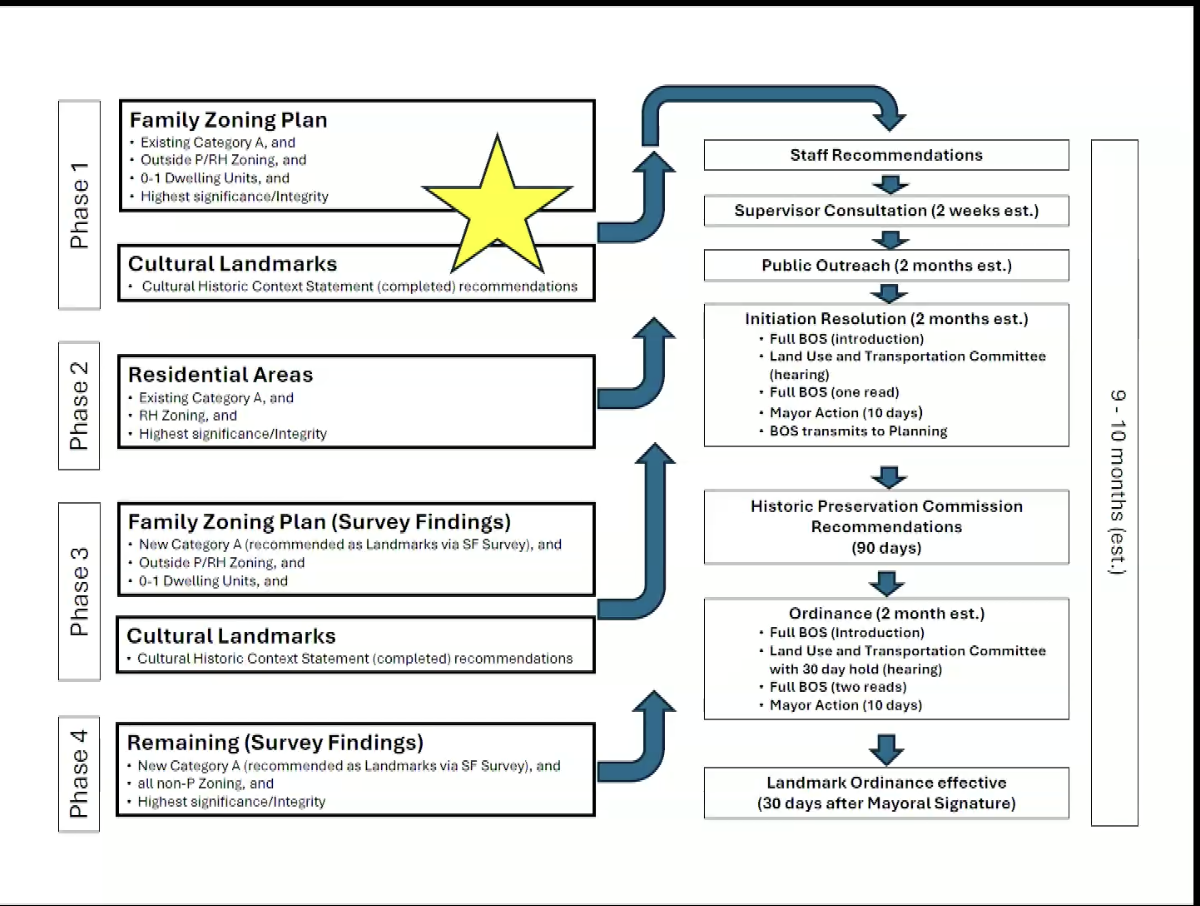
Phase one targets two categories: existing Category A properties — those with the highest level of significance and integrity — located outside P and RH zoning districts with zero to one dwelling units, and properties identified through Cultural Historic Context statements with underrepresented community associations.

The list reads like a cross-section of San Francisco's civic, religious, and commercial life, with construction dates spanning 1874 to 1960. Among the standouts:

  • Century Club of California (1355 Franklin): Remodeled by architect Julia Morgan in 1914.

  • Mel's Diner (3355 Geary): Site of the Bay Area's first mass civil rights sit-in in 1963, which successfully changed hiring practices.

  • Hannibal Lodge Number One (2804 Bush): The oldest Prince Hall Freemasonry lodge in the West, established in 1852.

  • National Urban League headquarters (2015 Steiner): The city's most prominent civil rights organization during the post-war period, advocating for improved housing conditions and expanded economic opportunities.

  • First AME Zion Church (2155-2159 Golden Gate): One of San Francisco's first three African American churches.

  • Presidio Theater (2336-2346 Chestnut), Bridge Theater (3008 Geary), and The Vogue (3290 Sacramento): Neighborhood theaters reflecting the city's mid-century commercial fabric.

Lorenzo, a staffer representing Supervisor Cheryl of District 2, told the committee that "these resolutions are the product of several months of community outreach work with the Historic Preservation Team and conversations around the Family Zoning Plan during its adoption late last year."

The other side: No opposition materialized — no public comment was offered on any of the 18 items. But Vice Chair Chyanne Chen, Supervisor, District 11, used the moment to flag a broader concern. She praised the designations but warned that landmarking alone won't protect vulnerable communities from displacement as rezoning accelerates.

"This wave of landmarks is directly connected to the city's recent adoption of the family rezoning legislation," Vice Chair Chen said. "This signals that the reality of many of our buildings and storefronts may be increasingly vulnerable to development pressure."

She called for complementary strategies: community cultural stabilization efforts, small business protections, affordable housing investments, and anti-displacement controls.

Decisions: The committee voted 3-0 to send all 18 resolutions to the full Board of Supervisors as committee reports. (For: Supervisor Chen, Supervisor Mahmood, Supervisor Melgar; Against: none; Absent: none.)

What's next: The 18 items are expected on the full Board of Supervisors agenda for March 24, 2026. If the board initiates the designations, the Historic Preservation Commission would then conduct formal review before final landmark status is conferred. The committee is closed for spring break, with its next meeting scheduled for Monday, April 6, 2026.

SF Committee Advances 18 Historic Landmark Designations Tied to Family Zoning Plan | Land Use and Transportation Committee | Locunity