Land Use Panel Advances SHADE Act, Cutting CEQA Appeal Window in Half
Land Use and Transportation Committee • San FranciscoSeptember 28, 2026
Locunity is an independent informational service and is not an official government page for this commission. All information is sourced from public footage and an analysis of official agendas with the aid of responsible, fact-checked AI. to report an error or omission.
San Francisco's Land Use and Transportation Committee voted 3-0 on Sept. 28, 2026, to send the SHADE Act to the full Board of Supervisors. The bill would halve the time residents have to appeal environmental decisions and remove shadow as grounds for local environmental review. The committee also advanced revisions to the Potrero Power Station megaproject that bar data centers, took a legal step toward reviving the dormant Fillmore Heritage Center, and updated green building rules for city buildings.
SHADE Act clears committee 3-0, cutting CEQA appeal periods from 30 to 15 days and ending shadow-based appeals.
11 public commenters split as renters and housing advocates faced off with neighborhood and environmental groups.
Potrero Power Station revisions advance 3-0, with new language banning data centers on any block.
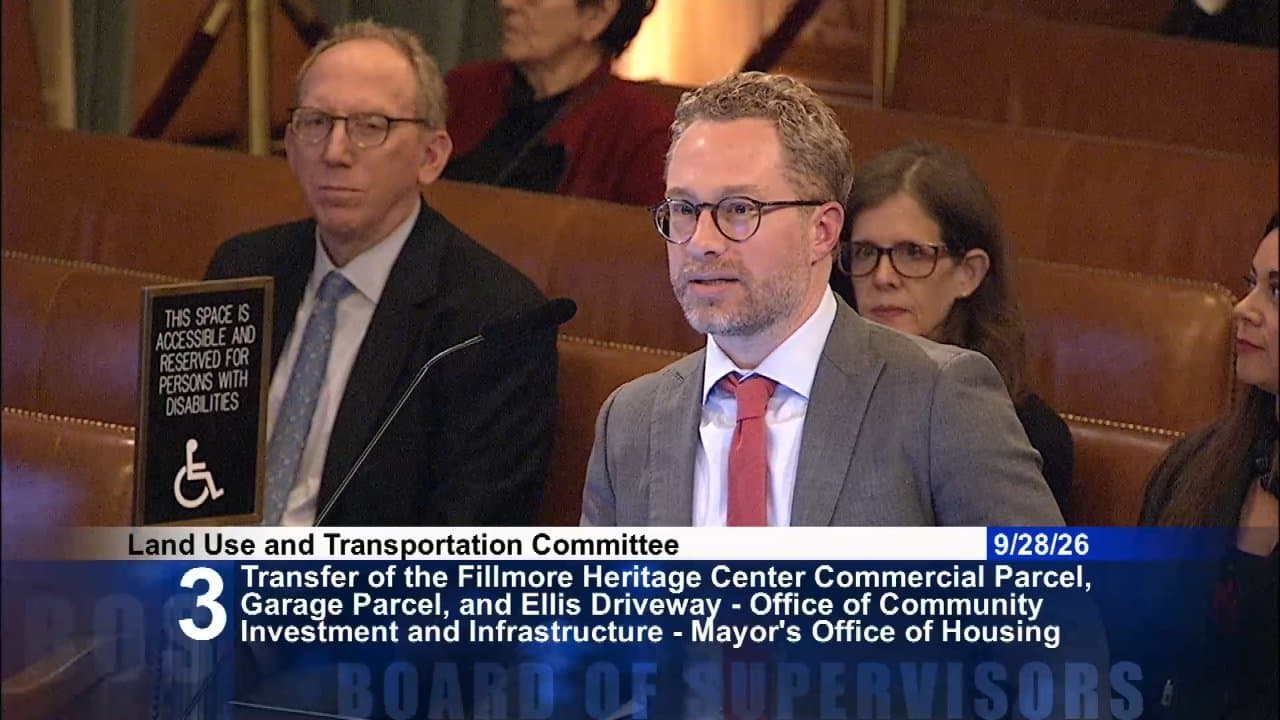
City moves to take title to the vacant former Yoshi's complex, a 50,000-square-foot space, as Fillmore revival plans take shape.
Green building update adopts LEED 5.0 and keeps a gas equipment inventory that will guide 10 decarbonization pilots.
SHADE Act Heads to Full Board
The basics: The California Environmental Quality Act, or CEQA, requires environmental review of projects. San Francisco's Administrative Code Chapter 31 adds local steps on top of state law, including shadow analysis, 30-day appeal windows and extra hearings.
Why it matters: The ordinance from Supervisor Bilal Mahmood, District 5, would narrow when and how residents can challenge projects. That shifts leverage away from appellants and toward housing builders.
"Since 2017, CEQA appeals involving shadow analysis have led to delaying or stalling over 2,000 housing units citywide," said Supervisor Mahmood. He said the name SHADE stands for "Slashing Housing Appeals and Delays Everywhere." Supervisor Matt Dorsey and Supervisor Danny Sauter are co-sponsors.
Where things stand: Planning Department Senior Planner Kei Zushi said the bill would cut appeal periods for exemptions, final negative declarations and environmental impact reports to 15 days. Several other changes would take effect:
Some appeals the state does not require would end.
The Board would face 14-day timelines to comply with the Housing Accountability Act.
Planning Commission hearings on draft EIRs would end, though written comment remains.
Shadow would come out of local CEQA review. Prop K and Planning Code Section 295 would stay intact.
Lisa Gibson of the Planning Department said the bill fulfills a housing element commitment. The Planning Commission recommended approval July 23. Staff said the city received dozens of opposition letters, including from Telegraph Hill Dwellers, Neighborhoods United SF and the Golden Gate Park Preservation Alliance. It received a few letters of support, including from the Housing Action Coalition.
Chen's questions: Supervisor Chyanne Chen, District 11, pressed staff on the data behind the change. Planning staffer Ryan Shum said most of about 18 public appeals in six years cited shadow. "14 of them mentioned shadow, but it is not the primary reason for the appeal," he said. Staff also confirmed they had not analyzed housing opportunity sites near open spaces that Prop K does not protect.
Gibson later said the certified housing element EIR had studied shadows on all open space from Family Zoning Plan development. "We did identify that that is a significant and unavoidable impact," she said. Chen split off a duplicate file to keep seeking that analysis, but she backed the bill. "I also see the benefits of being able to facilitate more housing is a trade-off that I'm currently willing to make," she said.
The other side: Eric Brooks, speaking for San Franciscans Protecting the Sequoia, Our City San Francisco and the SF Green Party, cited a letter from 28 environmental and justice groups. "This is a sneak attack to weaken the San Francisco access to the California Environmental Quality Act more than it has ever been weakened since the history of that act in the '70s," he said. He also warned that supervisors who voted yes would face political consequences.
"We're particularly concerned about the change from 30 days to 15 days to file appeals," said Bridget Maley of Neighborhoods United San Francisco. Another commenter argued a 15-day window would shut lower-income neighborhoods out of appeals. Lance Carnes, a District 3 resident, asked that the ordinance explicitly list laws like Prop K that override it.
The support: Renters from Districts 5 and 6 and the Tenderloin described rising rents and fears of being priced out. Whit Turner of the Housing Action Coalition said shadow appeals had stalled roughly 2,200 homes across 11 projects in nine years. Dorsey cited Holland and Knight research on CEQA misuse. "I'm tired of seeing CEQA abused in ways that frustrate rather than facilitate progress on environmental priorities," he said.
Decisions and stakeholder impacts: The committee chair, Supervisor Myrna Melgar, District 7, added herself as co-sponsor, she said, "since I got threatened with being kicked out of the progressive movement and also backlash from Westside voters." She said the bill does nothing about data centers or Prop K parks. The vote was For: 3 (Chen, Dorsey, Melgar), Against: 0, Absent: 0. The duplicate file was continued to the call of the chair, 3-0.
Developers and renters gain speed and certainty. Neighborhood groups lose appeal time and a key argument.
What's next: The full Board takes up the ordinance.
Potrero Power Station Deal Advances With Data Center Ban
Why it matters: The committee reshaped one of the city's largest waterfront developments. The changes raise height limits and revise rules while closing the door on data centers.
Where things stand: Two ordinances returned after a hearing the previous week. One amends and restates the development agreement with California Barrel Company LLC, covering housing, transportation and phasing plans. The other changes zoning for the project's Special Use District. John Lau of the Office of Economic and Workforce Development offered language "clarifying that data centers are not permitted on any block within the project." He also presented technical changes on non-potable water and community improvements.
Allison Heath, chair of the Potrero Boosters Development Committee, spoke as an individual. She said the changes respond to economic conditions. "The parks, shoreline access, transit commitments, and 30% affordable housing remain intact," she said. Demaria Gregory, a District 10 native, lived in the project's Sophie Maxwell Building. "The building provided me with peace of mind, stability, and convenience," she said.
The other side: Dr. Ahimsa Porter-Sun Chai raised earthquake liquefaction and projected permanent flooding by 2035. "We should expect historical and legacy pollutant contaminants at this site, and it needs to undergo a very extensive environmental review," she said.
Decisions and stakeholder impacts: Chen praised the project's affordability and Supervisor Shamann Walton's community benefits negotiation. "I'm pleased that the proposed language related to the eligibility of data center has been removed," she said. She also accepted mid-length stays tied to the UCSF Cancer Center for patients' families.
Both ordinances passed For: 3 (Chen, Dorsey, Melgar), Against: 0, Absent: 0. The zoning ordinance passed as amended.
What's next: Both head to the full Board as committee reports on Sept. 29, 2026.
City Takes Title to Dormant Fillmore Heritage Center
Why it matters: The former Yoshi's complex has sat mostly empty for years. City ownership is the legal step needed to bring it back to life.
"This is a small routine item that is part of a much more remarkable story about the renaissance that is going on on Fillmore Street," said Mahmood.
Where things stand: The Office of Community Investment and Infrastructure (OCII), the redevelopment successor agency, owns the site. The Mayor's Office of Housing and Community Development (MOHCD) has served as caretaker because federal urban renewal funds, now tied to Community Development Block Grants, bought the land. Benjamin McCloskey, MOHCD deputy director of finance and administration, said state dissolution law requires the transfer. "The ground floor space is vacant, about 50,000 square feet and 112 public parking spots," he said.
The deal covers three parcels:
The garage must stay public parking.
The commercial parcel, kept for future development, triggers a compensation agreement with taxing entities.
The Ellis Driveway parcel, valued at $33,000, will be paid through a service credit rather than cash.
Diana Ponce de Leon, OEWD acting workforce director, pointed to three pilot events held in June. She said a low-cost process for community use of the space is coming. OEWD is also running a market study on the best long-term use and the cost of restoring entertainment and restaurant space.
The other side: Melgar pressed on the community's role. She pointed to Japantown's success nearby: "you just go across Geary Street to Japantown. It is so economically successful and full of young people all the time." Ponce de Leon said no use is predetermined.
Decisions and stakeholder impacts: The resolution passed For: 3 (Chen, Dorsey, Melgar), Against: 0, Absent: 0, with Mahmood added as co-sponsor.
What's next: Mahmood said applications for community programming should open in November, after permits. The Fillmore Community Action Plan is due by year-end. "So we really wanted to wait for that plan," he said.
Green Building Rules Get a Housekeeping Update
Why it matters: Buildings drive most city-government emissions. A gas equipment inventory will shape 10 decarbonization pilot projects slated for the next capital bond.
Where things stand: Grace Huang, from the office of Board President Rafael Mandelman, presented the Environment Code Chapter 7 update. Nick Kastner, senior building decarbonization coordinator at the Department of the Environment, explained the details. "The 2026 update is much smaller in scale. We're focusing on streamlining and making adjustments. One might call it housekeeping," he said.
The update:
Cuts redundant reporting for small and limited-scope projects.
Exempts temporary construction buildings from extra reporting.
Requires plant lists to support biodiversity guidelines.
Moves from LEED 4.1, which is being phased out, to LEED 5.0.
Makes the natural gas equipment inventory ongoing.
Kastner said municipal emissions are about 5% of the citywide total. They fell 4% from 2022 to 2024.
The other side: Chen asked about barriers to removing gas equipment. Kastner said "San Francisco International Airport is at the top with the most pieces of natural gas equipment." He named funding and electrical service upgrades as the main hurdles. Melgar asked whether centralized planning saves departments money. Kastner said the Office of Resilience and Capital Planning will lead capital planning, and he offered to return with lessons learned.
Decisions and stakeholder impacts: The ordinance passed For: 3 (Chen, Dorsey, Melgar), Against: 0, Absent: 0. It heads to the full Board. Kastner said meetings with departments happen in October and November.
Mezzanine Fix Amended, Returns Oct. 5
Why it matters: The Building Code and Planning Code measure mezzanines differently. As a result, planners and building inspectors can count stories differently, which can stall projects such as second-floor retail.
Where things stand: Mahmood's ordinance was prompted by a Hayes Valley project. "And only in San Francisco could you look at the same building and 2 different codes say there's 2 different sets of stories," he said. Planning staffer Tate Hanna said the Planning Commission unanimously backed amendments on Sept. 10. The amendments keep the one-third default but defer to the exceptions in Building Code Section 505.2.1. Melgar said an Ocean Avenue business would have saved "a whole year and a whole lot of headaches" with the fix.
Decisions and stakeholder impacts: The amendments passed For: 3 (Chen, Dorsey, Melgar), Against: 0, Absent: 0. Because they are substantive, the item must be heard again.
What's next: The committee takes up the ordinance again on Oct. 5, 2026. Mahmood said his office will pursue other conflicts between the codes.
Minor Items
Plaque for parrot champion: The committee voted 3-0 to back a plaque honoring Mark Bittner on the Greenwich Street stairway near 241 Greenwich. The plaque needs Arts Commission design approval, and the resolution goes to the Board on Sept. 29, 2026. Dorsey joined as co-sponsor.
Looking Ahead
The Board of Supervisors takes up the Potrero Power Station ordinances and the Bittner plaque on Sept. 29, 2026. The SHADE Act, Fillmore transfer and green building update also head to the full Board. The mezzanine fix returns to committee Oct. 5, 2026, and Chen's duplicate SHADE file awaits the chair's call.