Land Use and Transportation Committee - Jul 27, 2026 - Regular Meeting
Land Use and Transportation Committee • San FranciscoJuly 27, 2026
Locunity is a independent informational service and is not an official government page for this commission.We use AI-assisted analysis and human editorial review to publish information.
Committee Advances Tree Ordinance Over Fierce Opposition From 1,000 Residents
San Francisco's Land Use and Transportation Committee waded through its most contentious hearing of the summer Monday, forwarding a street tree ordinance that lets smaller developers pay a fee instead of planting trees — despite organized opposition from more than a thousand residents and tree advocates who warned it will permanently shrink the city's already-smallest-in-the-nation urban canopy. The committee also broke new ground on resident-funded utility undergrounding and honored a Latina trailblazer with the city's first commemorative street name for a woman of her background.
- Tree ordinance allowing developer fee-outs advances 3-0 despite over 1,000 residents writing in opposition and unanimous public testimony against the measure
- First-ever resident-funded utility undergrounding launched for a Noe Valley block after San Francisco exhausted its ratepayer credits 14 years early
- Dr. Carlota Texidor del Portillo becomes the first Latina from SF honored with a commemorative street name, at the site of CCSF's Mission Campus
- Compton's Cafeteria Riot landmark expansion delayed as sponsors negotiate broader scope with the city attorney
- Hunters View HOPE SF streets formally accepted by the city, completing a major infrastructure handoff for affordable housing
The Great Tree Fight: Developers Get a Fee-Out, Advocates See a Canopy Crisis
The committee's longest and most emotionally charged item — consuming roughly an hour of debate and drawing a dozen public commenters, all opposed — was an ordinance that reshapes how San Francisco plants and protects street trees.
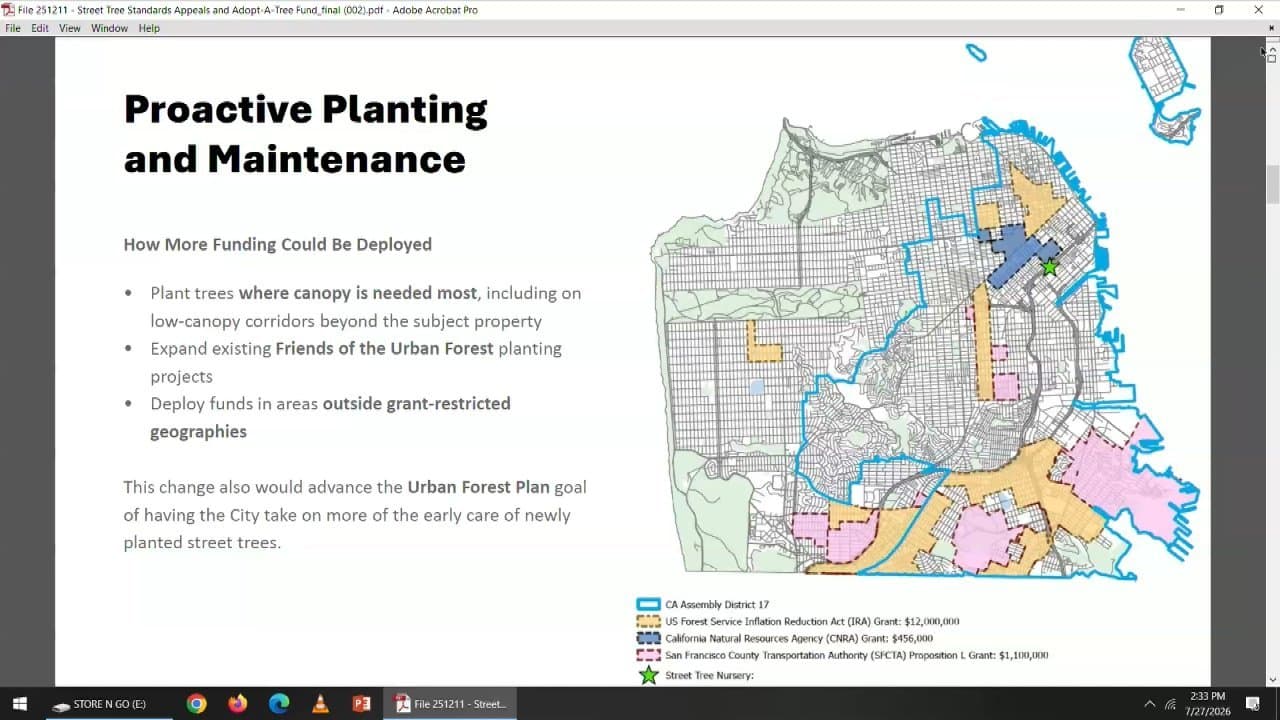
The basics: The legislation (File 251211) does three things. First, it allows smaller development projects to pay into the city's Adopt-A-Tree Fund instead of planting street trees on site, while still requiring larger projects (those meeting Better Streets Plan thresholds) to plant trees every 20 feet. Second, it exempts accessory dwelling units from tree planting requirements entirely. Third, it streamlines tree removal appeals by imposing 15-day hearing and 30-day decision deadlines on the Board of Appeals — and eliminates the board's jurisdiction over hazard tree removals altogether.
Why it matters: San Francisco has the smallest tree canopy of any major U.S. city. Opponents argue fee-outs will make that problem permanent; supporters say the fund will enable more strategic planting in communities that need it most.
Where things stand: Ayanna Schneider, DPW Government Affairs, and David Moore, Superintendent, Bureau of Urban Forestry, presented the ordinance as a way to increase flexibility and speed up hazard tree removals. Liz Waddy of the Planning Department clarified that the Better Streets Plan thresholds still require on-site planting for larger developments.
But public comment was unanimously and forcefully opposed. Josh Klipp, former vice chair of the Urban Forestry Council and co-founder of Mission Verde, delivered the sharpest critique: "Public Works currently has roughly four and a half million dollars in in-lieu fees. That's around 2,000 trees that the city already owes us from those fees alone. If this passes, that fund will grow. But our canopy may not." Klipp also presented evidence that an arborist had been asked to falsely designate a healthy tree as hazardous.
Sean Auckland, founder of fairtrees.org, said more than 1,000 residents had written to oppose the fee-out option, and argued developers who pay the fee will route utilities without regard for future tree wells, making sites permanently unplantable. "We are strongly pro housing. We envision a dense green San Francisco that's tall. But planting a street tree is not the barrier to building housing. Otherwise YIMBY would be here supporting this," he said.
Katherine Howard, a landscape architect, reinforced that point, warning that once a project is built without tree infrastructure, going back is effectively impossible. David Wolf, a public commenter, cited a case on 24th Street where an independent arborist contradicted DPW's hazard assessment on 78 trees, ultimately saving more than 40 of them. John Cersevini, president of the Board of Appeals, pushed back on eliminating his board's jurisdiction, noting that only two city-initiated tree removal appeals had reached the board since 2024: "The independent outside review of hazardous tree cases is critically important to the public. There's no need to distinguish between hazardous trees and the other trees, in part because hazardous necessarily mean dangerous."
The other side: Supervisor Myrna Melgar, Chair, defended DPW's forestry staff and expressed support for the ordinance, saying her own experience involved the opposite problem from what critics described. "Most of them were trying to convince DPW that a tree was dangerous and presents a hazard to the public, not the other way around," she said. She raised a substantive concern about equity, however, noting the city recently approved the family zoning plan upzoning much of the west side — areas that are not designated priority equity communities: "If we allow smaller projects to fee out and invest most of our tree planting money in equity communities, how do we ensure that there is an adequate tree canopy in the future in those communities that we just upzoned?"
Supervisor Chyanne Chen, Vice Chair, acknowledged the tension directly: "I know that San Franciscans care deeply about our trees. We also know that our city ranks poorly relatively to other major American cities with regards to our tree canopies." She questioned staff about the Board of Appeals caseload, establishing that only two city-initiated appeals had reached the board since 2024.
Supervisor Bilal Mahmood, Member, proposed a key amendment drawn from a recent neighborhood fight on Waller Street, where hundreds of residents mobilized after seven mature ficus trees were slated for emergency removal. A second review by the acting urban forester ultimately saved four of the seven trees. His amendment restores a DPW Director-level appeal right for hazard tree removals while still eliminating Board of Appeals jurisdiction. Madison Tam, representing Supervisor Dorsey's office, proposed a second amendment adding environmental justice community prioritization language to the findings governing how in-lieu fee proceeds are spent.
Decisions: Both amendments were adopted 3-0. The committee then voted 3-0 to recommend the amended ordinance to the full board (For: Melgar, Chen, Mahmood; Against: none; Absent: none).
What's next: The ordinance heads to the full Board of Supervisors. Given the volume and intensity of opposition — plus the involvement of organized groups like fairtrees.org and Mission Verde — expect continued advocacy and potential further amendments at the board level. The core tension remains unresolved: whether the Adopt-A-Tree Fund can actually deliver trees at the pace needed, given DPW already holds $4.5 million in unspent fees.
Noe Valley Block Pioneers a New Way to Bury Power Lines
A quiet Noe Valley street may have just created a template for the rest of the city.
The basics: San Francisco historically used CPUC Rule 20A credits — funded by ratepayer surcharges — to underground utility lines. But the city exhausted those credits and then some. Ranil Bijoy, from Board President Mandelman's office, explained the scale of the problem: "San Francisco had not only exhausted our credit balance, but borrowed 14 years into the future." The CPUC closed the program in 2022, leaving no public funding pathway for undergrounding.
Why it matters: This resolution (File 260818) initiates the first-ever Rule 20B process in San Francisco, where property owners fund undergrounding directly through an assessment district, with PG&E contributing what equivalent overhead construction would cost. It could open a door for any neighborhood willing to organize and pay.
Where things stand: The Homestead Street community submitted a petition with over 60% support. DPW held a public hearing on July 22 with a strong majority in favor. Ernie Bethel, a Homestead Street resident, presented research on other California cities that have used Rule 20B extensively, citing Newport Beach — which has created 125 such districts — and Palm Springs as models.
Josh Klipp and Katherine Howard urged the committee to ensure tree root preservation and future tree planting are integrated into the undergrounding design from the start, since moving utilities after installation is prohibitively expensive. Bijoy noted PG&E has not been responsive to the effort.
Chair Melgar was enthusiastic: "I am just pass the popcorn. I'm really looking forward to seeing what this community can do and doing it this way. It's great strategy and creativity."
Decisions: The committee voted 3-0 to send the resolution to the full board (For: Melgar, Chen, Mahmood).
What's next: If the full board approves, the city will create a financing mechanism and assessment district for Homestead Street. The real question is whether this model scales — and whether PG&E cooperates.
First Latina Street Naming Draws Standing Ovation
A block of Bartlett Street between 21st and 22nd streets — home to City College of San Francisco's Mission Campus — will carry the commemorative name of the woman who built it.
Why it matters: Dr. Carlota Texidor del Portillo becomes the first Latina from San Francisco to receive a commemorative street name, honoring her decades founding and growing CCSF's Mission Campus into the college's second-largest location and her trailblazing civic leadership.
Where things stand: Six community members testified in passionate support. Juanita Owens, former school board president, credited Dr. del Portillo with inspiring her to earn four degrees. Dean Gregoria Cahill of CCSF's Mission Center described the campus's growth under Dr. del Portillo's leadership. Mary Hernandez, attorney and former school board president, said Dr. del Portillo's greatest accomplishment was the thousands of lives she quietly changed. Jose Padilla, retired executive director of California Rural Legal Assistance, praised her understanding of education as a civil rights tool.
The original proposal included "Dr." in the name, but SFMTA's sign-space constraints required an amendment dropping the prefix. Vice Chair Chen asked to be added as co-sponsor.
Decisions: The committee voted 3-0 to amend and forward the resolution (File 260628) to the full board.
Minor Items
-
Hunters View HOPE SF infrastructure acceptance: The committee voted 3-0 to accept streets, sidewalks, curb ramps, utility lines, and bike infrastructure from the Phase 2 redevelopment of Hunters View, which has delivered 267 permanently affordable public housing replacement units and 133 new affordable units. The ordinance (File 260710) also delegates authority to DPW to accept Phase 3 infrastructure, which includes 118 additional affordable units completed earlier in 2026.
-
Compton's Cafeteria Riot landmark expansion continued: Supervisor Mahmood explained the ordinance (File 260415) to expand the landmark designation at 101-121 Taylor Street was not ready, citing "work that we have to do with the city attorney's office and advocates to better reflect the community's desire to see a more thorough landmarking on the space." Continued to the call of the chair, 3-0.