Land Use and Transportation Committee - Mar 09, 2026 - Regular Meeting

Land Use and Transportation Committee - Mar 09, 2026 - Regular Meeting

Land Use and Transportation CommitteeSan FranciscoMarch 9, 2026

Sources:

Locunity is a independent informational service and is not an official government page for this commission.We use AI-assisted analysis and human editorial review to publish information.

Street Named for Local Hiring Pioneer as Committee Advances Holocaust Center, Historic Firehouse

San Francisco's Land Use and Transportation Committee moved through three items Monday morning, each touching a different thread of the city's identity: a Bayview block renamed for the organizer who built the blueprint for mandatory local hiring, landmark protection for an 1896 firehouse threatened by state housing laws, and zoning for Northern California's only Holocaust education center. All three passed unanimously and head to the full Board of Supervisors.

  • Bayview block renamed James Richards Way, honoring the co-founder of Aboriginal Black Man United whose local hiring model reached the White House

  • 1896 Ocean View firehouse — SF's last horse-drawn unit — advances toward landmark status under a program designed to protect historic properties from state demolition streamlining

  • Special use district approved at 2245 Post Street to build a 34,000-square-foot Holocaust education center serving 165,000 students statewide

  • All three items passed 3-0, forwarded to the Board of Supervisors with positive recommendations


James Richards Way: A Bayview Block Gets a Permanent Tribute to a Local Hiring Giant

Why it matters: James Richards co-founded Aboriginal Blackman United (ABU) and spent decades fighting for mandatory local hiring on city-funded construction projects — a framework that labor leaders say became the model for federal infrastructure policy under Build Back Better. Monday's vote makes his name a permanent fixture in the neighborhood he organized.

Where things stand: Supervisor Shamann Walton, representing District 10, presented the resolution to rename one block of Oakdale Avenue east of 3rd Street to James Richards Way. Walton described Richards as an electrician by trade who co-founded ABU, fought for housing rights alongside community elders, and opened pathways for Bayview–Hunters Point residents to enter the building trades and public service.

"He created a legacy of ensuring that residents in their own neighborhoods have the first opportunity to work on development projects and receive the jobs benefits available through these projects," said Supervisor Walton.

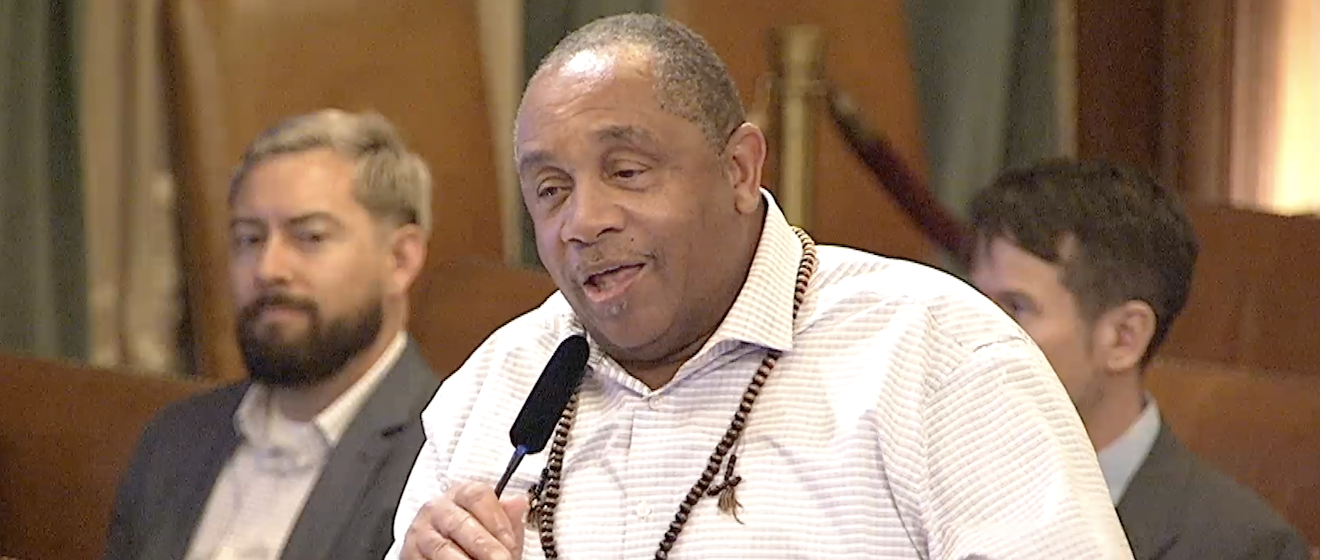
Three public speakers — all with direct ties to Richards' organizing — reinforced the case. Ashley Rhodes, a longtime ABU member, described Richards taking young men and women off the streets and placing them into construction unions and public service jobs with SFPUC, Parks & Rec, and DPW. She called him "the unproclaimed mayor of Bayview, Hunter Point."

Anthony Travis, a liaison for Local 261, testified that he grew up watching Richards in the Bayview and that the street naming would create a lasting legacy for community members who entered the trades because of his work.

Joshua Arce of the Laborers Union, a former city Director of Workforce Development, called Richards his mentor of 15 years and drew a direct line from ABU's organizing to national policy: "Everyone around the country wanted to know how we do local hiring in San Francisco, including at that time, the White House administration moved local hiring to the Build Back Better Infrastructure initiative. That conversation doesn't happen but for San Francisco mandatory local hiring. San Francisco local hiring does not happen without ABU. ABU does not happen without Mr. James Richards."

Vice Chair Chyanne Chen asked to co-sponsor the resolution, calling Richards' legacy important, then moved a technical amendment to correct the spelling from "Richard" to "Richards" in the resolution text.

Decisions: The committee amended the resolution and forwarded it as a committee report, 3-0 (For: Chen, Mahmood, Melgar; Against: none; Absent: none), for the full Board's consideration on March 10, 2026.


Northern California's Only Holocaust Education Center Clears Zoning Hurdle

The basics: The committee approved a special use district at 2245–2255 Post Street to enable the Jewish Family and Children's Services (JFCS) Holocaust Center to build a new 34,000-square-foot purpose-built facility. A special use district provides tailored zoning flexibility — in this case, permitting an educational and cultural institution at a site where standard zoning would not accommodate it.

Why it matters: The JFCS Holocaust Center, founded in 1979, currently reaches approximately 165,000 students, teachers, and community members across California in partnership with the California Department of Education. But the center's existing space can host only about 20% of its programming on-site. There is no other Holocaust museum or education center in Northern California.

Where things stand: Supervisor Bilal Mahmood, representing District 5, presented the ordinance and framed it against a backdrop of rising hate. "At a time when antisemitism and other forms of hate are rising across the country and around the world, institutions like the Holocaust Center play a critical role in education, remembrance and prevention," he said.

Mahmood read non-substantive technical amendments into the record reflecting the Planning Department's CEQA review, including a preliminary mitigated negative declaration published in December 2025 and a final mitigated negative declaration issued in January 2026. Deputy City Attorney Brad Russi confirmed the amendments were non-substantive.

Morgan Schneider, director of the Holocaust Center, provided the most detailed testimony. She described the center's founding as a direct response to a neo-Nazi bookstore that had opened in the Sunset District, and explained the scope of the facility gap: "Currently, we're reaching about 165,000 students, teachers and community members throughout the state of California. We're honored to be working in partnership with the state and with the California Department of Education to have an extremely broad reach. But only about 20% of those programs and those students have their programs within the four walls of the Holocaust Center."

The new facility will include exhibition space, classrooms, a lecture hall, and archival resources for engaging with primary source materials and survivor testimony. "There is no Holocaust museum center or facility of this kind in Northern California," Schneider added. "We will be serving our San Francisco students as well as our communities throughout the greater Bay Area and Northern California."

Planning Department staff Audrey Maloney confirmed the Planning Commission approved the item on Jan. 29, 2026.

Public commenter Gia Danieler Katz, a second-generation Holocaust survivor, president of the San Francisco Jewish Democratic Club, and consultant to JFCS, thanked the supervisors and invited the committee to the April 13 Holocaust Remembrance Day ceremony at the Jewish Community Center.

Vice Chair Chen expressed strong support, connecting the facility to the city's broader cultural infrastructure: "We are stronger as a city when we create time, space and learning to ensure that as we move forward, we carry the lessons of the past and present with us."

Decisions: The committee amended the ordinance with CEQA findings and recommended it as amended to the full Board, 3-0 (For: Chen, Mahmood, Melgar; Against: none; Absent: none).


SF's Last Horse-Drawn Firehouse Heads for Landmark Protection

Why it matters: Engine Company Number 33 at 117 Broad Street in the Ocean View neighborhood was built in 1896 and was the last horse-drawn unit in the San Francisco Fire Department, not converting to motorized apparatus until 1921. The landmark designation would protect it from demolition under state housing streamlining laws that allow ministerial approvals — bypassing the CEQA environmental review that has traditionally shielded historic properties.

Where things stand: Vice Chair Chen, whose District 11 includes Ocean View, presented the resolution initiating Article 10 landmark designation and noted the firehouse's unusual history. Planning Department staff Alex Westoff explained that the property is part of the Family Zoning Plan landmark program, which aims to identify and protect historically significant properties as the city ramps up housing production.

Westoff flagged a significant gap in district surveying: "Currently, there are only 47 Category A properties in District 11, some of which are already Article 10 landmarks, and many of which are in historic districts and have not yet been evaluated for individual eligibility." He noted the program was broadened to residential areas because "historic properties in residential areas are also vulnerable to state housing bills which allow for ministerial projects without taking into account the impacts to historic resources which CEQA has traditionally provided."

The firehouse retains significant architectural features including its denticulated cornice, original lettering, wood siding, carriage doors, and alarm tower. The property owner was notified and had questions answered about the implications of landmarking. No public comment was received.

Decisions: Recommended to the Board of Supervisors, 3-0 (For: Chen, Mahmood, Melgar; Against: none; Absent: none).

What's next: The resolution moves to the full Board for final action. A citywide Cultural Resources Survey will eventually evaluate every property in San Francisco, but the Family Zoning Plan program is working ahead of that timeline to protect the most vulnerable sites in under-surveyed districts like District 11.