Conservation Board Preps for $30M Bond Vote as Tax Worries Mount
Land Conservation Advisory Board • Buncombe CountySeptember 16, 2026
Locunity is an independent informational service and is not an official government page for this commission. All information is sourced from public footage and an analysis of official agendas with the aid of responsible, fact-checked AI. to report an error or omission.
Buncombe County's Land Conservation Advisory Board spent most of its Sept. 16, 2026, meeting on November's ballot, not on board business. Staff briefed members on a $30M open space bond and a $40M housing bond. Members, some active in bond outreach, heard in turn that rising property tax bills are shaping early public opinion.
- $30M open space bond would cost the median homeowner $18 a year. A separate $40M housing bond would cost $25 a year.
- The 2022 bond has funded 30 projects, conserved more than 2,500 acres and leveraged $46.3M in outside money.
- Members report tax-driven skepticism in Swannanoa and in WLOS poll comments.
- The county won't redraw conservation focus maps after Helene, though floodplain projects remain a priority.
- Commissioners approved four Newfound farm easements and a $2M bond match for a state farmland grant.
- FEMA buyout land, hundreds of acres, is "high on the list" for new bond dollars.
Two Bonds, One Ballot: What Voters Will See
Why it matters: The 2022 housing bond is fully allocated, so more general obligation housing money depends on passage. Open space dollars would back the county's conservation and greenway goals.
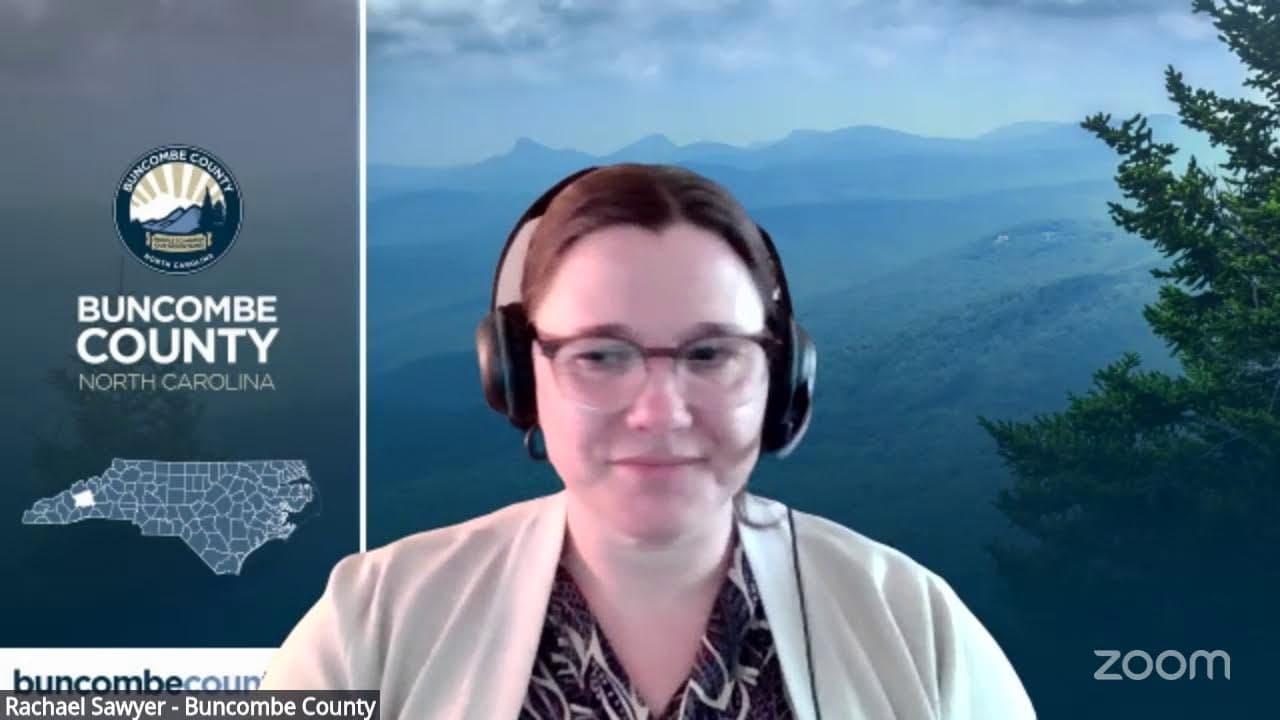
Where things stand: Rachael Sawyer, Strategic Partnerships Director for Buncombe County, walked members through both measures. Each repeats the purpose and amount voters approved in 2022.
"There are 2 bonds that will be on the ballot as separate measures, one for open space and one for housing," said Sawyer.
The $30M open space bond would fund land protection plus parks, trails and greenways. Sawyer tied it to the county strategic plan's 20% conservation goal, its target of 700 acres a year and its greenway mileage goals. She also linked it to the comprehensive plan, the Helene recovery plan and a forthcoming Open Space Master Plan.
A state disclosure rule that did not exist in 2022 now requires the ballot to show total cost, including interest, over the bond's 20-year life. Staff translated that figure into household terms: "The annual cost for a median homeowner would be $18," said Sawyer. The median home in that calculation is valued at $446,500.
The housing bond carries a larger price tag. "This is a $40 million total bond with an estimated cost over its life with interest of $63 million," said Sawyer. That works out to $5.50 per $100,000 of value, or $25 a year for the median homeowner. Staff tied the measure to Helene recovery, noting about 9% of the county's housing stock was damaged or destroyed. The 2022 housing bond supported 969 units across eight projects.
The 2022 scorecard: Voters approved the open space bond in November 2022 with a seven-year spending horizon and a possible three-year extension. Sawyer put allocations at $24.78M after the commissioners' latest approvals, with $2.78M not yet earmarked. Ariel's earlier tally put allocations at a little over $21M, leaving about $2.7M unallocated after $2.4M in projected land trust and Ag Advisory projects. The difference likely reflects different slides and definitions.
Board Member Stag asked for leverage data and was candid about why. "I'm part of the group that's pushing the new bonds, and an important talking point is how much leverage we're getting when we use the money," said Stag.
Sawyer's answer was roughly 2-to-1. "We've spent $22 million and we've leveraged $46 million," said Sawyer. Staff confirmed that figure includes landowner charitable donations, such as bargain sales, along with private gifts and matching grants.
Ariel, Buncombe County staff, said the ratio understates the program's reach, because bond rules require applicants to exhaust other funding first. "There are projects that land trusts are doing and the county is doing that never even see the bond," said Ariel.
What's next: Voters decide in November. Staff pointed residents to buncombenc.gov/bonds, which hosts annual reports and a live project dashboard. A separate appointed committee oversees bond issuance and financial health.
Tax Bills Cloud the Bond Pitch
Why it matters: Property tax reappraisals are shaping early opinion. Volunteer board members, not county staff, are positioned to carry the case into communities.
Where things stand: Stag raised the campaign question directly. "But one question I always ask in election — what's the other side doing?" said Stag.
Sawyer said staff stays in an "information-only lane." "As county staff, we don't take any actions that would be intended to influence any voters' support or opposition to any type of ballot measure," said Sawyer. She pointed to a separate Yes on Bonds campaign and noted commissioners have more political latitude.
The other side: A board member who attends the Swannanoa Grassroots Alliance weekly described the mood in Swannanoa and East Valley. "In Swannanoa, I'll just share that there's a lot of skepticism for this, and particularly around open space versus housing," the board member said. The member linked that doubt to priority maps that omit the area and to higher tax burdens this year. The member also argued that housing benefits the whole community.
Board Chair Nancy Edgerton said comments on a WLOS poll were very negative, driven largely by property taxes after reappraisals. She framed the board's role this way: "This board, we are not political appointees, so we can speak as ourselves as individuals and be knowledgeable about these programs," said Edgerton. She also praised the county dashboard as concise and easy to share.
"Right now people, the thing that hits them in the face is the tax bill for next year," said Stag.
Board Member Lang urged members to "shoot down the middle" and treat conservation as a nonpartisan "team sport." "This isn't a left or right issue. It's everyone," said Lang.
Board Member David flagged a different hazard. He said maps of land targeted for conservation can provoke fears that the county is "trying to get my land."
Decisions and stakeholder impacts: No action was taken. Members signaled a strategy of fact-based community meetings. Stag cited a roughly 75-person gathering at Budgie's Bakery that turned positive after presentations.
What's next: David is organizing a meeting in the northern county. Warren Wilson may host a Swannanoa easement conversation once its own easements close, hopefully in early 2027.
After Helene, Conservation Maps Stay Put
Why it matters: Focus areas determine which projects can tap bond and state grant money. Their absence in flood-hit Swannanoa is feeding local doubt.
Where things stand: A board member asked again whether the county would revisit priority areas after the flood, and whether a November bond approval would lock in current maps. "Are we locked into whatever the conservation areas are mapped as currently?" the board member asked.
Ariel answered after checking with her director and county management. "I'm not sure we will revisit those anytime soon. Not necessarily because — it's definitely not because we don't prioritize protecting land in the floodplain," said Ariel.
The basics: The focus areas come from a lengthy GIS suitability analysis tied to the county's 20% by 2030 goal and the 2022 bond. The analysis weighted factors such as proximity to other protected lands. The areas mainly add a few ranking points for farmland projects. They are mandatory for the state Agricultural Growth Zone (AGZ) grant, however. Because this application is a renewal, the areas must match those used in 2024.
The other side: Flood-zone projects still have paths to funding. LCAB's founding resolution names waterways, stream protection and agricultural lands as priorities. Another participant clarified that location limits bond access, not the county's $750,000 annual allocation. "So a project could still be funded coming from this board if it's not in one of those focus areas. So it doesn't remove funding," the participant said.
What's next: Sawyer said the ballot language is general, so the county can keep refining focus areas and priorities after November.
Commissioners Lock In Farm Easements, $2M Match
Why it matters: The approvals consume nearly half of the county's $750,000 annual conservation budget. They also secure another $2M in state farmland money.
Where things stand: Ariel reported what the Board of Commissioners approved the night before this meeting. "We had 4 conservation easements, all farms within the Newfound area, and they were all approved," said Ariel. Those deals draw on a prior state AGZ grant matched with bond funds. Transaction costs come from the annual county budget.
Commissioners also approved a 1-to-1, $2M open space bond match to renew the AGZ grant for another $2M. The grant funds the county Farmland Preservation Program's easements, but only inside designated conservation focus areas. LCAB's recommended Camp Sequoia project, presented by Michelle, also won approval for transaction costs and a bond-funded easement purchase.
Decisions and stakeholder impacts: Northern Buncombe farm families gain permanent protection, and the state match doubles county dollars for farmland. Stag noted that Upper Harmony sits inside the focus area but has produced no applications, and he called landowner outreach there a local action item.
What's next: "Half remains, or a little over half remains, with the hope that that January grant cycle that LCAB will go through will allocate the rest," said Ariel.
FEMA Buyouts Could Become Public Land
Why it matters: Buyout parcels, many in eastern Buncombe, offer a practical path to trails and visible bond benefits for flood-hit communities.
The basics: The Hazard Mitigation Grant Program (HMGP) is a voluntary FEMA program run through the state. It buys out properties in hazard areas, and the county will take ownership of those parcels.
Where things stand: "HMGP property activation, where there's a lot in the east, is high on the list," said Sawyer, describing possible uses for new bond money. She called the holdings hundreds of acres and a potential "game changer." Many parcels sit along waterways. Some landslide-prone properties are unlikely to become recreation sites, and the county is not ready to publish a full map.
A board member asked, "Will the FEMA properties be identified in the Open Space Master Plan or not?" "It's not including an inventory of parcels of any type that I've seen," Sawyer replied. She said the plan addresses the buyouts conceptually.
What's next: Parks and Recreation expects to release the draft Open Space Master Plan to the public this fall. "I think it'd be great if LCAB provides some input to that," said Stag. Ariel said her department's director and staff have reviewed drafts for months. Sawyer said it is not too late for the board to engage and promised to follow up.
Minor Items
- Soil and Water turns 75: The district, founded in 1951, celebrates Oct. 1 at Weaverville Community Center with barbecue and music.
- Easement celebration returns: A budgeted spring event, hopefully in May, will honor two years of closed deals. The board last held it in 2024.
- Ranking criteria review: Staff will email members a form to comment on LCAB's project evaluation system.
- Procedural: The agenda and the Aug. 19 minutes were approved by voice vote, with no opposition heard. Land trust updates were skipped because no partners attended.
Looking Ahead
The Open Space Master Plan draft goes public this fall, followed by the November bond vote. LCAB's January grant cycle is expected to allocate the rest of this year's $750,000 conservation budget.