
Conservation Board Steers Overhaul of Funding Scorecard Ahead of November Vote
Land Conservation Advisory Board • Buncombe CountyOctober 21, 2026
Locunity is an independent informational service and is not an official government page for this commission. All information is sourced from public footage and an analysis of official agendas with the aid of responsible, fact-checked AI. to report an error or omission.
Buncombe County's Land Conservation Advisory Board spent most of its Oct. 21, 2026, meeting rewriting the scorecard it uses to justify spending county conservation dollars, including bond funds. No vote was taken. Members gave staff informal direction to drop the zero-point score, add tiers for forests and spell out how landowner donations count, with a vote on the revised form expected in November.
- Zero scores on the way out: Members favored a simple low/medium/high scale for the project evaluation form.
- Forests get a middle tier: The board backed three forest options in place of an all-or-nothing 10 points.
- Donations count as leverage: Partial and 100% charitable donations would be named explicitly as funding sources.
- Lake Eden easement closes: More than 300 acres are protected, and SAHC has passed 100,000 acres overall.
- Flood-recovery preserves advance: Projects in Swannanoa and East Asheville are moving forward after Helene.
Scorecard Rewrite: No More Zeros
Why it matters: The LCAP project evaluation form is how the board explains to the public why a project earned county money. Its wording matters more as bond funds flow and competition for dollars may grow.
Where things stand: Staff brought survey feedback asking the board to better define the form's zero-point category. Members argued that projects brought by conservation groups would rarely have zero biological value. An unidentified member suggested scoring more finely than the current 0, 5 and 10 points, but said they did not feel strongly.
Board Member Cameron Farlow pushed the other way.
"I would lean away from getting too granular in the form because we'll have that opportunity to talk and make decisions after the fact," said Board Member Cameron Farlow.
Farlow also suggested replacing "no biological value" with "limited biological value." Board Member Liesl Erb proposed thinking about scores as low, medium and high.
The other side: Vice Chair Lang Hornthal asked what feedback land trusts need when a project is not funded. Jess, a representative of SAHC, and Ariel, a staffer with Buncombe County Ag and Land Resources, said the question has rarely come up: partners pre-screen projects, and the board has funded essentially every project it has seen so far.
"We wouldn't say yes to a project that we don't think has a lot of value," said Jess, SAHC representative.
Jess and Erb still argued that the score is valuable as public transparency, a record showing how the board rated each project it funded.
Decisions and stakeholder impacts: The board reached consensus without a vote. Land trusts would get a simpler form and softer language that better reflects the projects they actually bring forward. Residents and county commissioners would get a scoring record built for public accountability rather than fine-grained ranking.
What's next: "The hope is that at the November meeting you would then vote to adopt the revised evaluation," said Ariel, Buncombe County Ag and Land Resources staff.
Working Forests Push for Middle Ground
Why it matters: The forest criterion decides how working forests, often overlooked next to farmland, are valued in county-funded conservation deals. Under the current form, a project either earns all 10 points or none.
Where things stand: Hornthal called forestry undervalued and welcomed a middle option, with a caveat about judging how landowners manage their land.
"We wouldn't want to penalize or get into ranking," said Vice Chair Lang Hornthal, cautioning against scoring landowner stewardship.
He argued that forest land is valuable even when it is not the focus of a property: "I would argue that if there is adequate forest, that it does have conservation value."
Ariel floated tiers based on whether forest is present and how it is managed. Land trust representatives explained that management plans are uneven across deals. Jess said plans are required when state funding is involved, but not always for donated easements or agricultural present-use-value properties. Tom, a representative of Conserving Carolina, said his group requires plans only when landowners intend to actively manage their forests. He added that the Land and Water Fund will not pay for working forest management.
"Buncombe County's funding of working forest projects is so essential," said Tom, Conserving Carolina representative.
Decisions and stakeholder impacts: Board Chair Nancy Edgerton proposed three tiers: low for no forest, a middle tier for forest present, and the top tier for a management plan plus strong forestland. Hornthal agreed. Erb asked for hard numbers: "As a wildlife biologist, I'd like percentage." Staff agreed to draft three options and to add forest acreage and percentage to applications and presentations. Landowners with working forests stand to gain, and land trusts would carry the new reporting requirements.
What's next: Staff's draft options are expected at the November meeting.
Donations Named as Leverage
Why it matters: The leveraged-funds criterion, worth 15 points, shows the public that county dollars are matched by grants, private money and landowner gifts.
Where things stand: Survey feedback asked for clearer definitions of funding sources, including whether a landowner's charitable donation counts. Ariel said LCAP applicants nearly always include one, especially on bond-funded projects.
"Charitable donation, even if it's not 100%, it counts as one of the two or more sources," said Board Chair Nancy Edgerton. She said 100% donations should be listed as a separate category.
Members questioned whether any project would ever miss the 15 points. "Maybe it's more of a transparency question than a deciding question," said Jess. Erb suggested the criterion may work more like a threshold.
The other side: Tom offered the Land and Water Fund's model as an alternative: "For every 5% the county's not paying for, the landowner would get a point." He noted that approach disadvantages landowners who cannot afford to donate.
Decisions and stakeholder impacts: The board favored keeping partial and 100% donations as separate categories, with a full-credit tier and a lower tier, rather than a finer match-based system. Landowners who donate would see their gifts explicitly credited. Those who cannot donate would avoid being scored down point by point.
Lake Eden Closes, Flood Projects Move
Where things stand: Jess reported that the conservation easement on the Lake Eden Preserve, covering more than 300 acres, has closed, and that SAHC has passed 100,000 acres protected. The next Buncombe County closing is set for December: the Diana Stone Pinnacle Knob Slopes donated easement in Sandy Mush.
Hannah, presenting for a land conservation agency, described three projects:
- Swannanoa Valley Preserve: A 4.5-acre parcel is slated for flood benching funded through the Floodplain Blueprint Program.
- Gateway Park: The project is nearing permitting.
- Azalea Preserve: A 3.5-acre site in East Asheville near the Blue Ridge Parkway.
Tom had no update.
Why it matters: The reports show where county-supported conservation stands after Helene, with flood-recovery work now part of the pipeline.
- Leicester farm project advances: The Ag Advisory Board approved a new Leicester project, which goes to county commissioners Nov. 5.
- Friends of Agriculture breakfast: Scheduled for Nov. 10.
- Celebration dinner delayed: Discussion of the Conservation Celebration Dinner was deferred to November.
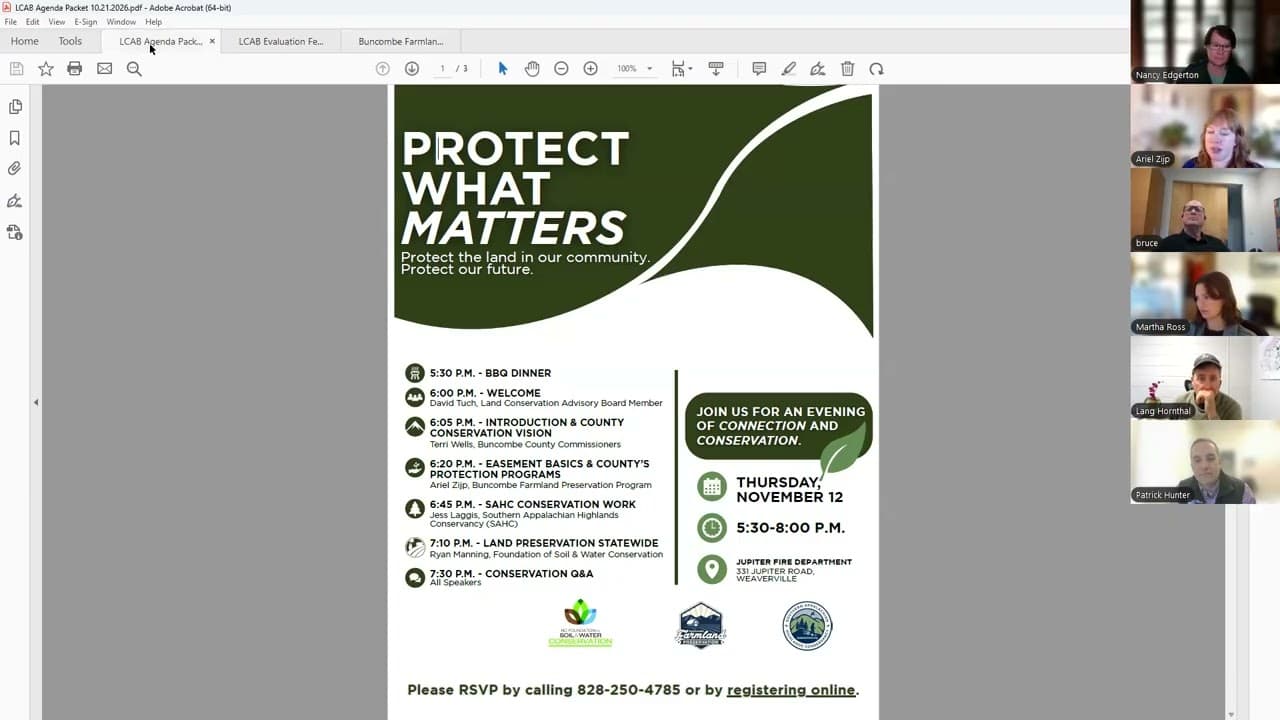
Looking ahead: The November meeting will be the board's last of the year, because it does not meet in December. The agenda is expected to include a vote on the revised evaluation form and the deferred dinner discussion. A Nov. 12 community land conservation event had zero RSVPs as of this meeting, and members and partners offered to circulate the flyer.