
Lafayette Council Shrinks Window Panes, Delaying Housing Design Rules
City Council • LafayetteOctober 13, 2026
Locunity is an independent informational service and is not an official government page for this commission. All information is sourced from public footage and an analysis of official agendas with the aid of responsible, fact-checked AI. to report an error or omission.
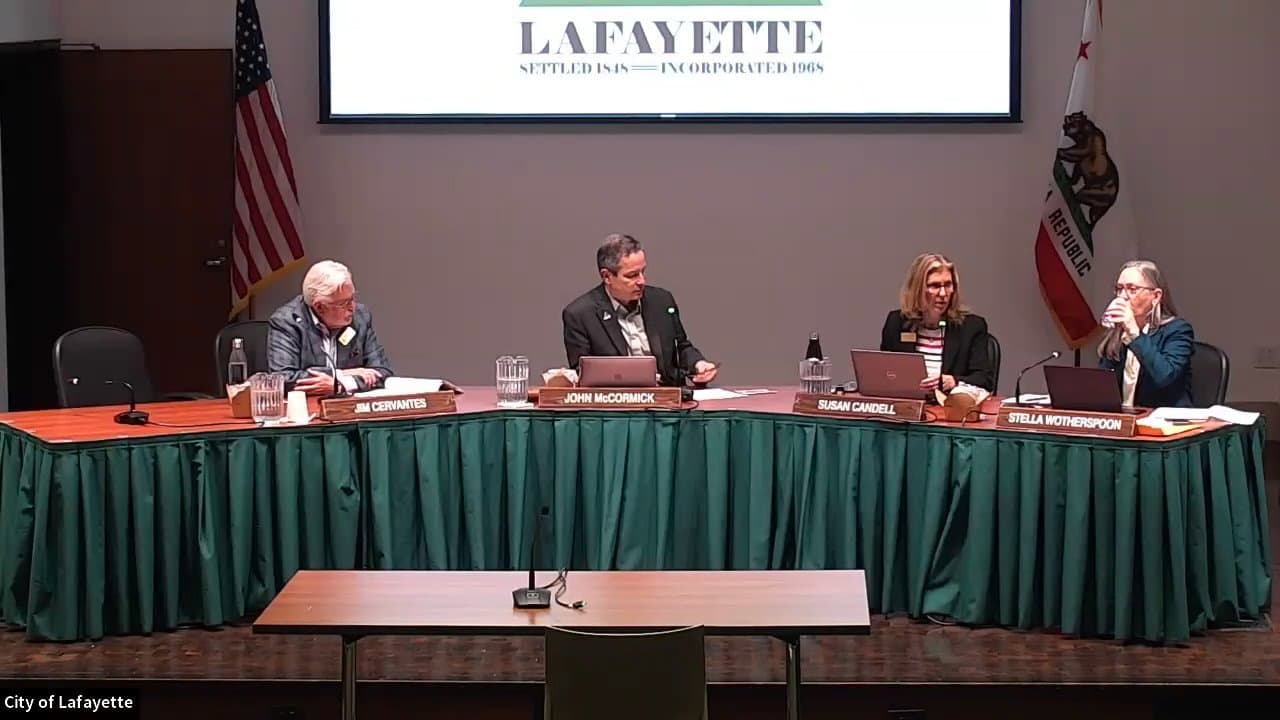
The Lafayette City Council spent its longest debate of the Oct. 13, 2026, meeting on the size of a single pane of glass, and the outcome pushes back final adoption of the city's Phase 2 housing design standards. On a 3-1 vote, the council cut the maximum pane size in Ordinance 703 from 18 to 6 square feet. It also unanimously set Lafayette's priorities for a possible 2028 countywide transportation measure.
Window pane cap cut from 18 to 6 square feet after residents pushed for more traditional-looking buildings. Vote was 3-1.
Ordinance 703 must be reintroduced, so adoption of the Phase 2 objective design standards slips to a later meeting.
Aqueduct Pathway and Pleasant Hill Road corridor study nominated as Lafayette's top regional transportation asks.
Downtown driverless shuttle concept added to the countywide project list as a placeholder.
Small Panes, Big Delay on Design Standards
The basics: Ordinance 703 amends Chapter 6-39 of the Lafayette Municipal Code to add objective design standards, Phase 2 of the city's Housing Element implementation. Objective standards are measurable rules applied to housing projects without discretionary judgment. The item was on the consent calendar, but the council pulled it at the start of the meeting and heard it later as Item 13A.
Why it matters: Pane size is one of the few aesthetic levers the city controls as state-driven density rules bring taller buildings. Tightening it costs time and carries some legal exposure.
Where things stand: Malathy Subramanian, City Attorney, warned the council before the debate began: "If you make any substantive edits as opposed to typographical errors, you would have to reintroduce it tonight, which means you could not adopt it." An ordinance takes effect 30 days after adoption, so any change extends that clock.
Three residents spoke. Rob LaVoy, a public commenter, urged a smaller limit, calling pane size one design element the city can control. He cited a seven-story building near McDonald's and the city's higher-density zoning, and said he was open to acting now or in Phase 2. Elliot Hudson, a public commenter, pushed for 6 square feet now, or about 7. He argued that delay risks construction that can't be undone, that photographs show no comparable building with panes larger than 6 square feet, and that the standard is not a blanket waiver. Libby Henry, a public commenter, joined Hudson's request and criticized state housing laws as eroding local control.
A procedural snag: Hudson raised a point of order. He asked why a person present in the room could cede time to another speaker but a remote participant could not. Subramanian said the policy likely should be updated but hasn't been. Vice Mayor John McCormick ruled that because LaVoy had already spoken, he could not also cede time. Hudson received the standard three minutes. The council signaled it will revisit the rule.
The legal risk: Staff said developers using state density bonus law can request waivers from window standards, and cities have rarely denied those requests. Subramanian flagged the cost of trying: "if you do decide to deny a waiver and we lose in court, we would be required to pay attorney's fees."
The other side: Councilmember Jim Cervantes credited design review and the ordinance's 35% fenestration cap, which limits the share of a facade that can be windows. "I'm fine with the 18-square-foot maximum," he said.
What changed minds: Councilmember Susan Candell pressed on the scope: "we're not limiting the total size of the window at all, right?" The answer was that the limit applies to individual panes, not whole windows. That clarification moved the rest of the council. "I'm actually supportive of a 6-foot as well," said McCormick. Councilmember Stella Wotherspoon said, "I understand the desire to have a more traditional appearance, which panes bring."
Decisions and stakeholder impacts: Wotherspoon moved to amend Section 6-3907 A.1 from 18 to 6 square feet and to change Section B.1 to require "at least one of the following" design options. Candell seconded. The motion passed. For: 3 (Wotherspoon, Candell, McCormick); Against: 1 (Cervantes); Absent: 1 (Mayor Carl Anduri). Residents who want a traditional streetscape gained a concrete win. Developers face a tighter pane rule unless they obtain density bonus waivers. The city takes on some litigation risk if it refuses those waivers.
What's next: The reintroduced ordinance returns on consent at the next meeting. It takes effect 30 days after adoption.
Lafayette Stakes Its Claim Before Measure J Expires
The basics: The Contra Costa Transportation Authority's (CCTA) Countywide Transportation Plan 2050 (CTP2050) is an inventory of about 1,200 projects. "The CTP is not a funding plan," said Patrick Golier, Transportation and Circulation Program Manager. Funding decisions will come through a separate Transportation Expenditure Plan (TEP) for a future countywide measure that would follow Measure J, which expires in 2034. Golier said CCTA is "thinking about a 2028 ballot measure."
Why it matters: Voters approve specific projects, so a project left off the list now may lose eligibility later. "Every single project that we can spend Measure J funds is in that voter guide that we vote on," said Candell.
Where things stand: Staff removed completed projects from Lafayette's list and consolidated overlapping ones. They recommended two candidates for "named project" status, which generally applies to projects over $10M:
Aqueduct Pathway, from Reesa Road to Pleasant Hill Road. Orinda and Moraga have expressed interest. "To me, that's like the holy grail of alternative transit for us," said Cervantes.
Pleasant Hill Road multimodal corridor and SR-24 interchange study, led by CCTA.
Councilmembers asked about deadlines, the scoring rubric and support from partner cities. Staff said now is the time to act.
The shuttle add-on: A late addition not included in the staff report was a conceptual autonomous circulator along Mount Diablo Boulevard. It would link downtown destinations, parking and regional transit, and the listing covers routes, ridership, costs and a possible pilot. McCormick suggested courting vendors for a pilot and coordinating with the chamber's earlier shuttle stops and the Lafayette Park Hotel. Wotherspoon proposed to "put it on the CTP list just to have it there, but then also let our folks at CCTA know that if they have a vendor who's interested in a test scenario, that we're interested." Golier said listing the shuttle does not dilute the two priority projects. Moraga is separately considering a shuttle.
Decisions and stakeholder impacts: Candell's motion approved the project list and the two priorities. It also added the downtown shuttle and named Pleasant Hill as a partner in the corridor study. The motion passed. For: 4; Against: 0; Absent: 1 (Anduri). Cyclists and pedestrians gain a top-tier ask in the pathway. Commuters on Pleasant Hill Road and SR-24 gain a regional study. Neighboring cities become potential allies for funding. No one spoke during public comment.
What's next: Lafayette's list moves into CCTA's process ahead of a possible 2028 measure.
Minor Items
Meeting moved: The Nov. 23 council meeting is rescheduled to Nov. 30. The council approved this on consent along with the Sept. 28 minutes, 4-0.
Library funding: Foundation Executive Director Carol Varney said the group funds more than half of expenses at the library building. It reimburses the city for two full-time staff and pays for 16 extra librarian hours each week.
Proclamation: The council approved a proclamation for Diablo Valley Montessori School's 60th anniversary, requested by Head of School Noah Starr. The school predates the city's incorporation.
BART access survey: The city manager asked residents to weigh in on a survey that will shape recommendations for BART connections.
Council reports: Wotherspoon noted a Lamorinda school bus program is seeking $9M. Cervantes said a ConFire pilot citizen assessment program may come to Lafayette.
Looking Ahead
Ordinance 703 returns on consent at the council's next meeting. Note the Nov. 30 date for the rescheduled late-November session.