
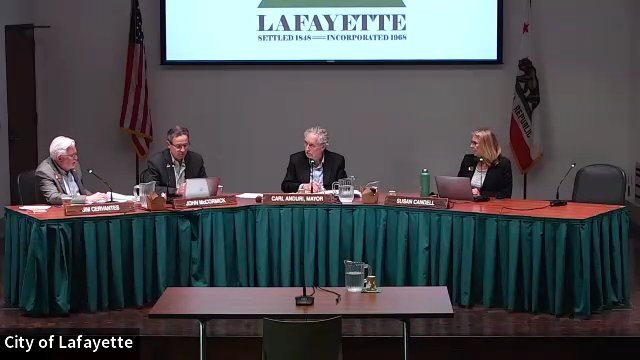
City Council - Jul 13, 2026 - Meeting

City Council - Jul 13, 2026 - Meeting

City CouncilLafayetteJuly 13, 2026

Sources:

Locunity is a independent informational service and is not an official government page for this commission.We use AI-assisted analysis and human editorial review to publish information.

Lafayette Opposes State Housing Bill, Backs Wildfire Reforms, Faces Pathway Fight

The Lafayette City Council took unanimous positions on three state bills Monday night — opposing one that would bypass local housing review and supporting two wildfire-preparedness measures — while a community attorney made a public plea to protect decades-old public access to a disputed pathway before the city finalizes a legal settlement. Residents also pressed the council to plan now for the expiration of Measure H's sales tax revenue and to ensure state transit dollars reach local bus service.

  • Council votes to oppose AB 1751, a state bill that would allow ministerial approval of townhomes on multifamily-zoned sites, warning it could actually reduce housing density
  • Two wildfire bills earn unanimous support: SB 876 closes fire insurance gaps; SB 894 creates a loan program for community hardening
  • Attorney for Save the Dips urges council not to sign settlement that could extinguish public access to a longstanding pathway
  • Resident proposes standing fiscal advisory body to prepare for Measure H's sunset in roughly five years
  • Transit worker asks council to ensure SB 63 funds go to bus operations, not competing priorities at the Contra Costa Transit Authority

Housing Bill Blocked: Council Says Townhome Shortcut Could Backfire

The basics: AB 1751, the Missing Middle Townhome Ownership Act by Assemblymember Quirk-Silva, would create a ministerial (automatic) approval pathway for townhome developments — similar to streamlining already available for large multifamily projects. The bill has passed both the Assembly and Senate unanimously, including votes by local legislators Rebecca Bauer-Kahan and Tim Grayson.

Why it matters: Lafayette's Legislation Committee — Councilmember Susan Candell and Councilmember Jim Cervantes — flagged a counterintuitive risk: on sites already zoned for multifamily housing, developers could use the bill to build lower-density townhomes instead. That creates a "no net loss" problem for cities that have counted on higher-density approvals to meet their state housing element obligations.

Where things stand: Councilmember Cervantes laid out the density concern: "If you've got a site that's zoned for multifamily, theoretically this bill could step in. You could end up with less density as a result, because the townhomes are approved, then the multifamily was already approved, which creates no net loss issues for a community like ours."

Councilmember Candell confirmed the scenario is not hypothetical: "And that did happen to us. It's not a theoretical at this point. And so that was another reason for us for Lafayette to oppose this one."

The other side: Vice Mayor John McCormick acknowledged the bill has bipartisan legislative support but agreed to oppose it — primarily over the ministerial approval bypass of local review. He also questioned whether the bill's density requirements (20–75% of a zone's default density) are workable: "22 units an acre for townhomes is really challenging. It's not going to get that much built. Feel good legislation I'm not really sure is going to accomplish what they think it's going to accomplish."

Decisions: The council voted 4-0 to adopt an oppose position, aligning with the League of California Cities (For: 4, Against: 0, Absent: 1 — Councilmember Stella Wotherspoon excused). The city will send a formal opposition letter to the Legislature, though the bill's unanimous passage in both chambers suggests it faces little resistance in Sacramento.


Wildfire Protection: Two Bills, Two Unanimous Votes

Insurance Gaps After the Flames

Why it matters: Many homeowners in fire-prone communities carry policies that don't cover the cost of rebuilding to updated building codes — leaving them significantly underinsured after a wildfire.

Where things stand: SB 876 by Sen. Padilla is a sweeping fire insurance bill that has passed the Assembly Judiciary and Insurance committees. It addresses post-disaster rebuilding, requires insurers to update actual replacement cost and building code estimates in policies, and grants the insurance commissioner new enforcement authority. Implementation may be delayed to 2028.

Councilmember Candell described the coverage gap: "It also adds provisions to update actual replacement costs and updated building codes estimates, which is kind of a gap for all of us who get insurance. They don't really do that for us."

Councilmember Cervantes emphasized the real-world impact: homeowners think they're covered but aren't, because their policies don't include building code upgrade provisions. Candell suggested elevating the bill to the Lamorinda legislative coalition for a joint letter.

Decisions: The council voted 4-0 to support SB 876 (For: 4, Against: 0, Absent: 1 — Wotherspoon excused).

A Loan Program for the 'Holy Grail'

SB 894 by Sen. Ben Allen would create the California Wildfire Resilience Loan Program — a financing vehicle for residents, businesses, and cities to pay for community hardening improvements such as fire-resistant roofing, defensible space, and vegetation management.

Councilmember Cervantes framed the stakes: "It seems like community hardening is like the holy grail in terms of wildfire preparedness and safety. Senator Allen's bill provides a key missing piece in the financing of that because the cost could be considerable for homeowners."

Vice Mayor McCormick noted the bill doesn't appropriate any money — it creates the framework first: "I guess maybe the way this stuff works is you need the enabling legislation first and then you need the actual funding."

Decisions: The council voted 4-0 to support SB 894 (For: 4, Against: 0, Absent: 1 — Wotherspoon excused).


The Dips: Attorney Asks Council to Protect Public Pathway Before Settling Lawsuit

The basics: The Vesce family purchased a property around 2016–17 that includes a paved pathway — known locally as "the Dips" — that community members have used for decades. The family filed suit in 2020, and the case was amended to include any members of the public with claims to the property. The council went into closed session to discuss the litigation and reported no action afterward.

Why it matters: If the city settles without protective language, the public may lose the ability to assert prescriptive easement or implied dedication rights — legal doctrines that can establish public access based on long, open use of private land. Attorney Dan Muller, representing the community group Save the Dips, says roughly 20 words of additional language in the settlement would resolve the issue.

Where things stand: Speaking before closed session, Muller made the group's position plain: "We're respectfully asking that the council please not agree to any settlement agreement that's proposed by the Vesces or otherwise, unless it reasonably and clearly protects the public's longstanding access rights to the pathway that's known as the Dips."

He said he has submitted proposed language to the city's attorney but was told the Vesce family would need to agree. His deeper concern is structural: "My fear is that the way that the proposal is written now seriously compromises the public's ability to just maintain the status quo."

Councilmember Cervantes, who said he was new to the matter, pressed Muller to clarify whether the public could independently litigate if the city settled out. Muller indicated the settlement appears designed to make independent public litigation difficult.

What's next: The council reported no action from closed session. The settlement remains unresolved, and Save the Dips continues to seek protective language before any agreement is signed.


Resident Pitches Fiscal Advisory Body as Measure H Clock Ticks

Why it matters: Measure H, a half-cent sales tax passed roughly two years ago, was always a temporary fix — designed to last about seven years. Almost every dollar has gone to maintaining existing services, not expanding them. With roughly five years left, Mario DePrisco urged the council to think beyond the next tax measure.

DePrisco proposed expanding the council's two-member finance subcommittee into a standing fiscal advisory body that would bring community members with financial expertise — investors, accountants, business owners — to the table. The body would be advisory, meet under the Brown Act, and cost almost nothing to establish.

He pointed to a local model: "In the recent successful campaign for the parcel tax, I saw firsthand the credibility the school district has earned by having exactly this type of body."

No council action was taken.


School Board Member Draws a Line on Crossing Guard Costs

Rob Sturm, a member of the Lafayette School District governing board speaking in an individual capacity, thanked the council for its recent decision to reclaim operational and financial responsibility for school crossing guards. But he specifically pushed back on comments made at a previous meeting suggesting the school district should "have skin in the game."

"The city is responsible and accountable for the safety of its streets. Those aren't shared responsibilities. They are complementary responsibilities," Sturm said. He drew a pointed analogy: "We don't suggest that the city should contribute towards textbooks, classroom technology or teacher salaries simply because excellent schools benefit our community."

No council action was taken, but the framing could matter if cost-sharing discussions resurface.


Transit Worker Urges Council to Watch SB 63 Dollars

Judy Barriantos, a transit worker with ATU Local 1605 at County Connection, urged the council to advocate for SB 63 — a bill to fund BART and County Connection operations — and to monitor how the Contra Costa Transit Authority allocates the money. She flagged the "Return to Source Fund" and expressed concern that the transit authority has competing priorities that could divert funding away from bus service.


Minor Items

  • Consent calendar approved 4-0, covering June 22 meeting minutes and reassignment of council liaison appointments to commissions and outside organizations.
  • New Senior Planner Scott Watkins was introduced to the council by Assistant City Manager Tracy Robinson. Watkins brings housing policy experience from Concord and private-sector environmental planning credentials.
  • Lamorinda Arts Council president Sue Farmer presented on the organization's 75 years of programming, including Lamorinda Idol (a youth singing competition serving about 100 applicants annually), a gallery with a two-year waitlist, and an upcoming Mixology fundraiser on Oct. 10 at Theater Square.
  • Mayor Carl Anduri recognized four departing commission and committee members, including Lee Thompson with 32 years of service on the Capital Projects Assessment Committee.
  • 250th anniversary celebration: Mayor Anduri recapped a July 2 event honoring the Marquis de Lafayette's role in American independence, featuring the Lafayette Historical Society, the DAR, and local organizations. He suggested making it an annual tradition.
  • City manager's update: The Mount Diablo/Hampton flashing beacon crossing project is out to bid; the 2026 repaving project covering 22 streets is underway in multiple phases; new standardized plaques with QR codes have been installed on all public art commissioned since 2021.
  • E-bike enforcement: Police are strictly enforcing e-bike laws, regularly impounding non-street-legal e-motorcycles, and at least one parent has been cited for their child's violations.
  • Emergency Preparedness Commission is developing programs within budget constraints, with state funding decisions expected in late August.