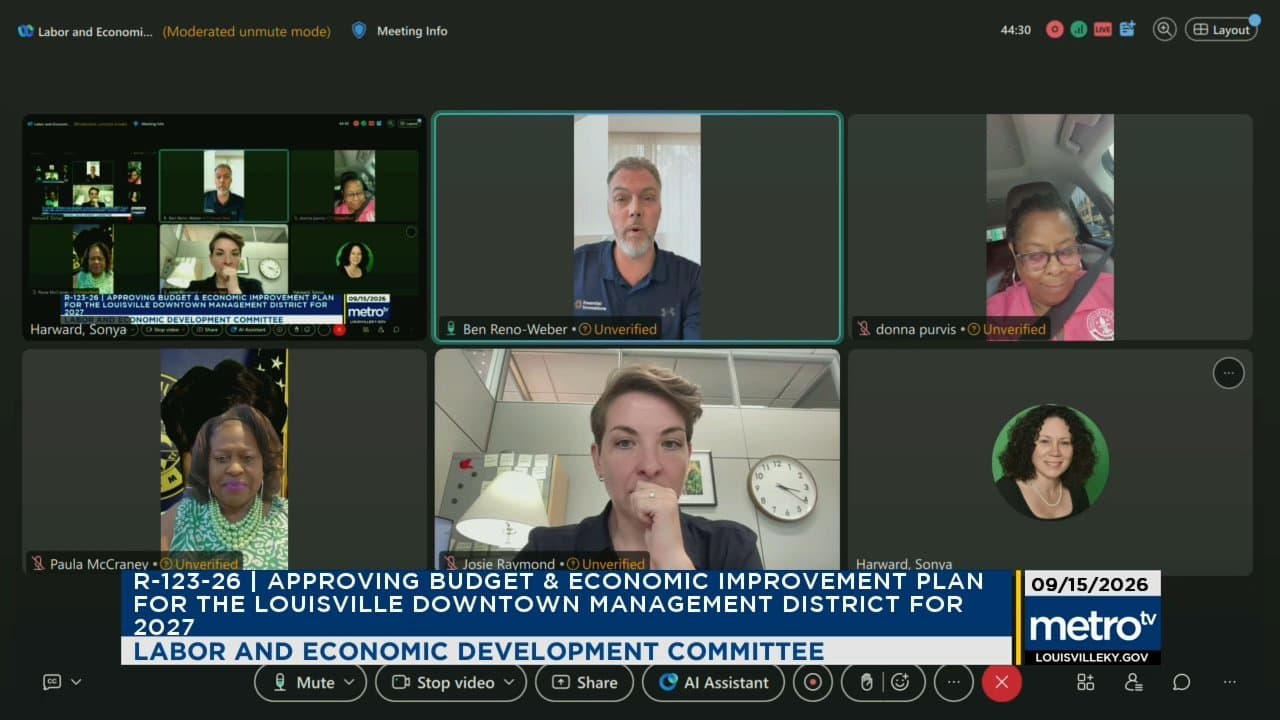
Labor and Economic Development Committee - Sep 15, 2026 - Meeting
Labor and Economic Development Committee • LouisvilleSeptember 15, 2026
Locunity is a independent informational service and is not an official government page for this commission.We use AI-assisted analysis and human editorial review to publish information.
Downtown District Advances $4.5M Plan With Eyes on Doubling Residents
Louisville's Labor and Economic Development Committee cleared five resolutions Tuesday, headlined by the Downtown Management District's ambitious 2027 budget that funds 36 street ambassadors, new placemaking installations, and economic development tools aimed at converting surface parking lots and office buildings into housing. The committee also backed bond financing for 147 senior living units, tax incentives for a fast-growing hemp company, and contracts sustaining addiction treatment and sexual assault forensic programs.
Downtown Management District locks in $4.5M+ budget for ambassadors, string lights over 4th Street, and a new investment fund to convert parking lots and offices into housing
Wesley Manor secures $6.2M in conduit bonds for 147 independent senior living units — Metro bears no debt
Cornbread Hemp wins tax incentives for $1M investment creating 50 jobs; chair abstains over client conflict
$184K sole-source contract renewed for 30-year addiction medicine physician serving 2,241 clients annually
$100K SAFE program coordinator funded for forensic exams across 23 regional hospitals
Downtown's Big Bet: Ambassadors, String Lights, and a Push to Double the Population
Why it matters: Downtown is Louisville's highest tax-revenue-producing neighborhood, and the district's leadership is betting that placemaking, cleaner streets, and aggressive housing conversion can attract 10,000 new residents — the threshold they say is needed to finally land a full-size grocery store.
Where things stand: Rebecca Fleischaker, Executive Director of the Louisville Downtown Partnership and LDMD, presented the 2027 Economic Improvement Plan and a budget exceeding $4.5 million. Assessment income accounts for roughly $1.88 million, with the remainder coming from Louisville Metro, Louisville Tourism, and Humana.
The lion's share — approximately 85% to 87% of the budget — funds the ambassador program, which deploys 36 workers through contractor Block by Block, 365 days a year, from 6 a.m. to midnight, for street-level cleaning, beautification, and community engagement.
"They are on the streets 365 days a year, 6 a.m. to midnight, no matter what the weather, when we can hide inside," said Fleischaker. "They are outside doing something to improve our aesthetic and what downtown looks and feels like."
The ambassador program drew bipartisan praise. Councilmember Jeff Hudson said he wanted to "advocate for the ambassador program. I don't know what you're feeding these people, but Chick-fil-A could learn from you."
Councilmember Ken Herndon (D-4) announced he has replicated the model in his own district: "For the first time this past Saturday, we introduced one of the yellow-shirted community ambassador programs from 7th Street all the way down to 30th on Broadway." He called the LDMD approach a philosophy of paying attention to details: "A fresh coat of paint, a flower pot, a friendly face. All of those things say to someone that somebody's paying attention."
Placemaking and the String Lights
New initiatives for 2027 include power washing sidewalks, upgraded ambassador equipment, continued public art installations — including the Disco Horse and new murals — underpass lighting projects on Jefferson and Liberty streets, an expanded City Spot network of activated public spaces, and, notably, string lights over 4th Street.
"String lighting is one of my favorites, just because twinkly lights across the street is unusual, and this will be the first time that there will be string lights across an open street in our city," Fleischaker said.
The Housing Math
Fleischaker laid out the economic development case bluntly. Downtown currently has about 10,000 residents. Two office-to-residential conversion projects are already underway, producing 120 new units from Class B and C buildings. But the district needs to double its population to attract the amenities residents want.
"We've got about 10,000 residents in the greater downtown area right now. I think we can double that, and that's really where we need to be," she said. "Everyone wants a grocery. We can get a couple small markets. But you're not going to get a big grocery until you've got at least 20,000."
Property Tax Abatement and Surface Lots
A forthcoming downtown investment fund, in partnership with One Louisville using state funding, is part of the strategy. Fleischaker also advocated for a 15-year property tax abatement or rebate program, noting that Kentucky's constitution currently limits local programs to five years — a disadvantage against neighboring states.
"Every surrounding state has a 15-year property tax abatement program. It helps developers pencil out a project," she said. "We need to be as competitive and we don't have it." She added that such a program would have "zero impact on the city budget" because it freezes property values at their current level rather than forgoing existing revenue.
Councilmember JP Leninger pressed on specifics: "What are we doing in tangible terms? I understand that this is a goal that we want to convert surface lots. What are we as a city doing to support that?" Fleischaker pointed to recent state law changes enabling local property valuation adjustments and said parking lot owners are increasingly willing to partner on development, but financial tools remain the missing piece.
Andy Trinen, LDMD Board Chairman, spoke during the public hearing in support of the plan, calling the staff excellent stewards of assessment dollars.
Decisions: The resolution (R-123-26) passed by voice vote with no opposition and moves to the consent calendar.
Wesley Manor Secures $6.2M in Bonds for Senior Housing
The basics: Industrial revenue bonds typically offer tax-exempt financing in exchange for economic development commitments. In this case, Wesley Manor Retirement Community is already tax-exempt as a nonprofit — the bonds simply give it access to lower-cost capital markets. Metro is the issuer but bears no debt obligation.
Where things stand: Jeff O'Brien, Executive Director for Economic Development, presented the conduit bond anticipation notes for 147 independent senior living units at 5012 and 5400 East Manslick Road. There are no PILOT payments and no tax deferrals.
Councilmember Jeff Hudson endorsed the project, noting Wesley Manor fills a gap in services by enabling seniors to age in place. Councilmember Khalil Batshon (R-25) asked staff to explain the pass-through mechanism for public understanding. Laura, a staff advisor, confirmed Metro is the issuer but Wesley Manor pays all debt.
Decisions: Resolution R-114-26 passed by voice vote with no opposition and moves to the consent calendar.
Cornbread Hemp Wins Incentives as Chair Steps Aside
Why it matters: The vote highlights both Louisville's growing hemp industry and the transparency of conflict-of-interest recusals on economic development incentives.
Where things stand: Abby Fletcher of One Louisville presented the incentives request for Cornbread Hemp (Cornbread CBD, PBC), located at 4612 Scruff Avenue in District 10. The company received preliminary approval from the Kentucky Economic Development Finance Authority in February 2025 for a $1 million investment creating 50 jobs at an average hourly wage of $26.56 including benefits. The request was for final approval of the Kentucky Business Investment incentive — a 1% wage assessment.
Councilmember Josie Raymond (D-10), the resolution's sponsor, spoke in support: "It has been on this meteoric rise. It's wildly successful. And what I appreciate about Cornbread is that they're really agile." She noted the company has diversified into candy, canned drinks, and walk-in retail while navigating shifting hemp regulations, and has brought retail to an industrial part of her district.
Chair Ben Reno-Weber (D-8) disclosed a conflict: "Because they are a client of ours in their supportive employment work because they are wonderful, supportive employers, I have to abstain from this vote." His abstention triggered a roll call.
Decisions: Resolution R-116-26 passed 7-0-1 (For: 7, Against: 0, Abstain: 1 — Chair Reno-Weber). The item moves to old business.
Addiction Treatment Contract Renewed for 30-Year Physician
Why it matters: The MORE program is Louisville's only medication-assisted treatment program serving incarcerated and transitioning populations, and the sole-source contract reflects both the physician's irreplaceability and the challenge of succession planning for specialized public health roles.
Where things stand: Danielle Cormel, Community Health Manager for Louisville Public Health and Wellness, presented the sole-source contract renewal for Dr. Mark S. Jorrisch, M.D., at $183,960. Dr. Jorrisch holds American Society of Addiction Medicine certification and has served the MORE program for over 30 years. He has not requested a raise in at least four years.
The program provides medication-assisted treatment at Community Transitional Services, DISMAS Charities, VOA, and Seven Counties facilities. "This past year we provided 2,241 services between DISMAS, CTS, VOA, and Seven Counties," Cormel said. "It was 125 females and 255 males," plus 94 additional follow-up calls.
Chair Reno-Weber offered a pointed endorsement: "I hate sole-source contracts and this is exactly the sort of thing that we should have sole-source contracts for."
Councilmember Batshon asked about succession planning. Cormel confirmed physicians are being trained under Dr. Jorrisch's guidance.
Decisions: Resolution R-117-26 passed by voice vote with no opposition and moves to the consent calendar.
Minor Items
SAFE program coordinator ($100,000): Lt. Andrew Meyer of LMPD's Special Victims Unit presented a noncompetitively negotiated contract with UofL Hospital for a Sexual Assault Forensic Examiner program coordinator. The program serves over 1,000 individuals affected by sexual assault and domestic violence annually across 23 regional hospitals, including UofL, Norton, and Baptist facilities. Examiners also serve the Center for Women and Families and conduct suspect examinations at LMPD offices. Resolution R-121-26 passed by voice vote; moved to old business due to an abstention.
Quorum delay: The meeting start was delayed approximately 15 minutes while remote council members resolved camera and login issues required to establish a quorum under virtual meeting rules. Vice Chair Crystal Bast presided over the opening.