Labor and Economic Development Committee - Aug 18, 2026 - Meeting

Labor and Economic Development Committee - Aug 18, 2026 - Meeting

Labor and Economic Development CommitteeLouisvilleAugust 18, 2026

Sources:

Locunity is a independent informational service and is not an official government page for this commission.We use AI-assisted analysis and human editorial review to publish information.

AFSCME Workers Press Council on Pay Scale Penalty as Committee Advances $1.8M in Contracts

Louisville's Labor and Economic Development Committee heard emotional testimony from zoo, parks, and library workers who say a contract quirk is costing them thousands of dollars a year — then moved swiftly through five resolutions funding everything from child abuse forensics to railroad rehabilitation.

  • AFSCME members say switching job classifications resets their pay to entry level, even after decades of Metro service — a problem a councilmember pegged at just $327,000 to fix

  • $1.18 million state grant application authorized for railroad track rehabilitation at Louisville Riverport

  • $200,000 contract approved for forensic medical exams of physically abused children through Norton Children's

  • $150,000 wastewater surveillance contract renewed with UofL, tracking measles, COVID, and RSV across Jefferson County

  • Engineering firm KPFF locks in tax incentive after $2.77 million downtown expansion and 20 new jobs


The Pay Scale That Punishes Loyalty

Four AFSCME contracts covering the Louisville Zoo, Metro Parks, Corrections, and the Louisville Free Public Library determine employee pay based on "years in classification" rather than "years of Metro service." The result: workers who accept promotions or transfer between departments get knocked back to the bottom of the pay scale, sometimes losing thousands of dollars in annual wages despite decades on the job.

The basics: Most Metro union contracts — Teamsters, Fraternal Order of Police, Firefighters, IBEW, and even AFSCME's own Master contract — advance workers through the wage schedule based on total years of Metro service. The four outlier AFSCME contracts reset the clock when an employee changes classifications, effectively treating a 30-year veteran the same as a new hire in their new role.

Why it matters: The disparity drives experienced employees away from promotions and erodes retention in positions the city already struggles to fill. Cody Jones, AFSCME Council 962 staff representative, told the committee that management dismissed the fix during negotiations, saying it "opens Pandora's box. I mean if you would just look at all of the — the vast majority of Metro's union contracts, the box is open."

Workers Put a Face on the Numbers

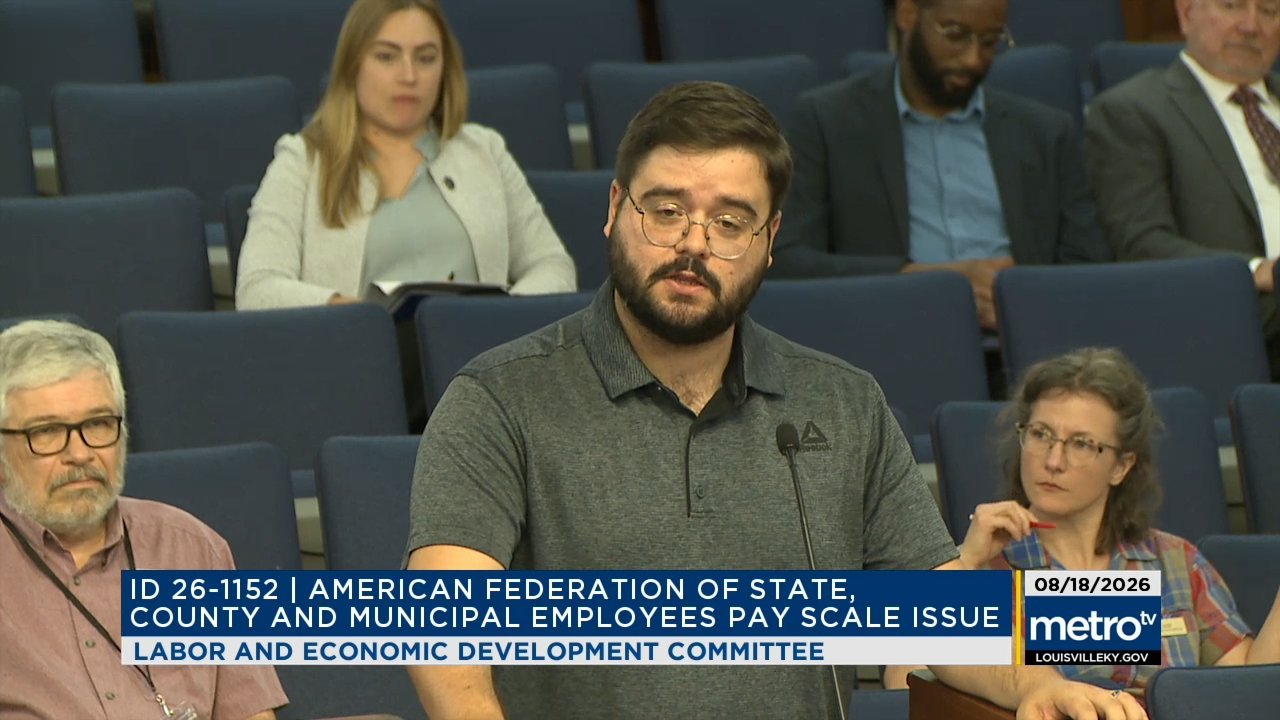
Three AFSCME members testified. Elizabeth Hague, Louisville Free Public Library / AFSCME, read statements from library employees describing stark consequences: "Despite being a longtime Metro employee, I'm only paid as if I have worked here for four years. Aaron, who wrote this, has been here for 17. He's being paid for four." She also highlighted a growing wage gap with Teamsters-covered positions, noting that a Teamsters role will see $12/hour in wage growth from 2021 to 2029 while a comparable AFSCME library position requiring a college degree will see less than a third of that.

Nick Keane, Metro Parks / AFSCME, described working an extra day of overtime every week just to keep pace: "I have to work a whole day extra worth of overtime in a week just to make my paycheck match that of my co-workers with similar seniority."

The most striking testimony came from Dana Pryor, Louisville Zoo / AFSCME, a 30-year employee whose promotion from Keeper 2 to Lead Keeper 3 dropped her from Step 12 to Step 4. An existing memorandum of understanding makes the sting worse: when Pryor is off, temporary coverage workers filling her role are paid at Step 12 rates — $4.38/hour more than she earns. "Someone as a Step 12 of a Keeper 2 wage schedule gets an upgrade to a Step 12 of the Keeper 3 wage schedule for the hours they cover me. When I'm off again, I'm in a Step 4," she said.

A $327,000 Fix in a $1.2 Billion Budget

Councilmember JP Linninger did the math and didn't mince words. Jones estimated the annual cost across parks, zoo, and corrections contracts at roughly $204,000 (library figures are still being calculated). Linninger put the total at approximately $327,000 — a fraction of Louisville's $1.2 billion budget. "We are talking about less than 3/100th of a percent of the total Louisville Metro government budget that we are currently balancing on the backs of workers. I think that's entirely unacceptable," he said. He added that public-sector union employees "give up the right to strike when they form a union to work with our government. I think that means that we have an extra responsibility to these workers."

The other side: Councilmember Jeff Hudson was sympathetic but flagged the limits of legislative power: "What is it you would have us do? This seems like an issue between the union and the executive branch." Jones acknowledged the contracts are negotiated by the administration, not the council.

Councilmember Josie Raymond pushed the conversation toward broader workforce conditions, asking whether any analysis has been done on how many Metro employees qualify for public benefits like SNAP or Section 8 due to low wages. Jones said he was not aware of such a study. Raymond also asked the union to bring concrete proposals the committee could act on.

Councilmember Khalil Batshon, who also chairs the Parks and Sustainability Committee, asked who in the administration the council should pressure. Jones identified Jeffrey Stanfield, the mayor's labor liaison, as the key negotiation contact.

Decisions: No formal action was taken — this was an informational discussion item. But multiple committee members signaled they intend to advocate with the administration for a contract language change.

What's next: AFSCME plans to provide library-specific cost figures to the committee. Council members indicated they will push the mayor's office and Stanfield to agree to a memorandum of understanding changing pay scale language from classification-based to years-of-Metro-service for the four affected contracts.


Riverport Seeks $1.18M State Grant for Railroad Overhaul

The committee unanimously authorized Louisville Metro to apply for a $1,178,295 Kentucky Product Development Initiative grant from KEDFA to rehabilitate railroad infrastructure at the Louisville Riverport.

Why it matters: The Riverport is a key regional logistics hub, and its aging rail loop limits the number of industrial tenants the facility can serve. The grant would fund rehabilitation of two loop railroad tracks on the dry side of the wharf and relocate the mainline track off the double loop to improve freight flow and capacity. The local match of $117,829.50 is already included in the FY27 budget.

Where things stand: Katie Litman, Deputy Director, Louisville Metro Cabinet for Economic Development, explained the state program targets infrastructure improvements at economic development sites to expand or attract tenants. Miguel Zamora, Executive Vice President, Louisville Riverport Authority, provided broader context on the facility's momentum: "The Authority obtained a $700,000 grant from KYTC three years ago and another $750,000 the following year to invest in that crane. We've already made the first investment. The crane is now operating basically as if it were new, a little bit better than new, actually." A separate $1 million federal grant secured through Congressman McGarvey, with $250,000 in authority capital match, is funding a master planning process expected to wrap up in Q1 next year.

Decisions: R-109-26 passed unanimously by voice vote and was sent to the consent calendar.


Minor Items

  • $140,000 Zoo/JCTC internship contract (R-095-26): Renewed funding for a 28-year-old mentor/internship program between the Louisville Zoo and Jefferson Community & Technical College. Zoo Assistant Director Steve Taylor said the partnership has produced zoo employees and that no other institution has approached the zoo to offer a similar program. Passed unanimously.

  • $200,000 LMPD forensic medical services contract (R-103-26): Funds forensic examinations of physically abused and neglected children through Norton Children's Medical Group — the only local entity capable of providing the service. Councilmember Josie Raymond, the resolution's sponsor, clarified that this contract covers child physical abuse investigations, distinct from child advocacy centers handling sex abuse cases. Lt. Andrew Meyer of LMPD's Special Victims Unit was present. Passed unanimously.

  • $150,000 wastewater surveillance contract (R-106-26): Third year of a partnership with the University of Louisville Research Foundation that tests wastewater across Jefferson County for communicable diseases including measles, Ebola, West Nile virus, RSV, COVID, and flu, with 48-hour turnaround. Director Connie Mendel, Louisville Metro Public Health and Wellness, said UofL is the only local entity equipped for the work: "They are the only entity in this area and region equipped, qualified and able to do the work with their collaboration and partnership with MSD." Passed unanimously.

  • KPFF Inc. KBI tax incentive (R-107-26): Final approval for a state tax incentive (1% wage assessment) for KPFF, a civil and structural engineering firm headquartered at 500 W. Jefferson St. in District 4. The company invested $2,770,500 and created 20 jobs averaging $54.76/hour. Ron Burst of 1Louisville presented. Passed unanimously.