Labor and Economic Development Committee - Jul 21, 2026 - Meeting
Labor and Economic Development Committee • LouisvilleJuly 21, 2026
Locunity is a independent informational service and is not an official government page for this commission.We use AI-assisted analysis and human editorial review to publish information.
$74M Boutique Hotel TIF Advances as NAMI Spotlights Louisville's Mental Health Gap
Louisville's Labor and Economic Development Committee moved forward on two economic development incentives representing more than $127 million in private investment, then heard an emotional presentation from NAMI Louisville that laid bare the gap between clinical mental health care and the peer support families desperately need.
- $3.76M tax incentive clears committee for $74M conversion of two vacant historic downtown buildings into a 150-room Canopy by Hilton
- Bigelow Tea wins final approval on state incentive after completing $53M expansion and adding 31 jobs in District 11
- NAMI Louisville asks council members for visibility, not money, as it reaches 10,000 people a year through free peer-led programs
- Board vice chair shares son's suicide story, urging council to close the awareness gap between crisis and community support
- Metro accepts $25,000 federal grant to pilot blended financial counseling and housing stabilization services
Vacant Downtown Landmarks to Become Boutique Hotel Under $3.76M TIF
Two historic buildings at 300 and 310 West Liberty Street — the first U.S. Customs House west of the Allegheny Mountains (built 1853) and a later warehousing facility (1907) — have sat fully vacant since 2017, generating roughly $25,000 a year in local property taxes. The committee voted 6–1 to approve a 20-year tax increment financing district that would reimburse up to $3,758,524 to the developer, Landmark Landlord LLC, tied to the Louisville-based Timbawala Group, as it invests $74 million to convert the properties into a 150-room Canopy by Hilton boutique hotel with restaurant, bar, cafe and meeting space.
The basics: A TIF captures the growth in property tax revenue that a project creates and redirects a portion back to the developer. In this case, the TIF is local only — Metro and Urban Services District taxes — and excludes school district taxes by state statute. It is reimbursement-based and performance-based, meaning the developer gets paid only after the investment produces results.
Why it matters: The buildings sit near Louisville's convention center, surrounded by major hotel development including the JW Marriott and Omni. Activating them fills a visible gap in the downtown streetscape and shifts a near-zero tax asset into a significant revenue generator.
Where things stand: Katie Litman, Deputy Director of the Cabinet for Economic Development, told the committee the project will require significant remediation, including lead paint and asbestos removal. She emphasized the fiscal math: "This will result in Louisville Metro earning over $1.5 million compared to the just $610,000 that we would otherwise receive if this property continues to sit dormant and without conversion." Over 20 years, projected property tax generation exceeds $5.3 million. Metro retains 20% of the new increment plus all base revenues throughout.
Councilmember Ken Herndon, in whose District 4 the buildings sit, offered strong support: "This is the dictionary definition of a missing tooth that we talk about a lot. It's a stunningly beautiful building, one of my very personal favorite buildings architecturally in downtown."
Decisions: The ordinance passed 6–1 on a roll call vote. Individual member votes were not read aloud. The measure moves to the full Metro Council.
NAMI Louisville Asks Council: Just Tell People We Exist
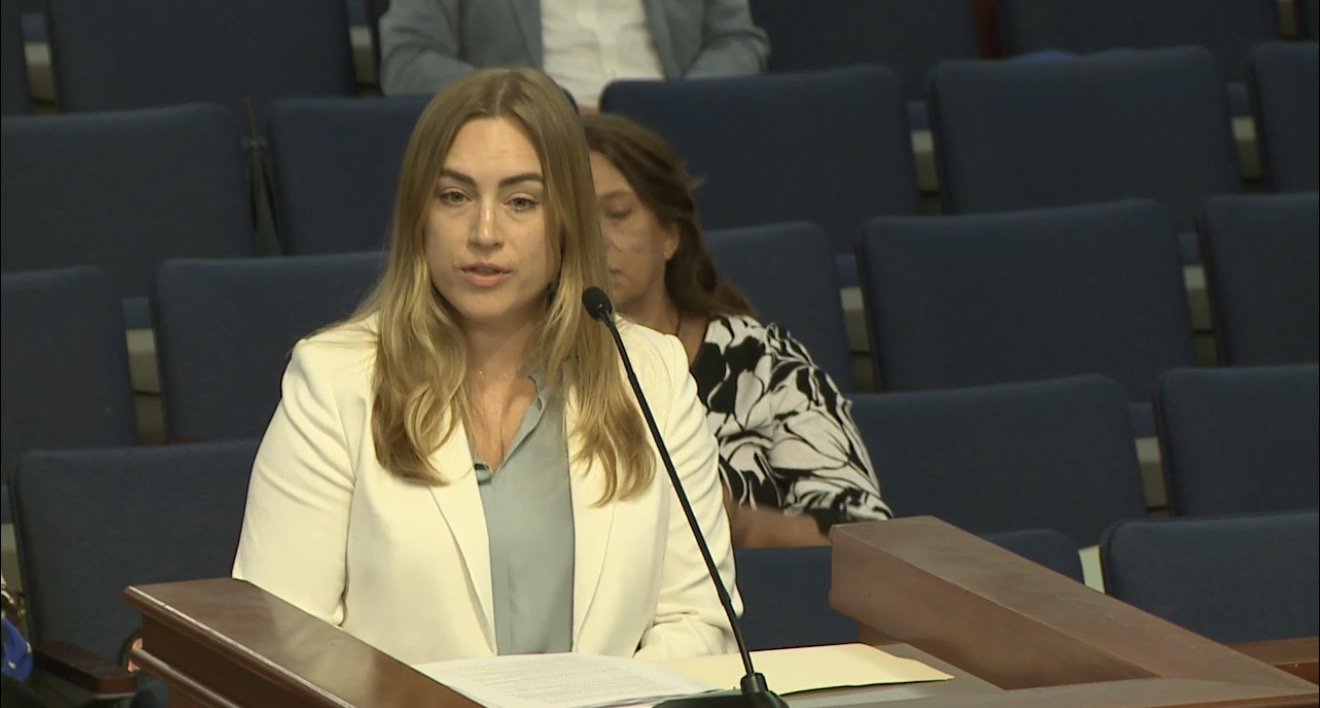
The committee's longest discussion — spanning roughly 30 minutes — was not a vote but a presentation that left multiple council members visibly moved. Nancy Brooks, Executive Director of NAMI Louisville, and Mary Dosset, Board Vice Chair, asked for something deceptively simple: awareness.
The basics: NAMI Louisville is an independent 501(c)(3) affiliated with the National Alliance on Mental Illness. Every service it offers — support groups, education classes, workplace training, mobile outreach — is free and led by people with lived experience of mental illness.
Why it matters: Brooks told the committee her organization reaches more than 10,000 people a year, maintains 45 workplace partners, hosts 1,000 monthly support group attendees, and has delivered more than 100 presentations. Yet families in crisis routinely don't know NAMI exists. The organization originated crisis intervention training at LMPD and works with the detention center, but its primary gap is visibility at the neighborhood level.
Where things stand: Brooks outlined several key programs. The NAMI Wellness Wheels — a mobile unit operated in partnership with Kosair for Kids and JCPS — brings stigma-reducing activities and resilience-building tools directly to schools and community events. Stigma-Free Workplace Training helps businesses build cultures of care. Family support programs help navigate the mental health system, including HIPAA barriers when a loved one is hospitalized.
Her core ask was direct: "At this point, I'd really like more visibility, more awareness. Bringing us out to your communities, connecting us with partners, business partners, or community leaders will really help to deliver that message."
A Mother's Story
Dosset then shared the story of her son Alex, a gifted artist who suffered from anxiety, depression and ADHD, and ultimately died by suicide. Her testimony centered on what was missing — not clinical care, but connection.
"No one ever told us about NAMI. No one told us there was a community of people who understood because they had lived it themselves. No one had told us there were families who could have helped us carry the fear, the uncertainty and the isolation."
She was careful to position NAMI's role precisely: "NAMI does not replace psychiatrists, therapists or hospitals. It complements them. It fills the space between appointments, the evenings when fear creeps in, the moments when families don't know where to turn, and the loneliness that mental illness so often creates."
Council Members Respond
Councilmember Ken Herndon disclosed his own experience with clinical depression and therapy: "I am a proud product of therapy, many years of it. I, at one point during my work, was diagnosed as clinically depressed." He urged young men not to see asking for help as weakness.
Councilmember McCraney asked about bringing NAMI to neighborhood meetings and described a recent six-hour mental health crisis in her district. Both NAMI representatives offered to bring Wellness Wheels, training and tailored discussions to any council district.
What's next: No formal action was required. The presentation was informational, but multiple council members expressed interest in connecting NAMI with their districts, which could significantly expand the organization's community reach.
Bigelow Tea Incentive Finalized After $53M Expansion
The committee unanimously approved the final Kentucky Business Investment incentive for RC Bigelow Inc. — better known as Bigelow Tea — which operates a manufacturing and packaging facility at 2401 Constant Comment Place in District 11.
Hayden Candle, Senior Director of Market Development at One Louisville, told the committee the company received preliminary state approval in August 2021 for incentives tied to a $53 million investment and 31 new jobs, adding to 126 existing employees at an average hourly wage of $21.65. Having completed the expansion, the company now seeks final approval. The local incentive is a 1% wage assessment from Louisville Metro, with compliance monitored by the Kentucky Cabinet for Economic Development.
Councilmember Kramer, representing District 11, praised the company's decision to stay: "They looked around at places that they could go and they decided that they really liked what was going on here in Louisville. They decided they wanted to expand in the spot where they were."
Chair Ben Reno Weber connected the approval to a broader metric: "This is exactly the sort of thing that we should be measuring. Growth of local companies, in addition to our ability to attract — having good corporate citizens here that are continuing to expand is something that we need to prioritize."
Decisions: Passed unanimously by voice vote. The resolution moves to the consent calendar.
Minor Items
- $25,000 National League of Cities grant accepted for a pilot at South Central Neighborhood Place blending financial counseling into housing stabilization case management. Josh Putnam, Co-Director of the Office of Social Services, said the grant will also fund a four-year retrospective data analysis to identify which combinations of financial and housing services are most effective. Passed unanimously by voice vote; moves to consent calendar.