
Regional Leaders Press for a Plan to Close $100B Sea Level Rise Gap
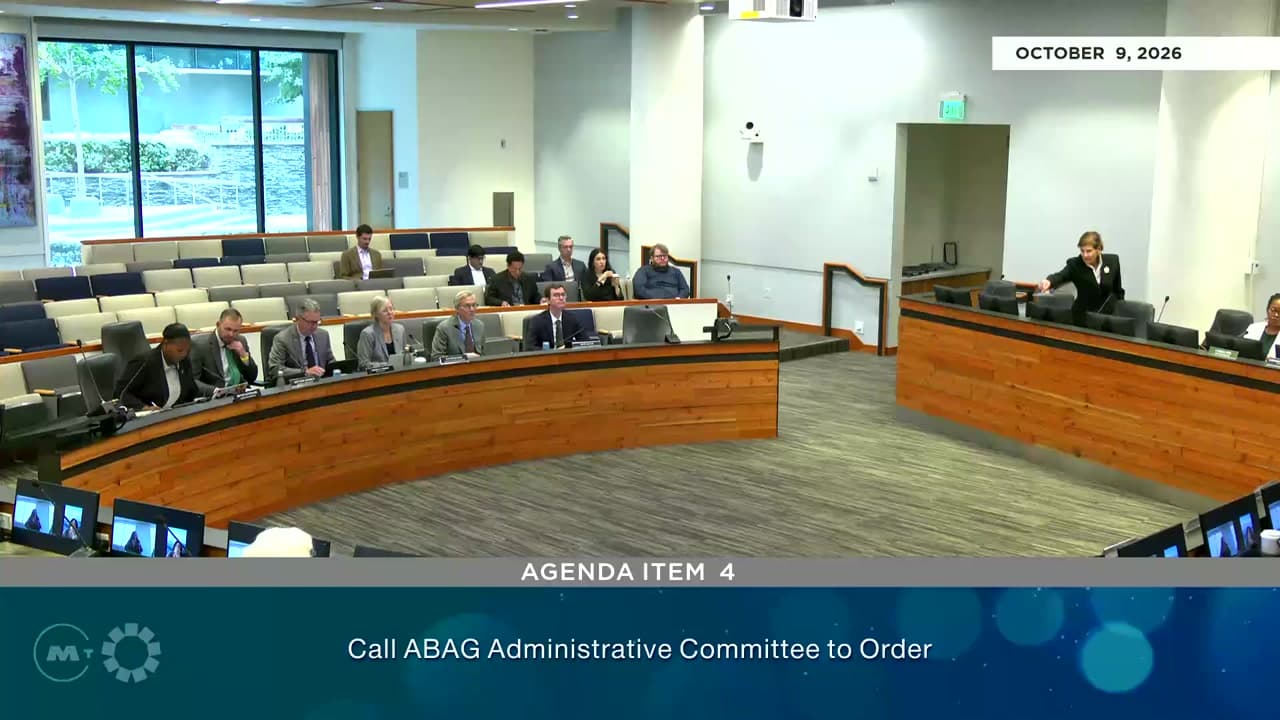
Joint MTC Planning Committee / ABAG Administrative Committee • Metropolitan Transportation CommissionOctober 9, 2026
Locunity is an independent informational service and is not an official government page for this commission. All information is sourced from public footage and an analysis of official agendas with the aid of responsible, fact-checked AI. to report an error or omission.
The Bay Area needs roughly $100 billion to adapt to rising seas through 2050 and has about $6 billion in sight, and there is still no regional strategy to close that gap. A new project-tracking dashboard put that gap in front of the joint MTC Planning Committee and ABAG Administrative Committee on Oct. 9, 2026. Commissioners also opened the four-year Plan Bay Area 2060 process under a newly signed state law, and several warned that regional planning is outrunning actual construction.
- Sea level rise funding gap: About $6 billion in anticipated revenue against nearly $100 billion in need; members demanded an investment strategy timeline
- New Bay Adapt Navigator draws scrutiny over self-reported data and missing flood-risk modeling
- Plan Bay Area 2060 launches: four phases, with adoption expected in early 2030 under new SB 1087 rules
- Housing lag: Members say construction hasn't kept pace with past regional plans and want a look back
- AI data centers enter the regional planning conversation after three local moratoriums
Sea Level Rise: Big Need, No Regional Strategy
Why it matters: Under SB 272, shoreline jurisdictions must submit adaptation plans to the San Francisco Bay Conservation and Development Commission (BCDC) by 2034. Paying to build those projects is another matter. Without a regional strategy, under-resourced communities may be left to fund adaptation on their own.
The basics: The Bay Adapt Project and Funding Navigator launched two weeks before the meeting. It is a living dashboard that tracks adaptation projects, costs and funding sources, built by MTC-ABAG and BCDC from existing EcoAtlas and SAP MAP data.
Where things stand: MTC Planning Committee Chair Eddie Ahn opened with the stakes: "We have a third of the coastline of California, yet we'll sustain a full two-thirds of the economic damage of the state because of sea level rise."
Kate Lyons, resilience and environmental planner, MTC-ABAG, traced the tool to Plan Bay Area 2050's Strategy EN1, the 2023 investment framework and the 2024 interagency MOU. "Somewhere around $100 billion will be needed to adapt the Bay Area to sea level rise through 2050. The estimated cost of inaction exceeds $230 billion over the same period," she said.
Cory Copeland, Adapting to Rising Tides Data and Science Manager, BCDC, said an 18-organization steering committee shaped the tool, and 37 users tested it across nine sessions. "We're not asking for new data inputs from any local governments," he said.
The other side: Commissioner Alicia John-Baptiste pushed hardest. "I'm a little worried about the lack of an actual investment strategy for sea level rise," she said. Staff answered that scoping with BCDC is in next year's work plan: "We only have about $6 billion of anticipated revenues at the moment for sea level rise and nearly $100 billion need."
Commissioner Marilyn Ezzy Ashcraft described a local example. An Oakland-Alameda consortium won $55 million in FEMA BRIC funding, which was later clawed back, and Alameda now has a $300 million infrastructure bond on the ballot. Member Carroll Fife described flooding near the Bay Bridge toll plaza. She also asked why a slide cited $100 billion while a video cited $90 billion. Lyons said estimates shift with new data and that the tool "doesn't escalate based on the inflation for the year of the project being built."
Data gaps: MTC Planning Vice Chair Pat Burt asked whether the modeling captures combined riverine flooding and storm surge. "We don't have really wonderful combined risk models in our region right now," Copeland said. Commissioner Noelia Corzo counted "only 5 in-progress projects for all of the County of San Mateo." Member Pat Eklund questioned relying on local self-reporting. Staff said a GIS expert and the dataset administrators review the submissions.
Decisions and stakeholder impacts: This was an information item, and no vote was taken. Committee member Moulton-Peters proposed a commissioner working group to help shape funding decisions. Ahn pointed to the sea level rise MOU update as a vehicle for sharing information. ABAG Administrative Committee Chair Susan Adams urged progress despite underfunding: "It's a today problem. It's a this weekend problem."
What's next: A Navigator webinar is set for Tuesday, Oct. 13, and annual SAP MAP updates are underway.
Plan Bay Area 2060 Starts Its Four-Year Run
Why it matters: Plan Bay Area 2060 will guide regional transportation, housing, land use and environmental policy. It is among the first regional plans developed under SB 1087.
Where things stand: Planning Director Dave Vaughn called the item the first step in a cycle that will produce the fifth iteration of the long-range plan. He celebrated SB 1087 as "planning modernization, nearly 2 decades in the making," signed by the governor the prior week. Plan Bay Area 2050+, adopted in March 2026, remains the guiding plan in the meantime.
Michael Meehan, Plan Bay Area 2060 project manager, laid out four phases: foundations, outlook, blueprint and final plan. More than 50 stakeholder meetings informed the scope. Public engagement will emphasize depth over breadth, including gamification and a new collaborative of community-based organizations. Meehan flagged three pressures on the timeline:
- SB 1087 greenhouse gas targets for 2035 and 2045, expected by December 2028, plus new CARB guidelines
- AB 2296's accelerated RHNA Cycle 7 schedule (the state's Regional Housing Needs Allocation)
- Uncertainty over federal funding
The other side: Members questioned whether the plans match reality. "We can't continue at this pace of planning when actual construction has not kept pace with that plan," said Member Pat Eklund. Commissioner Candace Andersen and Member Maureen Toms asked for retrospectives on past plans. "We really need to look at what has been accomplished, what has changed," Andersen said. Committee member Nowak urged broader scenarios and a stronger focus on economic development.
Chirag Rabari, Assistant Director of Major Plans, said an annual implementation report already exists but acknowledged it has been hard to access. An improved first report on Plan Bay Area 2050+ is due early next year. Moulton-Peters asked how laws passed mid-cycle get incorporated. Vaughn said existing laws go into baseline assumptions, and annual scans will catch new ones before the 2028-2029 blueprint analysis.
AI data centers: Member Carroll Fife noted that "there have been 3 moratoriums passed in the San Francisco Bay Area around the expansion of AI data centers," and asked whether the region is moving too slowly. Vaughn noted that on land use, "all power on that is at the local level." He said AI will be addressed early in 2027 through the growth forecast and land use framework.
Decisions and stakeholder impacts: No vote was taken. Cities and counties hold land use power, so the plan's housing goals depend on local follow-through. That gap is exactly what Eklund and Andersen flagged. Community groups gain a defined channel for input through the new collaborative.
What's next: Staff will hold a workshop on regional conditions in October. Guiding principles return for adoption in late winter or early spring 2027.
- ABAG consent calendar approved 8-0: The package includes a $4,902,578 BACWA contract for the Clean Water Together grant, with up to $800,000 to the Regents of the University of California. It also amends the sole-source Keyes & Fox contract for BayREN and 3C-REN legal support. (For: Adams, Williams, Carlson, Young, Eklund, Fife, Toms, Ramos; Against: 0; Absent: Romero)
- MTC Planning Committee approves September minutes 6-0: (For: Ahn, Burt, Andersen, Corzo, Ezzy Ashcraft, John-Baptiste; Against: 0; Absent: Mahan, Mashburn)
- Sea level rise MOU report: The annual interagency flooding progress report was received without discussion.
- Per diem: The clerk announced a $150 per diem for ABAG Administrative Committee members.
Looking ahead: Both committees next meet Friday, Nov. 13, 2026, at 9:40 a.m. at 375 Beale Street, San Francisco.