
SB 1087 Awaits Newsom as Bay Area Eyes Eight-Year Planning Cycle
Joint MTC ABAG Legislation Committee • Metropolitan Transportation CommissionSeptember 11, 2026
Locunity is an independent informational service and is not an official government page for this commission. All information is sourced from public footage and an analysis of official agendas with the aid of responsible, fact-checked AI. to report an error or omission.
The Bay Area's regional planning machinery could change in the next three weeks. SB 1087 (Cabaldon), co-sponsored by MTC and ABAG, now sits on the governor's desk with a Sept. 30 deadline. Staff told the Joint MTC ABAG Legislation Committee on Sept. 11, 2026, that the bill would move Plan Bay Area from a four-year to an eight-year cycle and put the state's climate regulators on the clock. The committee also sent a revised public participation plan to the Commission. Briefings on the state budget and federal reauthorization showed transit funding on shaky ground at both levels.
- SB 1087 awaits the governor's signature, promising an 8-year planning cycle; the building industry remains opposed
- Public Participation Plan advances 11-0 to the Commission as ABAG members press for a bigger role
- About $75M a year in transit and $650M a year in highway funds are at risk as federal stimulus expires
- State budget gives $6.75M to BAHFA, less than half the $15M request, and adds no new transit operating money
SB 1087: A "Solid Double" on the Governor's Desk
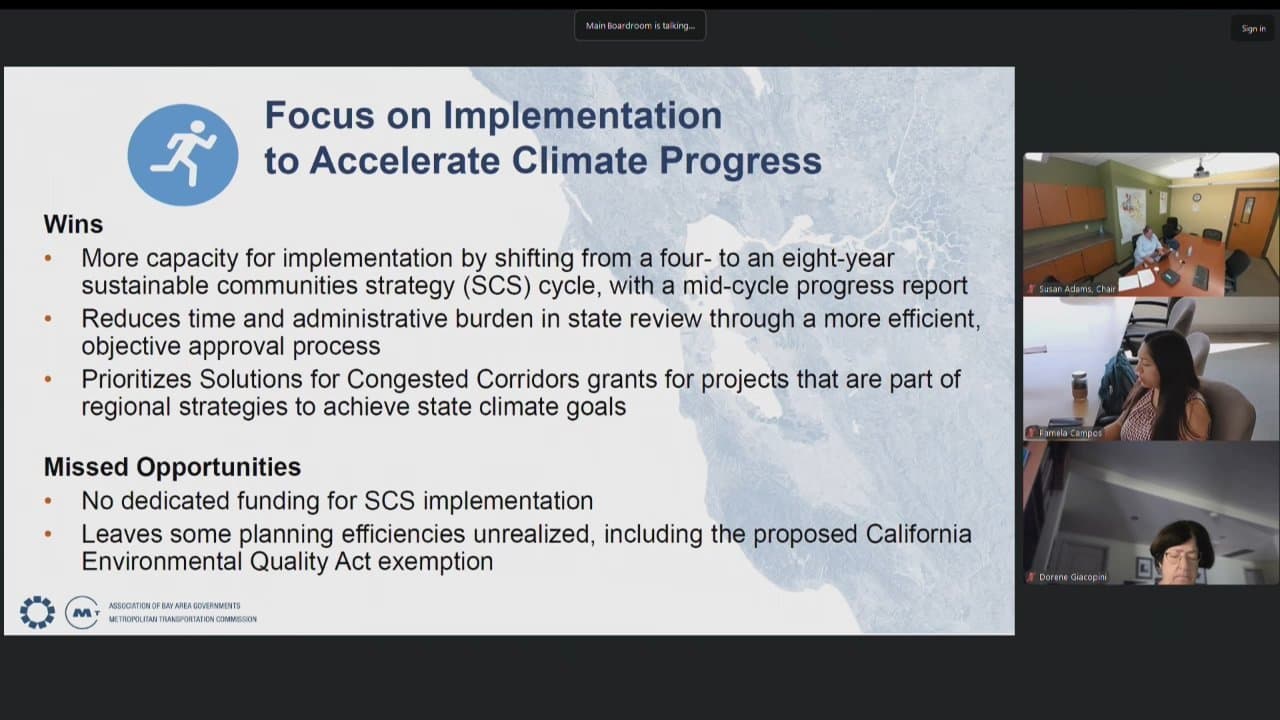
Why it matters: If the governor signs SB 1087 by Sept. 30, regional planners would update Plan Bay Area half as often. That would free staff time for implementation. The bill would also require the California Air Resources Board (CARB) to weigh housing and resilience when it sets greenhouse gas targets.
The basics: Under SB 375, the 2008 state law, each region must produce a Sustainable Communities Strategy. The strategy shows how land use and transportation will meet the greenhouse gas targets CARB sets. Plan Bay Area is the region's version.
Where things stand: Staff said the bill took seven months and more than 100 amendments to reach the governor, and it has support from more than 80 organizations. MTC-ABAG staff member Julie Snyder called one change a major win: "the shift from a 4-year to an 8-year cycle with a progress report of sorts at mid-cycle."
The bill also includes these changes:
- Regional plans are deemed approved if CARB misses its review deadlines.
- CARB must consider fair housing, affordability and resilience when it sets targets.
- CARB must use a more transparent process to set targets.
- The bill adds a 2045 target.
What was traded away: Several early goals did not survive negotiations:
- A California Environmental Quality Act (CEQA) exemption
- Dedicated funding for implementation
- Moving planning guidelines to the California Transportation Commission
- Caltrans consistency requirements
"SB 1087 may not be a home run, but it's a solid double," staff told the committee.
The other side: "The California Building Industry Association continues to oppose the bill," Snyder said. "Their primary stated objection is that the CARB guidelines and the targets won't go through the Administrative Procedures Act, the regulatory system." The Administrative Procedures Act is the state's formal rulemaking process. Staff said the governor's office rejected the change the industry wanted.
Risks remain even if the bill is signed. Staff flagged three:
- CARB could find workarounds on credit for electrification.
- The 2045 targets could prove ambitious.
- CARB faces a December 2028 deadline.
Members asked what happens if the governor does not sign. Staff said the existing SB 375 framework would stay in place, with new CARB targets expected around 2027 and the four-year cycle unchanged. Committee Member Burt said tension with CARB appears to center on vehicle miles traveled (VMT), a measure of how much people drive.
Decisions and stakeholder impacts: This was an informational item, and the committee took no vote. Committee Member Nowak welcomed the bill's shift toward implementation: "We spend so much time planning and not enough implementation." The outcome affects several groups:
- Regional agencies and city planners would get fewer update cycles.
- Housing advocates gain a required fair-housing consideration in CARB's target-setting.
- The building industry lost its push to subject CARB guidelines to formal rulemaking.
- Environmental interests keep enforceable targets, now extended to 2045.
What's next: The governor must act by Sept. 30. Staff said MTC's lobbyists are gathering whatever information they can on the bill's prospects.
Participation Plan Advances, but ABAG Wants a Seat
Why it matters: MTC Resolution No. 4795 sets how MTC engages the public on Plan Bay Area and the Transportation Improvement Program. The debate around it exposed a familiar strain in the MTC-ABAG partnership.
Where things stand: The draft plan was released June 8 for a 45-day comment period. "Together, these activities engaged more than 1,300 participants," said Leslie Lara-Enríquez of the Legislation and Public Affairs team. Outreach included focus groups and a multilingual survey.
The revised plan adds:
- Stronger reporting on how public input shaped decisions
- New techniques for reaching people with disabilities, older adults and youth
- An emphasis on trusted community spaces
- Earlier collaboration with local governments and elected officials
- A framework for evaluating the plan
The other side: Committee Member Eklund objected that the plan will not go to the ABAG board: "I feel as though we're not an equal partner." Lara-Enríquez responded that SB 375 put "the onus to approve the public participation plan for the plan … on MTC and not both agencies." Matt Maloney, Deputy Executive Director, Metro Planning and Policy, offered a compromise: "We are planning to go to the full ABAG executive board in November with an update on Plan Bay Area 2060."
Other members pushed for broader outreach. Their suggestions included involving local elected officials earlier, reaching city planning staff, paying community-based organizations as partners and reaching low-income renters. Committee Member Romero praised the plan's language commitments: "We're actually agreeing to do workshops in all Cantonese or all Mandarin and all Spanish." Committee Member Corzo backed outreach that ensures "we hear voices that are not always heard."
Decisions and stakeholder impacts: Committee Member Essie Ashcraft moved to refer the resolution to the Commission, and Corzo seconded. The motion passed unanimously among members present (For: 11, Against: 0, Absent: 5, Carlson, Young, Mahan, Mashburn and Ramos). Community groups and non-English speakers gain more formal commitments. ABAG's role on the plan stays advisory.
What's next: The plan goes to the full Commission. An update on Plan Bay Area 2060 is planned for the ABAG executive board in November. Matter page (26-0908)
Federal Funding Cliff Looms as IIJA Expires
Why it matters: Regional programs such as One Bay Area Grants (OBAG) and Transit Capital Priorities depend on federal money. The 2021 Infrastructure Investment and Jobs Act (IIJA) added temporary stimulus to those programs, and the law is expiring.
Where things stand: Staff member Georgia Gann Dohrmann said "about $75 million a year is tied to additional IIJA funding" for transit. About $650M a year in state highway funds is also tied to the stimulus. MTC has two defensive priorities:
- Protect Section 5337 state-of-good-repair transit funds, working through a coalition of big-city transit agencies.
- Protect highway formula funds, working through Local Officials for Transportation.
Staff also described a longer-term push: "It's called the Adapt Assets Act, which would provide $10 billion for up to 10 very large transportation resilience demonstration projects." The region's own resilience need is estimated at roughly $100B.
The House Transportation and Infrastructure Committee has approved its version of the bill. In the Senate, Gann Dohrmann said, "they just gave themselves till December 11th to have more time negotiating." A member asked how cities can help. Staff recommended co-sponsoring the bill and finding a Senate companion.
Public comment: Public commenter Alita Dupree said formula grants are more secure than discretionary grants. She asked what it takes to reach a Full Funding Grant Agreement, citing BART to Silicon Valley. Public commenter Roland asked whether the federal share in the Expedited Project Delivery program would rise from 25% to 40%.
What's next: The Senate is negotiating through Dec. 11.
State Budget: BART Commitments Kept, Operations Left Out
Where things stand: Staff said the August budget included "$6.75 million for the Bay Area Housing Finance Authority," compared with the $15M the region requested. Lawmakers also appropriated about $450M in additional Cap and Invest funds. About half goes to transit to fulfill the SB 125 commitments for BART to Silicon Valley Phase 2 and BART Transbay Core Capacity. Stronger auction revenues improve the outlook for state transit programs such as TIRCP and LCTOP. The budget added no new money for transit operations or other transit capital projects.
Why it matters: Vice Chair Alicia John-Baptiste, who presided in Chair Carlson's absence, said the outcome shows "the fact that we don't really have a sustainable funding strategy for transit from the state level." She also called the Greenhouse Gas Reduction Fund (GGRF) a diminishing source. She noted that road pricing would be a difficult replacement for the gas tax.
What's next: Ashcraft asked whether MTC will meet with candidates for governor, including Becerra. Staff said early outreach and lobbying strategy are priorities.
Minor Items
- Consent calendar approved: Minutes from Aug. 14 and the Washington, D.C. Report passed (For: 12, Against: 0, Absent: 4, Carlson, Young, Mahan and Mashburn).
- Private rail pitch: Public commenter Roland urged a 50-year private concession for rail service between Gilroy and Emeryville. The committee did not respond.
Looking Ahead
The committee next meets Friday, Oct. 9, 2026, at 9:45 a.m. at the Bay Area Metro Center, 375 Beale Street, San Francisco. By then, the governor's decision on SB 1087 will be known.