
Ten Full Study-Abroad Scholarships Raise Question of Who Covers Travel
Governing Board • Jefferson Union High School DistrictOctober 20, 2026
Locunity is an independent informational service and is not an official government page for this commission. All information is sourced from public footage and an analysis of official agendas with the aid of responsible, fact-checked AI. to report an error or omission.
A nonprofit study-abroad program offered Jefferson Union High School District students 10 fully paid summer 2027 trips, then asked the Governing Board to help with the costs the scholarships don't cover. At the Oct. 20, 2026 meeting, one trustee rejected district money for that purpose. The board also learned that the reason staff gave in September for a $550,000 food service deficit was wrong, and it said goodbye to Trustee Jerome Gallegos at his final meeting.
- 10 full, merit-based scholarships for summer 2027; trustee opposes district funds for domestic flights
- Food service deficit hit about $550,000; staff retract claim that fewer students were eating
- Trustee Jerome Gallegos honored at final meeting after four years
- Oceana graduation rate rises as new diploma pathway lowers college-prep rate
- Bargaining opens for AFT Local 1481 and Teamsters 856; no public comment
Study Abroad: Full Rides, Except the Ride to the Airport
Why it matters: The scholarships pay for tuition and international flights. Families must still pay for domestic flights, passports and spending money, and those costs can decide whether a student can actually go.
Where things stand: World Learning's Experiment in International Living, funded through the Woodlawn Foundation, has supported district students since 1999.
"In total, we've spent $1.4 million in supporting students to study abroad," said Christina Thomas, divisional vice president of the youth exchange portfolio, World Learning / The Experiment in International Living.
For the 2027 cohort, "we are offering this year 10 full scholarships for summer 2027," Thomas said. All 10 will be awarded on merit. Students who had gone on past trips described what the experience meant to them.
Thomas asked the board for two things: consider setting up funds for students' domestic flights, and help promote the program.
The other side: Trustees asked about safety, customs, application numbers, publicity and why Thornton is left out. Alexandra Mullen, French teacher and world languages department chair, Westmoor High School, gave a candid answer on Thornton: "We've never opened it up to Thornton, and I don't know why." Presenters said they would look into including the school.
Mullen estimated that a big year draws about 30 applicants districtwide. She said Woodlawn Foundation students do not pay an application fee.
On funding, Trustee Andy Lie, the board's clerk, drew a firm line. "Certainly I would not be in favor of utilizing district funds to support something like this," Lie said. He said he would support outside help from a PTO or a foundation.
Decisions and stakeholder impacts: This was a presentation only, and the board took no action. Families of scholarship winners still face out-of-pocket travel costs unless outside funders step in. Thornton students remain outside the program for now. Parent groups and foundations are the obvious candidates to cover the gap.
What's next: No date was set for any funding decision. Presenters committed to exploring whether Thornton can be included.
Food Services: A Deficit, Then a Correction
Why it matters: The general fund pays for classrooms, so every dollar it sends to the cafeteria is a dollar it can't spend elsewhere. Staff warned that more cuts could come in December.
Where things stand: "Our food service program ran a deficit of about $550,000," said Tina VanRaaphorst, Deputy Superintendent of Business Services. The district "needed to make a general fund contribution of $370,000 last year," she said.
VanRaaphorst then corrected what she told the board in September, when she attributed the deficit to falling participation. She said she had misread the format of the meal reports. "I interpreted the meal reports incorrectly," she said.
The corrected numbers tell a different story:
- Meals served were nearly identical to the prior year.
- The district received its reimbursements.
- Food spending fell by about $115,000.
- August meals rose by about 1,700 over the previous August.
- September meals rose by about 3,800, or 6.5%.
Those gains came even though enrollment dropped about 4%.
Danielle Sweeters, food services director, described staffing cuts at the cafeterias amounting to a "full reduction of 16%."
The other side: Trustees praised the quality of the food and warned against cutting further. Trustee LaSaundra Gutter cautioned against "any little change and we don't want to mess things up because the students are counting on you."
Decisions and stakeholder impacts: The board was not asked to decide anything. VanRaaphorst laid out the options if the program does not break even. "One is eliminating the grab-and-go carts," she said. The other is further staffing cuts. Either option would fall on students and cafeteria workers who have already absorbed reductions.
What's next: More financial detail is due with the first interim report in December.
Gallegos Exits After Four Years
Why it matters: Gallegos is not seeking reelection. He stays on the board until December, when his seat will change hands.
Where things stand: "This is the last meeting he'll attend," said Board President Sherrett Walker. She read certificates from the U.S. House, the California Assembly and the California State Senate, along with a board certificate of appreciation.
Gallegos's wife spoke for the family. Trustees and Superintendent Toni Presta recounted his path to the board and his term as president. While describing how she recruited him, Presta said "having a strong school board is so very essential in having a good school district."
Gallegos thanked his colleagues and family. He spoke about his care for children and the bonds trustees formed through trainings and study sessions. "I can't believe 4 years went by this fast," said Trustee Jerome Gallegos.
What's next: Gallegos continues to serve through December.
Oceana's Numbers Need Context
Why it matters: "A-G" courses are the sequence students must complete to be eligible for the University of California and California State University. A falling A-G rate usually signals trouble, but Oceana argues its drop reflects a policy success.
Where things stand: Principal Torres said graduation rates rose and A-G rates fell after Oceana adopted an alternative pathway to a diploma. Students with significant cognitive disabilities now earn diplomas instead of certificates. Those graduates count in the totals without completing college-prep courses, which pulls the A-G rate down.
"Initially, it looks bad that Oceana's A-G rates went down, but it's actually a great thing when you look at the entire picture of our graduates," Torres said.
Torres also covered:
- Oceana's consensus decision-making process
- The state seal of civic engagement
- The Student Equity Team
- Special education supports, including an inclusion specialist, collaboration time for paraprofessionals and co-teaching
- Upgrades to lockers, signage, siding and locker room floors
Trustees praised the presentation. "All I have to say is this presentation was just dripping in equity," Lie said.
Graduation requirements: In a separate first read, Ms. Baca of Education Services proposed new requirements for Oceana starting with the class of 2031:
- 10 credits of world language
- 10 credits of visual and performing arts
- 5 credits of personal finance
The changes would match the district's other comprehensive high school, which requires 230 credits. Oceana students would still complete 100 hours of community service and a senior exhibition project. Trustees had no questions.
What's next: Oceana has a WASC accreditation mid-cycle visit in April. The graduation requirements return on the consent agenda at the next meeting.
Bargaining Opens, Every Article on the Table
Why it matters: Every contract article is open in this three-year cycle. Both the teachers' union and the Teamsters are starting negotiations early on contracts covering 2027-2030.
Where things stand: Director Luhan opened back-to-back public hearings on the district's initial proposals for AFT Local 1481 and Teamsters 856. "This is an opportunity for the public to provide feedback on any articles we would like to open and discuss," Luhan said. No one spoke at either hearing.
Earlier in the meeting, Mr. Cubie, representing AFT Local 1481, said teachers are engaging on the budget. "Over the next month we have some negotiations going on as well as the election cycle," he said.
Decisions and stakeholder impacts: Lie moved to adopt each initial proposal, and each motion was seconded. Ayes were heard on both voice votes. The board president did not declare a result, and no tally was recorded.
What's next: Cubie said negotiations would take place over the next month.
Minor Items
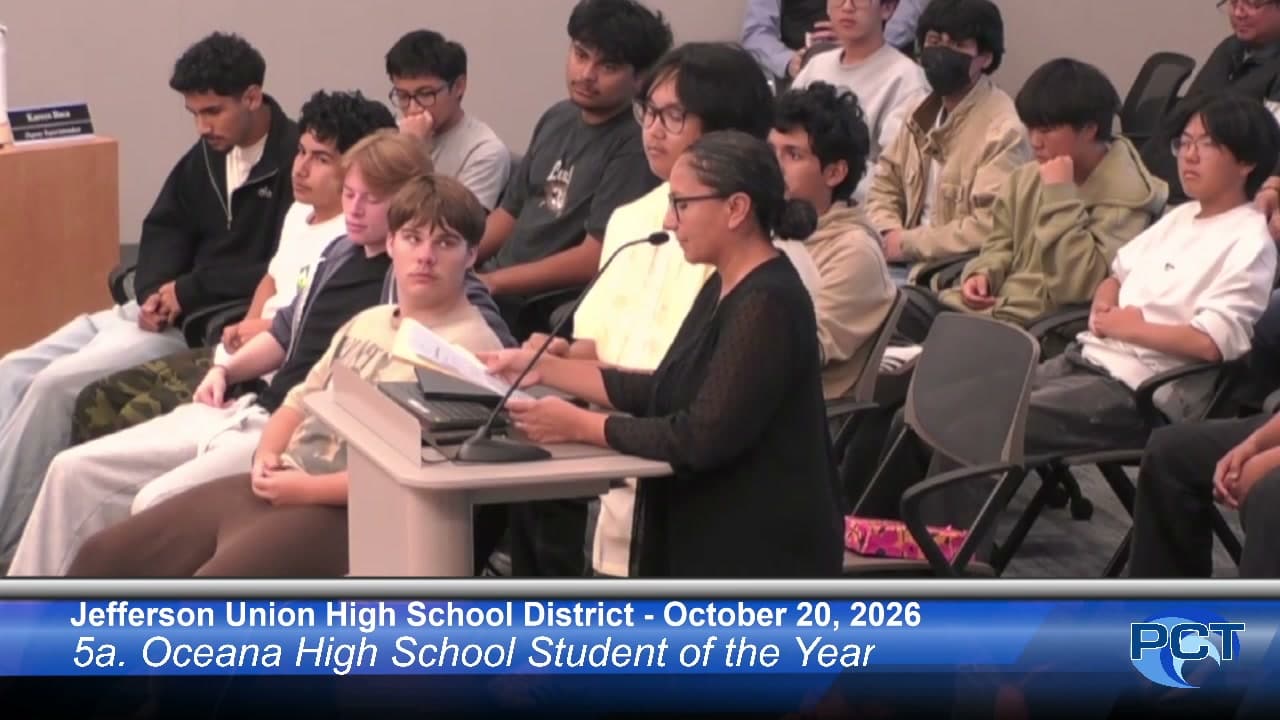
- Student of the Year: Oceana honored Andre Balibata for quiet leadership, yearbook work and a founding role on the Student Equity Team.
- Student reports: Student trustees Ramona Orlando, Caitlin Tan and Elise Griffith reported on homecoming, fall sports and Oceana's Halloween Festival.
- Jefferson construction: Trustees reported on a site visit to Jefferson High School, where a new pool and gym are under construction.
- Consent agenda: The consent agenda was moved and seconded with ayes heard, but no result was declared. No public comment was offered.
- Minutes: The minutes from Oct. 13 and Oct. 15 drew an aye, but no result was declared.
Looking Ahead
The district's high school fair was scheduled for the evening after the meeting. Presta also promoted the Daly City Partnership fundraiser. The food service options come back with the first interim report in December, the same month Gallegos's seat changes hands.