
CTE Hits Record 436 Capstone Students as Board Covers Premium Spike
Governing Board • Jefferson Union High School DistrictOctober 13, 2026
Locunity is an independent informational service and is not an official government page for this commission. All information is sourced from public footage and an analysis of official agendas with the aid of responsible, fact-checked AI. to report an error or omission.
The Jefferson Union High School District's career technical education (CTE) program reported its biggest year yet at the Governing Board's Oct. 13, 2026, meeting: a record 436 capstone students, more than double the dual-enrollment sections and rising participation from English learners. Trustees also took two votes with real budget and community stakes. They approved an MOU with AFT Local 1481 that has the district absorbing a premium jump twice the size it planned for, and they extended a 1976 pool agreement with Pacifica by six months.
Record 436 CTE capstone students in 2025-26, up from 110 completers in 2019-20
Dual-enrollment sections more than doubled, from 22 to 47, but internships and teacher credentials limit further growth
District covers $500,000 annual health premium increase for AFT 1481 employees, double the anticipated amount
Maintenance chief reports busiest year, launches a help desk and prepares for El Niño
Gene Brink Pool agreement with Pacifica extended to June 30, 2027, while terms are renegotiated
CTE Growth Outpaces the Seats to Hold It
Why it matters: The district is expanding career pathways even as overall enrollment declines. The program's main constraints now are internship placements and state credential rules, not student interest.
The basics: Career technical education, or CTE, organizes coursework into industry-themed pathways. A capstone is the final course in a sequence. Dual enrollment lets high schoolers earn community college credit.
Where things stand: Director Denise Shreve presented a program of 13 pathways and 17 offerings across Oceana, Westmoor, Jefferson and Terra Nova high schools. In 2025-26, 436 students were enrolled in capstone courses, compared with 110 pathway completers in 2019-20. Dual-enrollment sections rose from 22 to 47, and all 1,856 CTE students completed at least one simulated work-based learning project.
Shreve framed the program as a complement to college, not a substitute. “CTE is not an alternative to college,” said Director Denise Shreve.
Bell-schedule changes at Jefferson and Westmoor are bringing more ninth and 10th graders into pathways earlier. Asked by trustees what is driving the growth, Shreve pointed to a change in teaching approach. “We have made a shift in that in the last 5 years to not only being project-based, but being work-based learning,” said Shreve.
Equity gains: Board Vice President Rosie Tejada asked about English learners' participation in capstone courses. “Today our percentage has grown to 8.26%. When I started in 2019-2020, it was at 3.6%,” said Shreve. Capstone participation among special education students also grew.
The bottlenecks: Only 25% to 30% of concentrators complete a full pathway. Shreve said the number of available sections and teachers limits that rate. “Our biggest challenges are internships and getting students connected to those internships,” said Shreve.
The second barrier is credentials. Dual-enrollment courses require instructors with subject-area master's degrees, which many CTE teachers lack. Shreve floated co-teaching arrangements with community colleges as a workaround.
Decisions and stakeholder impacts: The presentation was informational, and the board took no action. Trustees praised the program. “I think we all know that this program is really what it is because of you and your team,” said Superintendent Toni Presta. Students in the four high schools gain from expanded college credit and work-based learning. The internship gap, however, puts pressure on local employers and community partners to open more placements.
What's next: Shreve said she would pull data on students who complete more than one pathway.
Health Premiums Came In Double. The District Is Paying.
Why it matters: The district had budgeted for a $250,000 increase in employee health contributions. Instead, premiums rose by more than $500,000. The board chose to absorb the difference rather than pass it to employees, and the cost will show up in the December budget update.
Where things stand: District staff member Tina VanRaaphorst walked trustees through the numbers. Negotiations with AFT Local 1481 had anticipated a $250,000 increase. “However, they came in at over $500,000,” said VanRaaphorst.
The MOU adds $250,000 a year in district funding, bringing the total annual increase to $500,000. That covers 100% of premium increases for every plan except the UHC PPO. Employees enrolled in that plan will pay a higher share or may switch plans.
Board President Sherrett Walker confirmed that AFT 1481 represents most district employees. VanRaaphorst noted the district's other bargaining arrangements. “We have our food service workers are represented by the Teamsters,” said VanRaaphorst. Management staff are unrepresented but receive the same terms.
Earlier in the evening, an AFT Local 1481 representative signaled a collaborative posture with district administration heading into benefit and budget decisions.
Decisions and stakeholder impacts: The board approved the MOU by voice vote. No tally or individual votes were announced. Most employees avoid premium increases for 2027. UHC PPO enrollees are the exception and face higher costs or a plan change. The district takes on a recurring $500,000 annual obligation.
What's next: “This additional expense will be incorporated into the first interim budget report, which will be presented in December,” said VanRaaphorst.
Maintenance Team Logs Busiest Year, Opens Help Desk
Why it matters: In what the district describes as the county's lowest-funded high school district, campus upkeep depends on staff coordination, outside partnerships and even student labor. Two skilled-trade positions remain unfilled heading into winter.
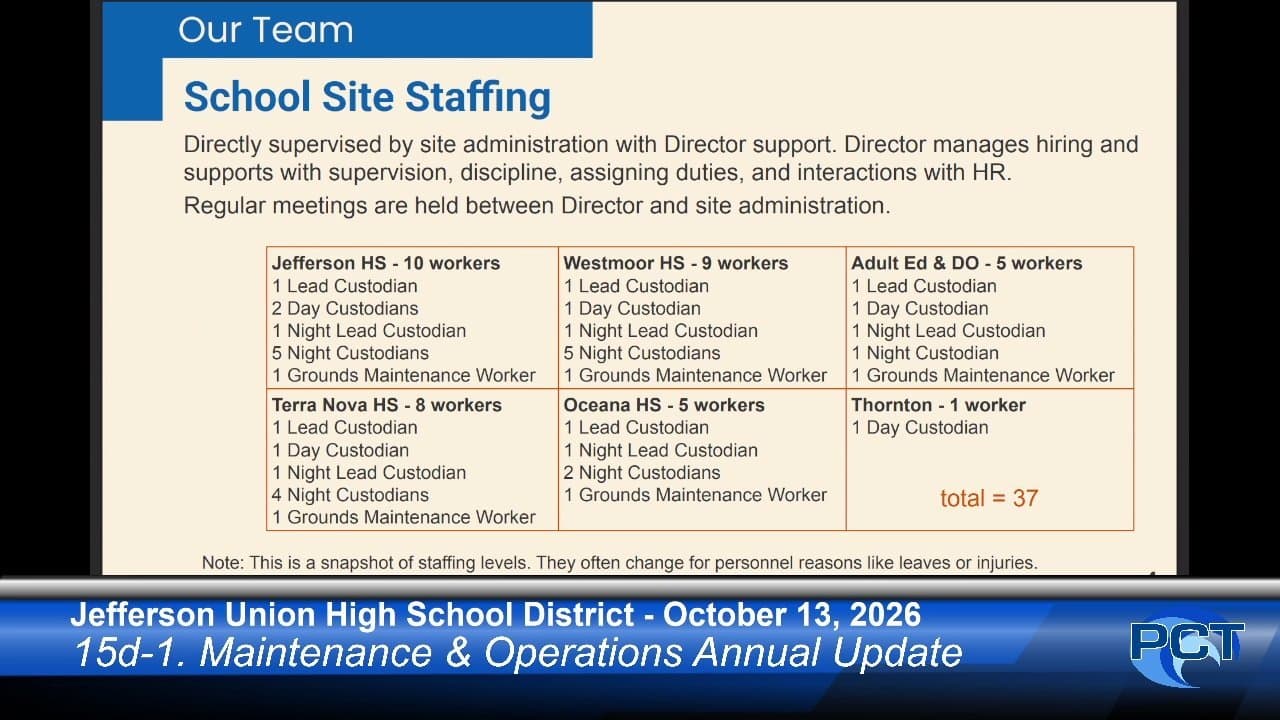
Where things stand: Marcus Peppers, Director of Maintenance and Operations, described a shared-supervision model with site administrators covering 37 school-site staff. “We have 3 current vacancies,” said Peppers. The open roles include an electrician and an HVAC technician.
Completed work this year included:
Paving at Oceana and Terra Nova
New locker-room floors
Office and cafeteria upgrades
Pressure washing and gum removal at Thornton
A building remodel and woodshop revamp at Terra Nova
Clearing of outstanding compliance items
Ongoing projects include portable ramps at Westmoor built with help from student woodshop classes, tripping hazards at Oceana and new signage. Partners include the Jefferson Union Sustainability Committee, the San Mateo County Office of Education, SMCSIG, Green Schoolyards of America and local cities.
Peppers also flagged the season ahead. “El Niño and winter prep is huge,” said Peppers. A maintenance help desk launched the morning of the meeting, and a compliance and contractor tracking system is coming.
Decisions and stakeholder impacts: The update was informational, and no action was taken. Trustee LaSaundra Gutter asked about night custodian hours, which Peppers said generally run 2:45 to 10:45 p.m. The superintendent tied the new system to service expectations. “Closing out those help desk tickets efficiently, responsiveness is really important,” said Presta.
Pacifica Pool Deal Gets Six-Month Runway
Why it matters: The shared-use agreement for the Gene Brink Pool at Oceana High School dates to 1976 and was set to lapse at year's end.
Where things stand: “The original agreement dates back to 1976 and is set to expire on December 31st, 2026,” said VanRaaphorst. The amendment extends the agreement to June 30, 2027, while the district and the City of Pacifica negotiate new terms. Earlier, Board Vice President Tejada reported that the facilities subcommittee had met with the city on the pool lease and called the meeting productive.
Decisions and stakeholder impacts: Trustees raised no questions and approved the amendment by voice vote. No tally was announced. Pool users avoid a January lapse in access, but the long-term terms remain open.
Minor Items
Policy first reads: Board Policy 7131 adds duties to coordinate with local park authorities, weigh in on city and county general plans, and address district workforce housing.
More first reads: Bylaws 9260 and 9310 were revised; Policy 6173.1 trims duplicate foster-youth language; Policy 6173.2 references the California Purple Star program.
Consent agenda and minutes: Approved by voice vote, including minutes of the Sept. 15 regular meeting and the Sept. 19 study session.
Closed session: All five trustees were present when the board reconvened; nothing was reported out.
In memoriam: The board adjourned in memory of Jim Phillips, father of a Westmoor teacher.
Looking ahead: The five policies and bylaws return for adoption at a future meeting. The $500,000 premium cost lands in the first interim budget in December. Pool negotiations with Pacifica run through June 30, 2027.