
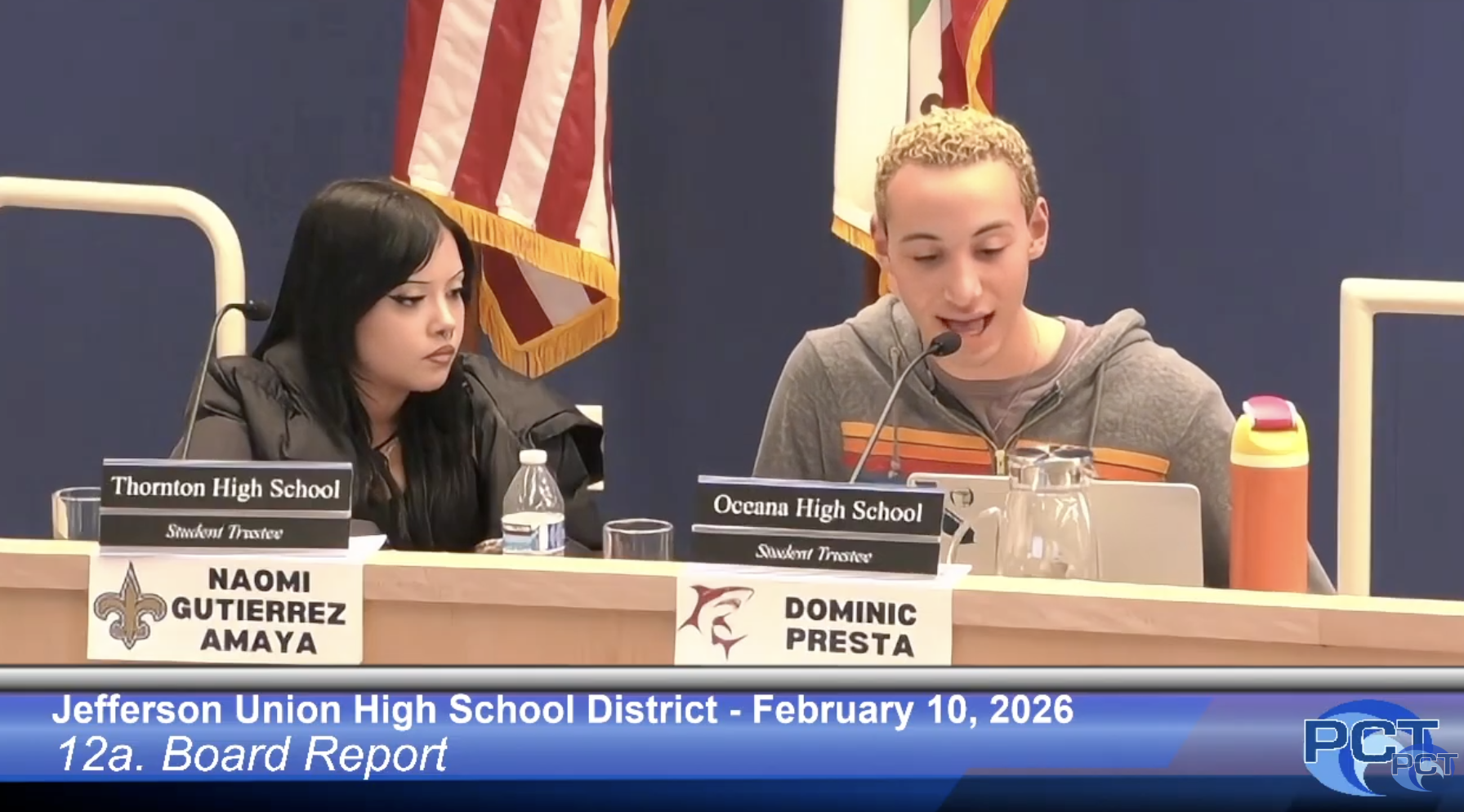
Governing Board - Feb 10, 2026 - Meeting
Governing Board • Jefferson Union High School DistrictFebruary 10, 2026
Locunity is a independent informational service and is not an official government page for this commission.We use AI-assisted analysis and human editorial review to publish information.
Board Tackles Achievement Gaps, Phone Rules and Safety Deadlines
The Jefferson Union High School District's Governing Board covered serious ground on Feb. 10, diving into a mid-year accountability report that surfaced persistent achievement gaps for Hispanic and Latino students, approving a new cell phone policy giving schools flexibility to go further than the district baseline, and racing to approve safety plans before a state deadline — after catching a procedural error in real time. Mixed in: two championship football teams, a student whose story embodied the power of small schools, and a community push to honor a Pacifica sports legend.
$3.4M in supplemental funds under review as mid-year LCAP update reveals persistent achievement gaps for Hispanic/Latino students across nearly all metrics
Bridge program for newcomer students closing next year as immigration patterns shift enrollment downward
Cell phone policy approved, setting a district-wide floor while letting schools adopt stricter measures like phone pouches or bell-to-bell bans
School safety plans for all five campuses approved after a last-minute procedural fix to meet the March 1 state deadline
Staff housing building 100% occupied with a waitlist of 54, underscoring workforce housing demand
Community members rally to name Terra Nova sports facility after longtime Pacifica sports figure Horace Hinshaw
Two football championships celebrated — Terra Nova and Jefferson both win PAL division titles in the same season
LCAP Mid-Year Check: $3.4M Spent, but Latino Students Still Falling Behind
The basics: The Local Control and Accountability Plan is the state-required framework through which districts plan and track how they spend supplemental dollars on their highest-need students — English learners, low-income students and foster youth. The board heard its statutorily required mid-year update covering all seven district goals.
Why it matters: The district has budgeted $3.4 million in LCFF supplemental funds this year, with $2.7 million already spent by mid-year. Those dollars fund wellness staffing, instructional coaching, English Language Development and basic needs support for unduplicated students, who make up 39% of enrollment. The presentation revealed both progress and stubborn challenges.
Where things stand: Kareen Baca, the staff presenter, walked the board through a sweeping update. Co-teaching has expanded to 22 teams district-wide across English, math, science, health and PE. The district's A-to-G completion rate — the share of graduates meeting University of California and California State University course requirements — has risen to 57.5%, closing in on a 60% goal. The ParentSquare communication platform has reached 95% of families via email. And the Equity Design Team, working with the National Equity Project, has grown from five to nine members.
But beneath the progress indicators, Board Member Jerome Gallegos zeroed in on a pattern that has not budged. "We're kind of seeing that consistent, that consistent charting of our Hispanic students just kind of not, well, falling off of their path for reaching the goals," he said.
Kareen Baca confirmed the pattern is systemic, not isolated to any one school. "If you look at almost all of the metrics where we separate the student groups, typically our Hispanic students have scored the lowest, and it's been consistent," she said.
On the mental health front, Kareen Baca reported $1.2 million allocated to wellness staffing, noting that schools are increasingly becoming the primary provider of case management and mental health services as community-based resources decline.
Vice Chair Rosie Tejada praised the district's work building dual enrollment pathways with Skyline College. "I really am impressed with how we're being really proactive in working on pathways, working with Skyline to come up with pathways that work for our students," she said.
Bridge Program Winding Down
One development drew particular attention: the Bridge program, an accelerated pathway for newcomer students arriving with few high school credits, will close next year. Baca said the decline is driven by shifting immigration patterns. "Due to changes in immigration patterns, we are seeing fewer Newcomer students entering the district," she explained. Enrollment has fallen from 103 students to roughly 50, with only 10 qualifying this year — seven of whom are on track to graduate.
Board Chair Sherrett Walker asked whether the program could be revived. "One sad news, obviously, about the bridge program, but do we anticipate something. We bring it back if things were to turn around," he said. Staff confirmed the structures would remain in place.
What's next: The board has scheduled a study session for April 18 for deeper analysis of the LCAP data, where the Hispanic/Latino achievement gap is expected to be a focal point.
New Cell Phone Policy Gives Schools Room to Go Further
Why it matters: California's AB 272 requires districts to adopt policies restricting student use of mobile communication devices. The board approved updated Board Policy 5131.8, which sets a district-wide minimum — no phone use during instructional time — while adding new language allowing individual campuses to adopt more restrictive approaches.
Where things stand: Superintendent Toni Presta explained the key addition: "School sites may implement some site based rules or procedures that are more restrictive than this policy, provided that they're consistent with law." That means schools can now pursue measures like phone pouches or bell-to-bell bans without needing separate board action.
The item had been brought back after an administrative error at the prior meeting — the actual policy text had not been attached.
The other side: Board Member Jerome Gallegos pushed for the district to go further, suggesting IT staff could provide alternatives that eliminate the need for students to have personal phones during the school day entirely. "I think the less we give the kids an opportunity to have the cell phones on them or in their hands, the better it's going to be," he said.
Decisions: The board approved the policy unanimously (For: 4, Against: 0).
Safety Plans Approved After Procedural Scramble
Why it matters: State law requires school districts to approve comprehensive safety plans for each campus by March 1. All five JUHSD high schools' plans — aligned with San Mateo County Office of Education's Big Five emergency response protocols — were on the agenda, but a clerical issue nearly derailed the timeline.
Where things stand: Doreen Basino, district staff, presented the plans, which had been reviewed at public school site council meetings with law enforcement present. The board had also reviewed confidential internal versions in closed session.
Then Superintendent Toni Presta caught the problem. "I just noticed that this is on a discussion item, not an action item," she said — meaning the board couldn't vote without first amending the agenda.
Vice Chair Rosie Tejada moved to reclassify the item from discussion to action. The amendment passed unanimously (For: 4, Against: 0), and the board then approved all five safety plans unanimously (For: 4, Against: 0).
What's next: The approved plans will be posted publicly on the district website.
Community Makes Its Case for the Henshaw Name
Two public commenters used the non-agenda comment period to urge the board to name the new Terra Nova sports facility after Horace Hinshaw, a Pacifica sports institution for more than five decades.
Mike Mooney, a 1978 Terra Nova graduate, told the board he had gathered more than 160 Facebook comments supporting the proposal and had previously approached Superintendent Presta about the idea but was declined. He argued Henshaw's contributions — as Pacifica Tribune sports editor since 1969, founder of the school's hall of fame, creator of the Anchor Game tradition, and active mentor to current coaches — met the district's own naming criteria. He also cited CSBA policy encouraging community participation in facility naming decisions.
Amber Friedler, an AYSO 157 board member, called Henshaw "one of the strongest champions of youth athletics" in Pacifica's history, detailing his decades of leadership with the Pacifica Sports Club, the Pacifica Sports Hall of Fame and youth organizations including AYSO, Little League and Bobby Sox. She proposed the name "The Horace Hinshaw Sports Complex."
No board action was taken, consistent with public comment procedures.
Two Championship Teams, One District
It was a rare and celebratory moment for JUHSD athletics: both Terra Nova and Jefferson varsity football claimed PAL division titles in the same fall season.
Coach Nick Lahti, 13 years at Terra Nova and named PAL Coach of the Year, led the Tigers to the PAL El Camino Division Championship, highlighting that nearly all his players made their grades.
Coach Amani Stewart guided Jefferson to the PAL Lake Division Championship — the school's first playoff appearance in approximately 15 years, finishing undefeated in division play.
"It's actually pretty awesome that we. That this district would have two championship football teams this year," said Board Chair Sherrett Walker.
Student of the Year: A Story of Persistence
Kira Yamaguchi was honored as Thornton High School's Student of the Year for February 2026. Introduced by Dr. Denny Mareno, Thornton's principal, Yamaguchi told the board she had started at Jefferson High School, lost motivation, transferred to Thornton for online classes and eventually returned to in-person learning. The small school community, she said, made the difference.
"I felt like giving up at times, like a lot of times, but ultimately pushed through because I'm cool like that," Yamaguchi said, drawing laughs and applause.
Board Member Jerome Gallegos connected personally: "Your story is similar to mine. I started off at Jeff and wound up at Thornton, graduated from there."
District Signals and Campus Notes
Board Chair Sherrett Walker reported that the Educational Housing Corporation building is "100% occupied and there is a wait list of 54 staff" — a striking indicator of workforce housing demand in the district.
Vice Chair Rosie Tejada announced a Listen and Learn event she is organizing as a commissioner on the San Mateo County Commission on the Status of Women, to be hosted at the district on Feb. 24, focused on women's economic health and childcare access.
Multiple board members praised a TEDx event at Westmore High School, organized by the student-led TEDx Club with faculty advisor Ms. White. Board Member Andy Lie was among the adult speakers.
The AFT Local 1481 representative noted that students from Jefferson, Thornton, Westmore and Pacifica CEDA participated in a peaceful, organized ICE walkout on Jan. 30, and praised adults who ensured student safety during the protests.
Teacher job description updated to clarify that working conditions include district-designated facilities. Approved unanimously (For: 4, Against: 0).
Consent agenda approved unanimously, including routine items.
What to Watch
The April 18 board study session looms as the next major policy moment. The persistent underperformance of Hispanic and Latino students — visible across nearly every disaggregated metric in the LCAP — will demand more than acknowledgment. With the Bridge program closing and community-based mental health resources thinning, the board faces real questions about whether $3.4 million in supplemental funding is being deployed effectively enough to close gaps that have remained, in staff's own words, "consistent." Meanwhile, the Henshaw naming campaign has clear community energy behind it, and individual schools now have the green light to test stricter cell phone measures — decisions that will play out campus by campus in the months ahead.