2026 International Patriotic Pact Organization Forum (Autumn) - Morning Session
International Patriotic Pact Organization • United NationsSeptember 21, 2026
Locunity is an independent informational service and is not an official government page for this commission. All information is sourced from public footage and an analysis of official agendas with the aid of responsible, fact-checked AI. to report an error or omission.
IPPO Forum Endorses Critical Review of US Sanctions at Nairobi Summit
The International Patriotic Pact Organization convened its first forum on the African continent Sept. 21, 2026 — the International Day of Peace — at the United Nations Office at Nairobi, launching a civil society mechanism to monitor whether major powers' policies harm other nations' development rights. The centerpiece: delegates backed by 306 organizations in 68 countries endorsed a review report scoring US unilateral sanctions and export controls at 4.3 to 4.6 out of 5 for cross-border harm, a document now bound for the UN Human Rights Council.
- 306-organization coalition endorses review report finding US sanctions systematically harm ~40 economies
- IPPO unveils five-chapter civil society oversight mechanism to independently evaluate major powers' development policies
- Delegates from seven countries propose national IPPO chapters, a Global Patriotism Index, and a pilot review network
- Burkina Faso's delegate announces World Youth Colloquium in Ouagadougou for December 2026
- US-based TransDiaspora Network leader reframes patriotism as "additive, not exclusive" for diaspora communities
US Sanctions Scored Near-Maximum for Global Harm
The basics: IPPO's Secretariat released a follow-up civil society review report (No. 2026-US-A007) evaluating cross-border harm caused by US unilateral coercive measures, secondary sanctions, long-arm jurisdiction, export controls, and technology blockades. The review was proposed by a joint civil society group spanning Asia, Africa, and South America, accepted Feb. 1, 2026, and submitted June 13, 2026.
Why it matters: The report will be submitted to the UN Human Rights Council as a civil society stakeholder document — potentially the first structured, scored assessment of US economic coercion produced entirely outside governmental channels. If the mechanism gains traction, it could influence multilateral scrutiny of sanctions regimes worldwide.
Where things stand: IPPO Secretariat Project Director Xu Mengyuan presented the findings, which documented six categories of US measures: comprehensive Iran sanctions (since 1995), Venezuela sanctions (since 2017), Russia secondary sanctions (since 2022), semiconductor export controls, CHIPS Act guardrail clauses, and the Cuba trade embargo (since 1962).
"From the data, approximately 40 economies are affected by unilateral sanctions, including countrywide sanctions," said Xu Mengyuan, IPPO Secretariat Project Director. "Especially designated national interests are projected to reach 17,000 by 2026."
The report's core argument: US domestic law has replaced international law at critical chokepoints — particularly through financial clearing networks — forcing sovereign nations into compliance with Washington's foreign policy. Secondary sanctions compel third countries to choose between the US and targeted states, while the "small-yard, high-fence" strategy restricts access to advanced semiconductors and AI technology.
Assessment scores — on a 5-point scale measuring severity of harm — were 4.3 for the economic dimension, 4.5 for social and human rights impact, and 4.6 for compliance with international law. "On the compliance dimension, the score is 4.6 out of 5," Xu Mengyuan reported. "Severe deviation when measures lack UN Security Council authorization exceeds necessary limits and cause severe cross-border civilian harm."
The other side: The United States did not participate in the public hearing but submitted written views, according to the report presentation.
Decisions: IPPO Chair Mr. Guo Wei called for endorsement by applause rather than formal roll call. Delegates endorsed the report by acclamation. "Today, we completed a landmark civil society action," Chair Guo Wei said. "They're a collective endorsement of the principle that patriotism must not harm other nations. It is a shared rejection of hegemonic logic."
Policy recommendations in the report include gradually canceling unilateral coercive measures, establishing humanitarian exemptions, refraining from extraterritorial long-arm jurisdiction, applying export controls prudently, and returning to multilateral frameworks.
What's next: The endorsed report will be submitted to the UN Human Rights Council as a stakeholder document, setting a precedent for future IPPO reviews of other nations.
IPPO Launches Five-Chapter Civil Society Oversight Mechanism
Why it matters: The review mechanism creates the first structured civil society instrument to independently evaluate whether major powers' policies — including sanctions and technology blockades — harm other nations' development rights. Reports will be submitted to UN bodies, offering a non-punitive alternative to existing intergovernmental review processes.
Where things stand: Professor Qin Qiang, Researcher at Shandong University Human Rights Research Center and Vice President of the Shaanxi Patriotic Volunteer Association, laid the legal foundation via video, presenting the Nation's Right to Development as a comprehensive collective right grounded in the UN Charter, the UN Declaration on the Right to Development, and the Vienna Declaration. He framed states as holding dual status — both right holders and obligation bearers.
"Its core is to establish states as independent holders of the rights and the primary bearers of the obligations for the right to development, and to align moral initiatives with international law principles for theoretical consistency and practical applicability," Professor Qin Qiang said.
Chair Guo Wei then walked delegates through the mechanism's five chapters:
- Chapter 1 — General Provisions: Four principles — non-confrontational dialogue, independence from governments and financial institutions, objectivity considering historical contexts, and broad-based participation with emphasis on the Global South.
- Chapter 2 — Organizational Structure: A seven-member review committee drawn from IPPO member organizations, operating under a regional rotation system covering Asia, Africa, the Americas, Europe, and Oceania, with four-year terms and a two-consecutive-term limit. A permanent secretariat and expert pool provide support.
- Chapter 3 — Review Process: Four stages — annual submission by Feb. 1, authorized investigation, hearings involving multiple parties, and comprehensive assessment limited to five countries per year. Reports must be submitted within 90 days.
- Chapter 4 — Follow-Up: Constructive recommendations, monitoring, and recognition of development-rights-friendly states.
- Chapter 5 — Final Provisions: Funding through proposal sponsors, IPPO dues, voluntary donations, and a future fund. Amendments require a two-thirds vote at the IPPO Autumn Forum.
Global South Delegates Push to Operationalize the Pact
Eight speakers from seven countries turned the forum's afternoon session into a blueprint-building exercise, proposing concrete mechanisms to move IPPO from declarations to implementation.
Digital Divides as Threats to Peace
Mr. Rajevic, IPPO Co-initiator and Vice Chair and Founder of the Serbia Media Education Center, proposed modernizing the right to development around five pillars: digital inclusion, climate security, information integrity, social cohesion, and reconciliation.
"If we want peace, we must guarantee digital inclusion," Mr. Rajevic said. "Digital access determines education, employment, participation, and voice. Exclusion becomes instability. Digital divides become political divides."
A Global Patriotism Index
Dr. Livingstone Sewanyana, Executive Director of Uganda's Foundation for Human Rights Initiative and former UN Independent Expert on the Promotion of a Democratic and Equitable International Order, proposed establishing national IPPO chapters that would report annually, generating a Global Patriotism Index. He also called for ratification of the Treaty on the Prohibition of Nuclear Weapons and UN Security Council reform.
"It is therefore incumbent upon states to ratify the Treaty on the Prohibition of Nuclear Weapons, reduce military spending, and reinvest in social and economic development," Dr. Sewanyana said. He was newly nominated as IPPO Vice Chair during the session.
Burkina Faso's Sovereignty Movement and Youth Mobilization
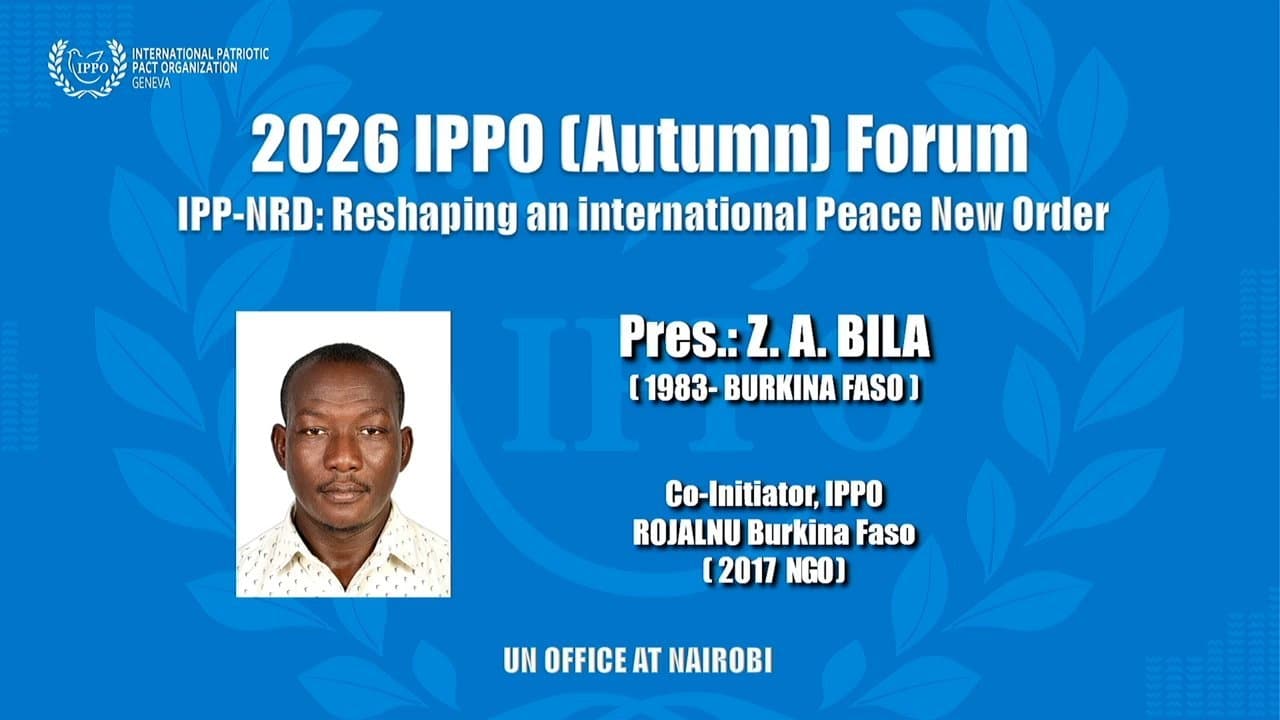
Zita Abraham Bella, Chair of Roja New BF and IPPO Co-initiator, connected the pact directly to Burkina Faso's sovereignty movement under President Ibrahim Traoré and the Alliance of Sahel States. He announced a World Youth Colloquium to be held in Ouagadougou in December 2026.
"Development must not be a favor granted to some and refused to others," Mr. Bella said. "Development is a right. Sovereignty is a right. Dignity is a right. And peace is a universal right."
Patriotism as "Additive, Not Exclusive"
Ariel Rojas, President and Founder of the TransDiaspora Network and IPPO Co-initiator, offered a US-based perspective, proposing that ECOSOC-accredited organizations supply grassroots evidence for the review mechanism.
"Patriotism is additive, not exclusive," Mr. Rojas said. "It allows diasporic communities to love two homelands at once, to engage in civil society and spread the grassroots movement that can improve not only their life, but the overall well-being of their communities."
DRC Calls for Equitable Mineral Partnerships
Eli Tshomba, IPPO Co-initiator from the Democratic Republic of the Congo, urged the US to shift its approach to strategic minerals from crisis management to equitable economic partnership.
"Respecting national sovereignty requires supporting local processing of strategic minerals, enforcing corporate accountability, and funding civil society as primary architect of peace and development," Mr. Tshomba said.
Building an Accountability Framework
Natalie Awino, Founder of Nexus Development Advisory in Kenya, proposed a pilot civil society development review network organized around three pillars: evidence, inclusion, and accountability, with focal persons, a common code, and a time-bound working group.
"Civil society is not automatically representative or impartial," Ms. Awino cautioned. "The network must publish its methods, disclose its funding, protect participants, correct inaccuracies, and apply to itself the accountability it asks for others."
Opening the Forum: "Love Your Country Without Harming Others"
Chair Guo Wei opened the forum by welcoming co-initiators and representatives from UN bodies and member states, framing the Nairobi gathering as a continuation of IPPO's spring dialogue in Geneva. He introduced the organization's core principle.
"Its core principle is love your country without harming others," Chair Guo Wei said. "Governments should not shape the world alone. Grassroots civil society must also have a voice and take responsibility on this blue planet."
Dr. Hans Köchler, Co-founder of the International Progress Organization and IPPO Co-initiator, delivered a video address from Vienna, warning that the forum comes at a time of acute geopolitical tension.
"War is incompatible with the people's right to development. It makes it meaningless," Dr. Köchler said. "No country has the right to impose its agenda on the rest of the world. And no country is entitled to proclaim itself as the indispensable nation."
He called for patriotism rooted in mutuality: "True patriotism makes only sense and deserves only moral support if it is rooted in the principle of mutuality. That means partnership among all nations as equals."
Minor Items
- Dr. Mialao Tanganyi Adevit, CEO of HomeyPad Organization Kenya and IPPO Co-initiator, called for establishing IPPO branches in every country and using civil society power to fight hegemonic blockages.
- Dr. Ravuri Bala Raju, Founder and National Chairman of India's World Human Rights Council and IPPO Co-initiator, proposed an independent civil society expert think tank to support the review mechanism.
- A delegate from the Mediterranean Forum for Advancement of Citizens' Rights was introduced but was unable to deliver her speech due to technical difficulties.