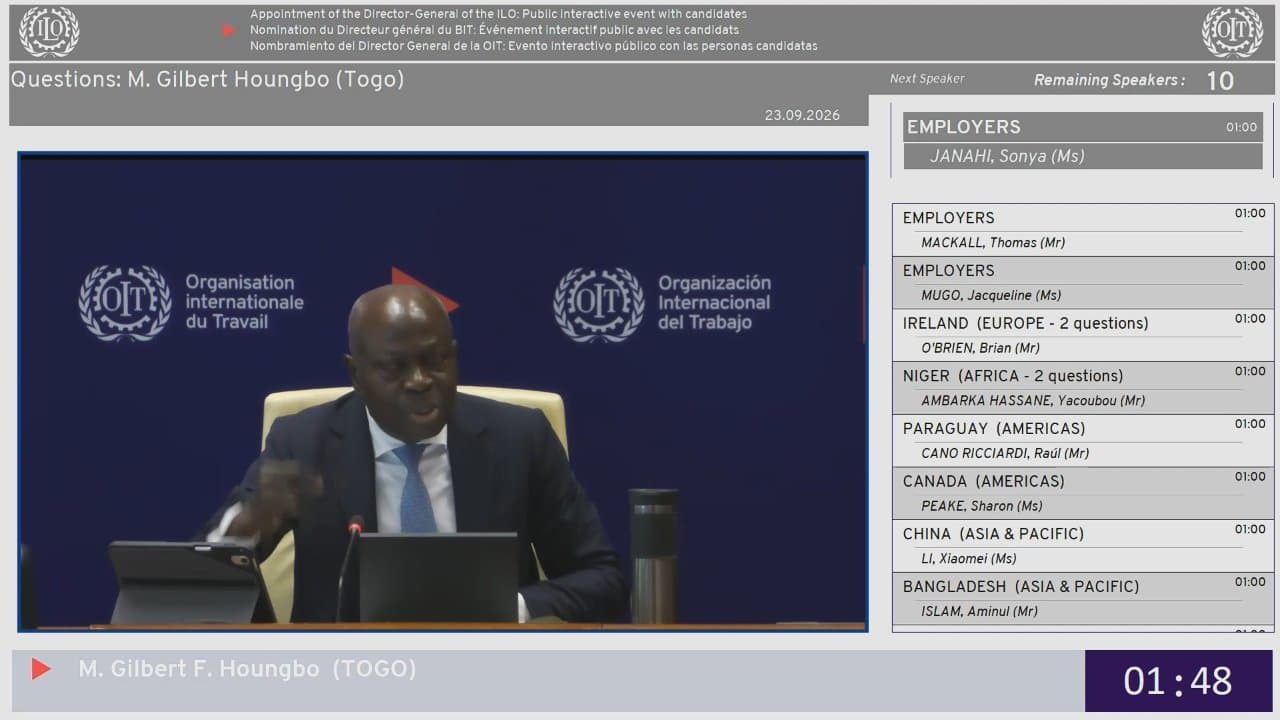
Public interactive event with candidates: Session 2
International Labour Organization • United NationsSeptember 23, 2026
Locunity is an independent informational service and is not an official government page for this commission. All information is sourced from public footage and an analysis of official agendas with the aid of responsible, fact-checked AI. to report an error or omission.
Hungbo Pitches 25% Budget Buffer and AI Leadership in Bid for Second ILO Term
Incumbent ILO Director-General Gilbert F. Hungbo laid out his most detailed financial-reform blueprint yet during a tripartite candidate dialogue on Sept. 23, proposing to cap spending at 75% of assessed contributions and build a hedge fund by 2032 to shield the organization from future liquidity crises. The session — structured as employer, government, and worker question rounds — exposed sharp fault lines over whether the ILO's pivot toward productivity and AI governance will protect workers or tilt the institution further toward business interests.
Hungbo proposes capping ILO expenditures at 75% and building a resilience fund by 2032 after a 2025 liquidity crisis forced programme cuts
Employers accuse the ILO of being "very pro-trade union" and demand institutional neutrality reforms
Workers challenge the productivity agenda, asking how it will address growing inequality and a "broken social contract"
Hungbo bets on AI, pledging to make the ILO the global reference point on labour and artificial intelligence and proposing a G20 expert panel
Specific programmes face the axe: standalone HIV/AIDS work, social-and-solidarity-economy projects, and action programmes on informality and just transition are deprioritized
Convention 193 on platform workers gets a ratification push, and the MNE Declaration will be refreshed at its 50th anniversary
A Leaner ILO: The 75% Cap and a Fund to End Crises
Why it matters: A March 2025 donor suspension and a September liquidity crisis forced staff reductions and programme suspensions, exposing the ILO's vulnerability to arrears-driven shocks. Hungbo's proposed budget cap and hedge fund represent the most concrete financial reforms the organization has considered in decades.
Where things stand: Director-General Gilbert F. Hungbo told the Governing Body's tripartite constituents that his top priority is finishing the institutional reform already underway, then hardening the ILO's finances against future disruption.
"My intention is to ask if the board agrees that the assessed contribution remains at the same level as current biennium, with the commitment of the office to cap the expenditure at 75%, and therefore creating a buffer of 25%," said Director-General Hungbo.
The remaining 25% would seed a revolving resilience fund designed to absorb shocks from donor withdrawals or arrears. "It's very clear to me that if you accord me a second term, by 2032 I want to make sure that I have that reserve, that hedge fund that is sufficiently built and financed," he added.
Employers' Group Representative Matthias Thons opened the employer round by pressing on specifics: "What would be your top priority and what would you be prepared to deprioritize given the organization's limited budget and the need to make the ILO more agile, more effective, and more responsive to the changing world of work?"
Hungbo responded with a concrete list. Standalone HIV/AIDS programmes, social-and-solidarity-economy standalone work, action programmes on informality and just transition, and certain communication activities within the normative department would all be deprioritized. He emphasized that regional offices and the norms department received the smallest cuts — 10% and 11%, respectively — and declared field capacity a bright line: "It is vital that we preserve technical capacity in the field. That's a red line for me. That's not negotiable."
Workers' Vice President Kathleen Peschiera pushed back on the human cost, questioning whether downsizing would drain expertise and institutional memory. Hungbo assured that a functional review and contingency framework would guide decisions, and that his programme guidance letter for the 2028–29 budget cycle would embed these protections.
What's next: The Governing Body will debate Hungbo's 28-29 programme and budget proposal, where the 75% cap and hedge-fund timeline will face their first formal test. The election itself — decided by the Governing Body — will determine whether these commitments become policy.
ILO's AI Gamble: From Vulnerability Index to Global Authority
Why it matters: With Switzerland hosting the next AI Summit and the ILO already producing an AI vulnerability index used by the World Bank, Hungbo is staking the organization's relevance on becoming the international authority on AI's impact on labour markets — a claim with immediate geopolitical stakes.
Where things stand: In his opening presentation, Director-General Hungbo declared artificial intelligence his signature second-term ambition: "I really want to put ILO to become the international reference point when it comes to the labor dimension of artificial intelligence and the technology changes."
He proposed creating a high-level panel with scientists, AI companies, workers, employers, and government representatives — and plans to pitch it to the G20: "It's my plan to propose to the G20 the creation of a group of experts from the scientific, from the current AI companies, obviously, from the workers, employers, and the representative of government so that that panel can advise the Office."
Government Representative Xiaomei Li of China pressed on the ILO's comparative advantage in AI labour governance. Hungbo pointed to the observatory established two years ago, the existing vulnerability index, and the upcoming engagement with Switzerland's AI Summit. He floated the possibility that a new tripartite mechanism may need to replace the Standards Review Mechanism to identify normative gaps arising from technological transformation.
Workers' Vice President Peschiera questioned whether the productivity gains from AI would actually flow to workers. Hungbo framed redistribution as integral, citing the Samsung Electronics case in Korea as an example of how productivity gains must be shared — but the tension between an AI-forward strategy and worker protection remains unresolved.
'Not Just a Perception': Employers Demand the ILO Shed Its Pro-Union Image
Why it matters: If employers view the ILO as structurally biased toward trade unions, their cooperation on standard-setting and implementation — the very foundation of tripartism — is at risk.
Where things stand: IOE Vice President Sonia Janahi delivered the session's most pointed critique: "Employers and many stakeholders outside the ILO are far from viewing the ILO as a balanced organization. ILO has been set up as a tripartite organization for very important reasons, but the organization's mindset is not balanced and is seen as very pro-trade union. And it is not just a perception."
Employers' Group Representative Jacqueline Mujo reinforced the challenge from a business-operations angle: "We also believe that ILO policies and standards often prevent businesses from moving forward and creating jobs." She cited rigid regulations, high taxes, and administrative hurdles as obstacles, particularly for small enterprises.
The other side: Hungbo acknowledged the concern directly, pledging two concrete governance changes. First, he committed to consulting employers more systematically before sensitive senior appointments at the D1 and D2 levels: "Even for some D2, D1 sensitive appointment, I want to consult much more with you, formally or informally, so that we could come to a point where people who are appointed, you do not see them as prima facie impartial on that." Second, he promised stronger impartiality reviews of ILO documents and invited employers to flag specific instances.
On the business-environment critique, Hungbo pointed to existing programmes — Better Work, the enterprise network, the Vision Zero Fund, and the Office of the Chief Economist — while acknowledging the ILO lacks the full expertise needed on fiscal burdens and must partner with the World Bank, IMF, and development banks.
Productivity or Protection? Workers Draw the Line
Why it matters: The tension between a productivity-focused ILO and its constitutional mandate to protect workers could reshape the organization's policy orientation for the next decade. Whether Hungbo's "driving prosperity through productivity" framing satisfies the Workers' Group will be critical to 2028-29 budget approval.
Workers' Vice President Kathleen Peschiera posed the question directly: "How would you convince the workers in the world that your productivity agenda will deliver for them? And how would this be reconciled with the need to address growing inequalities, the broken social contract, and the imbalance of power in economies and labor markets between workers and employers?"
She followed up on fundamental rights, invoking the International Court of Justice ruling on the right to strike: "How would you ensure that there would be a solid dedicated space and sufficient resources for supporting fundamental principles and rights, especially freedom of association and the right to collective bargaining, which now also includes clearly the right to strike according to the ICJ?"
Director-General Hungbo responded that productivity "imposes itself" in the AI era and that redistribution of gains is the key. He acknowledged the balancing act explicitly: "The real challenge for us to have the balance: economic growth, protection, and job creation. Even the protection and job creation, they are not necessarily linear on the same direction."
On collective bargaining, Hungbo referenced an article by Jeff Vogt as containing "quite very valid" points and acknowledged the need for better internal policy coherence — a notable concession that signals potential recalibration on a sensitive institutional fault line. He committed to embedding freedom-of-association and collective-bargaining support in the 28-29 budget.
Closing the Implementation Gap on Labour Standards
The basics: The ILO has roughly 200 existing international labour conventions. The perennial question: Is the organization better served creating new standards or ensuring the ones on the books actually work?
Where things stand: Employers' Group Representative Thomas Macko asked directly about closing the implementation gap. Hungbo responded that "nobody wants new norms for the sake of new norms" and said any new instruments must emerge from tripartite consensus.
Government Representative Sharon Peake of Canada pressed on follow-through, asking: "As ILO Director General, what would you do to strengthen the ILO's focus on the fundamental principles and rights at work and ensure follow-through on supervisory recommendations?"
Hungbo outlined three pillars: maintaining an up-to-date body of standards via the Standards Review Mechanism, modernizing the supervisory system by reducing the reporting burden through thematic Article 22 reporting (approved in November, with a target implementation of 2027), and maintaining targeted development cooperation for member states facing Article 24 or 26 complaints.
What's next: The thematic Article 22 reporting reform, targeting implementation by 2027, will be the clearest near-term test of whether the ILO can actually lighten its administrative load while strengthening compliance.
Minor Items
Gender-equality progress: Hungbo reported that women's share of P5-and-above positions rose from 38% when he took office to 46%, and the ILO's UN System-wide Action Plan (SWAP) score went from 50% to 75% — but remains short of the 100% target. Government Representative Brian O'Brien of Ireland asked how 2026 ILC gender-equality conclusions would translate to concrete results; Hungbo committed to embedding gender equality across the 28-29 programme and budget, including equal pay, care economy, and Convention 190 on violence and harassment.
Supply chains and platform workers: Hungbo pledged to promote ratification of Convention 193 on platform workers, calling it a "landmark" recognized across the multilateral system, and committed to embedding ratification support in 28-29 budget outputs. He also flagged the MNE Declaration's 50th anniversary as an opportunity to "uplift the declaration."
UN-system synergies: O'Brien asked how Hungbo would define the ILO's comparative advantage within the UN system. Hungbo described ongoing alignment with UNHCR on regional reform and positioned the ILO's tripartite structure and normative mandate as unique assets.
Workers at the field level: Peschiera raised concerns that "workers' experience is that often tripartism and workers' rights are not adequately recognized nor addressed in the work of the UN at field level." Hungbo reaffirmed field-capacity preservation as non-negotiable.
Asia-Pacific underrepresentation: Government Representative Aminul Islam of Bangladesh and Government Representative Xiaomei Li of China raised concerns about regional staffing imbalances. Hungbo acknowledged the gap and committed to addressing it.
Africa strategy and informality: Government Representative Yakuba Abakar of Niger and Ambassador Raúl Caño Ricciardi of Paraguay raised questions about informality in developing countries. Hungbo said a roadmap is due in November, and outcomes from the Windhoek regional meeting will shape Africa and Latin America budget allocations.
Hungbo's closing pitch: The Director-General framed his candidacy around pragmatic bridge-building: "You need a Director-General that is a bridge builder, a Director-General that can bring all those people, all those groups, all those views together."