
I-680 Ramp Metering Plan Advances as Cities Press on Queues, Control
Innovate 680 Policy Advisory Committee • Contra Costa Transportation AuthorityFebruary 12, 2026
Locunity is an independent informational service and is not an official government page for this commission. All information is sourced from public footage and an analysis of official agendas with the aid of responsible, fact-checked AI. to report an error or omission.
Contra Costa's plan to move more traffic on Interstate 680 without adding lanes is shifting from planning to construction schedules. Local officials want to know what happens at the bottom of each on-ramp before the meters start cycling. At its Feb. 11, 2026, meeting, the Innovate 680 Policy Advisory Committee took no policy votes. It did learn that Caltrans meters are already under construction, a corridor agreement is headed to city councils this spring, and a $166M federal grant agreement remains unsigned.
- Two ramp metering systems, one corridor: Caltrans' $108M meters will rest on green until CCTA's system is ready
- Corridor MOU heads to city councils in April or May
- Members press staff on ramp queues, emergency vehicles and evacuations
- $166M Mega Grant agreement still unsigned, which holds up a project labor agreement
- 49-signal Danville–San Ramon corridor chosen for adaptive signal demonstration
Ramp Meters Arrive, but Cities Want the Keys
The basics: Ramp meters are signals on freeway on-ramps that control how quickly cars merge. CARM, or coordinated adaptive ramp metering, links meters along the corridor so they respond to traffic conditions in real time.
Why it matters: Cities' main worry is traffic backing up onto local streets. The corridor memorandum of understanding (MOU) would set roles and expectations before construction begins.
Where things stand: Caltrans' ramp metering project, funded through the state highway repair program known as SHOPP, began Phase 1 construction in November 2025 under a $108M award. Completion is expected in 2028. "We intend to activate meters, but we'll rest them on green. We will not cycle them until CARM project is ready," said Inder Preet Singh, Caltrans staff.
Scott Pitera of consultant GHD said the Mega Grant extended CARM to Olympic Boulevard–Willow Pass. The 65% design went to Caltrans in October. Construction is anticipated in 2027, with operations beginning in late 2028. Darren Henderson of GHD said CARM is being deliberately coordinated with the county's adaptive signal project.
The MOU among CCTA, Caltrans and local partners defines where each metering system begins and ends and who is responsible for what. It is in final technical review. "We're hoping to present at each of your city councils in April or May timeframe in the spring to get that approved at the local level," said Stephanie Hu, CCTA staff.
Who holds the controls: "Who's going to be controlling those city street/on-ramp signals once this all is completed?" asked Chair Candace Andersen. Singh said Caltrans technically does and will coordinate cycling strategies with local agencies. "If there is a location where it makes sense to delegate the control to locals, we can look into that as well," he said.
The other side: Members questioned whether the system could handle the corridor's real-world limits. "How are we going to calibrate this since the storage is going to be different?" asked Committee Member Carlyn Obringer. Staff said CARM knows how many cars each ramp can hold and manages queues in real time. Henderson acknowledged that physical constraints prevented adding capacity at a handful of ramps, so the system will balance queues across the corridor instead.
Committee Member Mark Armstrong asked about emergency vehicles: "Will there be some kind of an electronic way where they can override the system themselves as they get close to the meters or something like that?" "That is not a feature that's embedded in the initial deployments of ramp metering that we're doing as part of these two projects," Henderson said. He pointed instead to shoulders, ramp closure signs and defined contacts. For evacuations, he cited active management by operators and a long-term goal: "to develop a centralized traffic management center, capability for Contra Costa County through the Transportation Authority."
Decisions and stakeholder impacts: No vote was taken. Pitera described an operations and maintenance document with a chart assigning each agency's role, performance metrics, a web dashboard and communications protocols. "We don't plan to finalize this until operations are actually about to begin," he said. Drivers should expect construction at multiple interchanges at the same time. Emergency responders will not get a meter override at launch.
What's next: The MOU goes to city councils in April or May. CARM construction is anticipated in 2027.
$166M Federal Grant Still Unsigned, Labor Deal Waits
Why it matters: The unsigned agreement delays access to construction money for express lanes and ramp metering. It also delays the labor agreement tied to that money.
Where things stand: "Was that the big grant that we were promised, but we were actually waiting to get the money?" asked Obringer. Hu said CCTA received notice of the $166M award in October 2024. Of that, $116M goes to Express Lane Phase 1 and $50M to CARM Phase 1. Changing priorities under the new federal administration forced staff to renegotiate the agreement templates.
Staff expect to unlock the first $6M soon and then pursue the next tranche. That tranche would cover progressive design-build, in which one team carries a project from design through construction, and program construction management. Hu confirmed the arrangement with the labor union: a project labor agreement is signed only after the funding agreement is executed. Obringer noted the project is also still working through issues with the Naval Weapons Station.
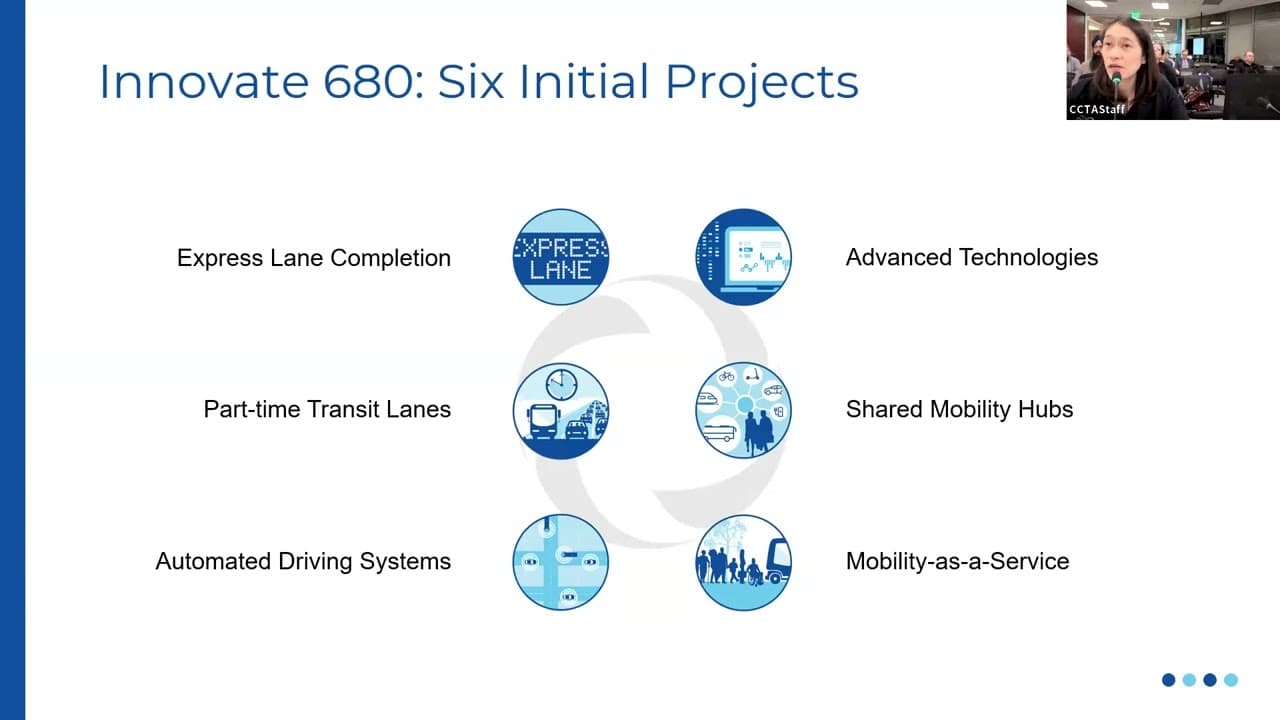
The broader program: The express lane environmental document was completed in December 2025, and 30% design is underway. A board award for the construction management team is anticipated in May. The part-time transit lane is waiting on guidance from Caltrans. Shared mobility hubs are in early design or environmental review at Walnut Creek BART, Martinez Amtrak and Bollinger Canyon Road. The MOSS app is slated for beta testing this year, with a public launch in early 2027.
Automated shuttles: The pilots have ended, and UC Berkeley is analyzing the data. Relaying a request from Committee Member McKillop, Andersen asked whether results would go to Martinez, Rossmoor and others. Deputy Executive Director Ryan said CCTA will return when the report is nearly complete. "I would really do broad outreach, particularly if in the future it might be part of a transportation expenditure plan," Andersen said.
What's next: Staff expect 2027 to bring more construction across the corridor.
Danville, San Ramon Signals Become Test Bed
Why it matters: The coordinated adaptive traffic signals (CATS) demonstration tests whether local and state-owned signals can run as one system alongside the freeway meters.
Where things stand: Danielle Stanislaus, CCTA Stakeholder Engagement Manager, said CATS is one of 16 identified corridors, and eight are strong candidates for transit signal priority. The 12-mile Danville and San Ramon Valley Boulevard demonstration runs parallel to CARM Segment 1 and includes bike and pedestrian considerations in downtown Danville. "It includes 49 signalized intersections, 21 of which are owned and operated by Danville, 10 by San Ramon, 4 by the county, and 14 by Caltrans," Stanislaus said. "We really are looking at CCTA being the system operator," she added.
Deal math: A Metropolitan Transportation Commission IDEA grant pays for the concept of operations, systems requirements and operations planning. The draft concept of operations has completed its first internal review.
Decisions and stakeholder impacts: With four signal owners, the project depends on Danville, San Ramon, the county and Caltrans agreeing to cede day-to-day control to CCTA. Andersen noted the risk is low: "If we shut down, everything just goes dark, but people will still be able to drive."
What's next: Draft requirements and a workshop are planned for spring, with finalization around May.
- Minutes approved: Nov. 12, 2025, minutes approved by roll call. For: 7 (Armstrong, Ken Carlson, Mike McCorriston, Obringer, Matthew Rinn, Vice Chair Sue Noack, Andersen); Against: 0. The final result was not formally announced.
- New member: Councilmember Mike McCorriston of Dublin joined, saying, "my night job is on the City Council of Dublin."
- Map question: Public commenter Suzanne Howard asked whether a gap on the ramp metering map signaled a bottleneck. Staff said the gap reflects only how the map is drawn and the segments connect at the I-680/SR-24 interchange.
- No new requests: Members offered no requests for future agenda items.
Looking ahead: The committee's next regular meeting is proposed for April 29, 2026, at 6 p.m.