
Residents Urge Indio to Drop Flock Cameras as Police Defend System
City Council • IndioSeptember 17, 2026
Locunity is an independent informational service and is not an official government page for this commission. All information is sourced from public footage and an analysis of official agendas with the aid of responsible, fact-checked AI. to report an error or omission.
Indio's police leadership spent nearly an hour on Sept. 16, 2026, defending a 72-camera license plate reader network. Eight public speakers then asked the City Council to cancel the Flock Safety contract. The council took no vote, but it moved on other fronts: it ordered a new study of the city's $23,000 cannabis renewal fee, loosened rules for massage and tattoo businesses by urgency ordinance, approved drive-through pads at the old Indio Mall site and opened the hearing on the 183-acre Oasis at Indio plan.
- Police defend 72 Flock cameras logging about 12.3 million plate reads in 30 days. Eight speakers urged cancellation. No vote was taken.
- New cannabis fee study ordered unanimously. Staff see "opportunity" to cut the $23,000 renewal fee.
- Urgency ordinances loosen massage and tattoo rules, effective immediately on a unanimous vote.
- Indio Grand Marketplace Phase 2 approved unanimously with three drive-throughs, despite a call for housing.
- Oasis at Indio hearing opens on up to about 3,200 homes after a 3-2 Planning Commission denial recommendation.
The Flock Fight Comes to Indio
Why it matters: Indio's automated license plate readers, or ALPRs, captured about 12.3 million reads in a rolling 30 days. They share data with about 317 California agencies. Every public speaker on the item wanted the system gone or reined in. That sets up a possible future agenda fight over cancellation, a ban or a privacy ordinance.
The basics: ALPR cameras photograph passing vehicles and log plate numbers, time, location and vehicle attributes. Indio got its first camera in September 2022 and contracted 54 more in December 2023.
Where things stand: "So the City of Indio has 72 ALPR cameras currently," said Police Chief Brian Tully. He said the system keeps data 30 days, has no facial recognition and that "it is not video, it does not perform mass surveillance." Police said they can revoke sharing with other agencies at any time.
Lt. Chris Shannon reported 952 searches in the 30-day window. "We require a valid reason and a case number in order to conduct a search in Flock," he said. Police said searches are audited monthly with AI assistance.
Access extends to sworn personnel, dispatchers, a crime analyst, an IT engineer and one code enforcement employee. A councilmember pressed on who picks camera locations and whether officers search single vehicles repeatedly. That councilmember then asked for oversight: "I think it would be a good idea to include the mayor with the report, whoever that mayor is at the time." The police presenter replied, "Yes, sir, we can definitely do that." Councilmember Oscar Ortiz stressed that every search must be tied to a case number.
The other side: Speakers cited error rates, misuse by officials elsewhere, vendor data access and federal immigration enforcement. Public commenter Allison urged the council to "cut the Flock contract and ban all AI-powered automated license plate readers." She noted that 12 million stored photos produced roughly 900 searches.
Public commenter Lorenzo Calderon said the council approved 27 cameras in February 2025 for $321,735, money he said could fund officers, lighting or youth programs. "It's not simply can we track this information, but should we?" he asked.
"City after city is canceling their Flock contracts because they realize that they have been lied to," said public commenter Tyler Peterson. Public commenter Jonathan Becerra, who disclosed he is running for council, said "we need to make sure those rights are codified into ordinance here in the city." Public commenter Ash asked that monthly audits be published, saying "having them public to the community, is really important."
Decisions and stakeholder impacts: There was no motion and no vote. The only concrete change is that audit reports will go to the mayor, not the public. Police keep a tool they call essential. Privacy advocates, and at least one council candidate, now have a public record to campaign on.
What's next: Nothing is scheduled. Residents seeking public audits or an ordinance will need a councilmember to agendize it.
Cannabis Operators Get a Fee Rethink
Why it matters: Indio collected about $650,000 in community benefit payments from cannabis retailers this year. Any change to the fee shifts that revenue and sets terms ahead of 2027 permit renewals.
Where things stand: Indio issued five retail permits in July 2023, each with a negotiated community benefit agreement. Operators pay a $23,000 renewal fee, a 6% community benefit payment, a 1% additional contribution and business license fees. Four of five renewals had been issued; one was outstanding.
Finance Director Ruby Walla said neighboring cities charge from about $8,000 to more than $100,000. She said most rely on voter-approved 5% taxes. Indio's fee rests on 2022 assumptions, so staff recommended a new nexus study, the cost analysis that legally ties a fee to the actual cost of regulation. "So we think there is opportunity here to reduce the fee," Walla said, adding that council could also waive it.
The other side: Kenneth Churchill, owner of West Coast Cannabis Club, spoke for operators. He said the third-party HDL compliance review duplicates state enforcement and that the renewal fee exceeds a quarterly benefit payment. "I'm barely breaking even," he said. One councilmember echoed him: "How do we expect our local businesses to thrive if we're having all these fees pushed upon them."
Decisions and stakeholder impacts: Councilmembers were sympathetic but wanted to keep oversight. The motion directing staff to complete the analysis passed unanimously (For: 5, Against: 0, Absent: 0). No fee changed yet. Operators could see relief, while the city weighs revenue and enforcement costs.
What's next: Walla said staff aim to finish within about two months and return to council.
Massage and Tattoo Rules Loosen Overnight
Why it matters: Two interim urgency ordinances, 1848 and 1849, took effect immediately. They open more of Indio to personal-care businesses without waiting months for the regular process.
Where things stand: Under prior rules, "accessory massage is only allowed at medical facilities, essentially," said City Attorney Stephen Graham Pacifico. Tattoo studios faced many distance restrictions. Pacifico said both uses will now be treated like other personal care uses. He noted that Ninth Circuit case law protects tattooing as expression.
Safeguards for accessory massage include:
- Massage must be secondary to a primary business, with non-massage service offered continuously.
- Floor area is capped at 25%, with no more than 40% of rooms and four rooms total.
- The business must share an entrance and follow sign copy limits.
Existing tattoo businesses get 180 days to comply.
The other side: Councilmember Benjamin Guitron IV asked about distances from schools and churches. Another councilmember worried about illegal activity. Pacifico said enforcement runs through license revocation or injunction: "The most effective I found is immediate revocation of their business license."
Decisions and stakeholder impacts: "I think we're missing out on the ability to have that kind of wellness," said Mayor Elaine Holmes, who also argued for keeping spending in Indio. The ordinances needed a 4/5 vote and passed unanimously (For: 5, Against: 0, Absent: 0). Small personal-care businesses gain locations. Anti-trafficking limits stay in place.
What's next: Staff will bring identical permanent ordinances to the Planning Commission.
Drive-Throughs Advance at Old Indio Mall Site
Why it matters: The approvals push the Indio Mall redevelopment forward. They also drew a pointed critique about what the site is not delivering.
Where things stand: Phase 2 of Indio Grand Marketplace splits a 6.68-acre Highway 111 site into seven parcels plus a remainder lot. Planned uses include a 3,500-square-foot quick-service restaurant, a second drive-through and a 3,390-square-foot bank with drive-up service. The Planning Commission approved Phase 1 in May 2025 and recommended Phase 2 on Aug. 12, 2026.
Staff found the project consistent with the General Plan, the Highway 111 Corridor Specific Plan and CEQA Guidelines Section 15183. That section allows projects consistent with prior plans to rely on earlier environmental review. Brent McManigal of Hagan Company, the applicant representative, said date palms lost in Phase 1 to utility undergrounding will be replaced and Phase 2 palms reused. The mayor asked about screening the drive-throughs.
The other side: "We have enough fast food, we have enough drive-thrus, and we don't have enough housing," said public commenter Jonathan, who said the project does not meet District 4 needs. Public commenter Al said the city displaced him from the area decades ago. He disliked the drive-throughs there but called the plan better than current conditions: "So I guess everybody wins."
Decisions and stakeholder impacts: Resolutions 10607, 10608 and 10609 passed unanimously (For: 5, Against: 0, Absent: 0). They cover the planning review with a master sign plan, a conditional use permit for three drive-throughs and Tentative Map 39527.
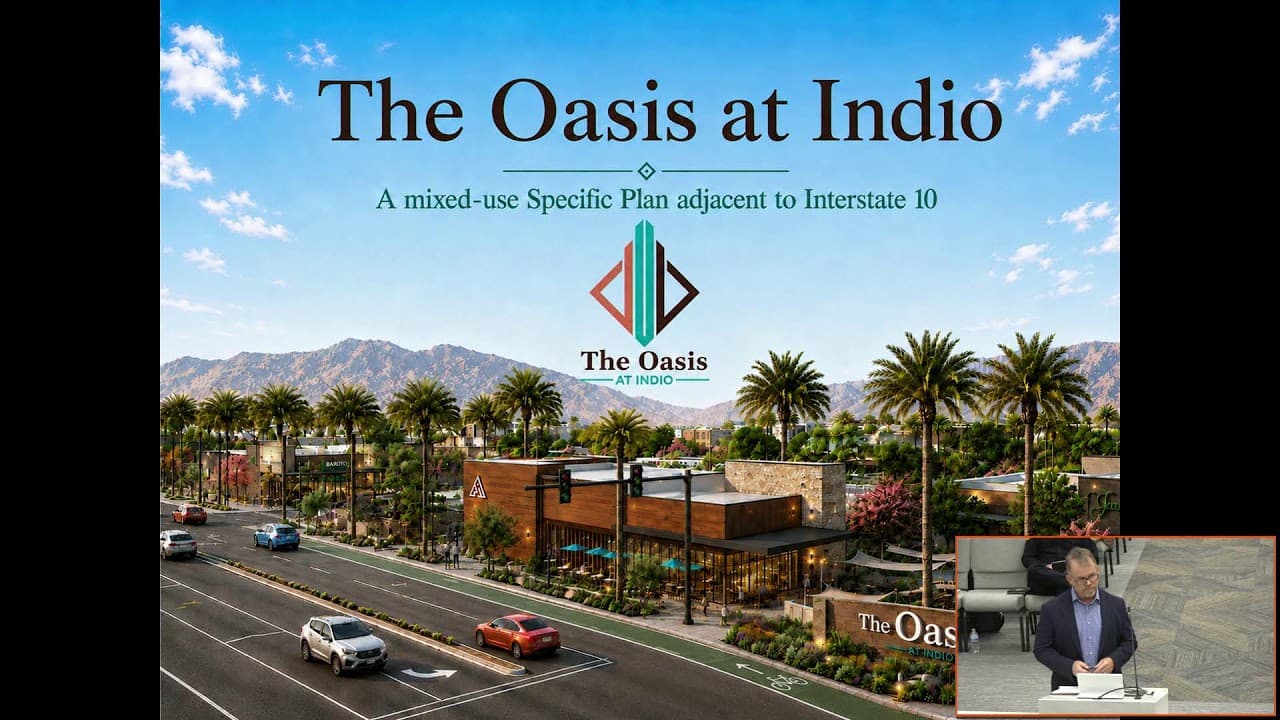
Oasis at Indio Hearing Opens on 183 Acres
Why it matters: The plan would allow up to about 3,200 homes and 1.8 million square feet of industrial space. That makes it one of the largest land-use decisions in front of the council.
Where things stand: Community Development Director Brian Halvorson described the site, north of Interstate 10 and south of Avenue 42. The package includes general plan and zoning amendments, a specific plan, a financing-only parcel map and a development agreement. The final environmental impact report found all impacts mitigable except greenhouse gases and air quality. Approval would therefore require a statement of overriding considerations, along with 34 mitigation measures.
"Without the Monroe Bridge expansion, this Oasis project cannot happen," Halvorson said. Development agreement benefits include $3.5M toward the Row Street/I-10 bridge, affordable housing, 3 acres of parkland and public safety contributions. The city engineer said the developer would build its westbound half of Avenue 42.
The other side: The Planning Commission recommended denial 3-2 on May 27, 2026. The applicant then cut industrial building heights from 100 to 65 feet, widened I-10 setbacks from 10 to 35 feet and added landscaping. Staff gave council both denial and approval options.
What's next: John Crump of BH Properties was presenting for the applicant, saying "we actually bought the first 100 acres back in 2013." Public comment, deliberation and any vote had not yet occurred. Locunity will report the outcome when available.
Minor Items
- Consent calendar passed 5-0, including a $500,000 federal grant for a citywide transportation Safety Action Plan with traffic-calming options. Holmes abstained on items 10.12 and 10.13 because she owns a nearby business.
- Sponsorship policy adopted unanimously: Resolution 10606 lets City Manager Jonathan Nicks accept sponsorships up to $75,000 without council approval.
- Hunger Action Month proclaimed: FIND Regional Food Bank reported 16.3% of Indio residents are food insecure. Martha's Village detailed about 46 beds and a pet-friendly shelter.
- Mayor Pro Tem Waymond Fermon urged a DMV temporary ID portal so outreach workers can place unsheltered residents quickly.
- Holmes reported a $1.25M Mountains Conservancy grant for shade along the CV Link.
Looking Ahead
The Head Trip festival is expected to draw about 80,000 people to the Empire Polo Club on Oct. 10-11. Avenue 50 between Monroe and Madison closes for about three weeks starting Sept. 29, and Monroe between avenues 50 and 52 closes on show days. A 24-hour resident hotline, 760-391-4112, opens the Wednesday before the event.