
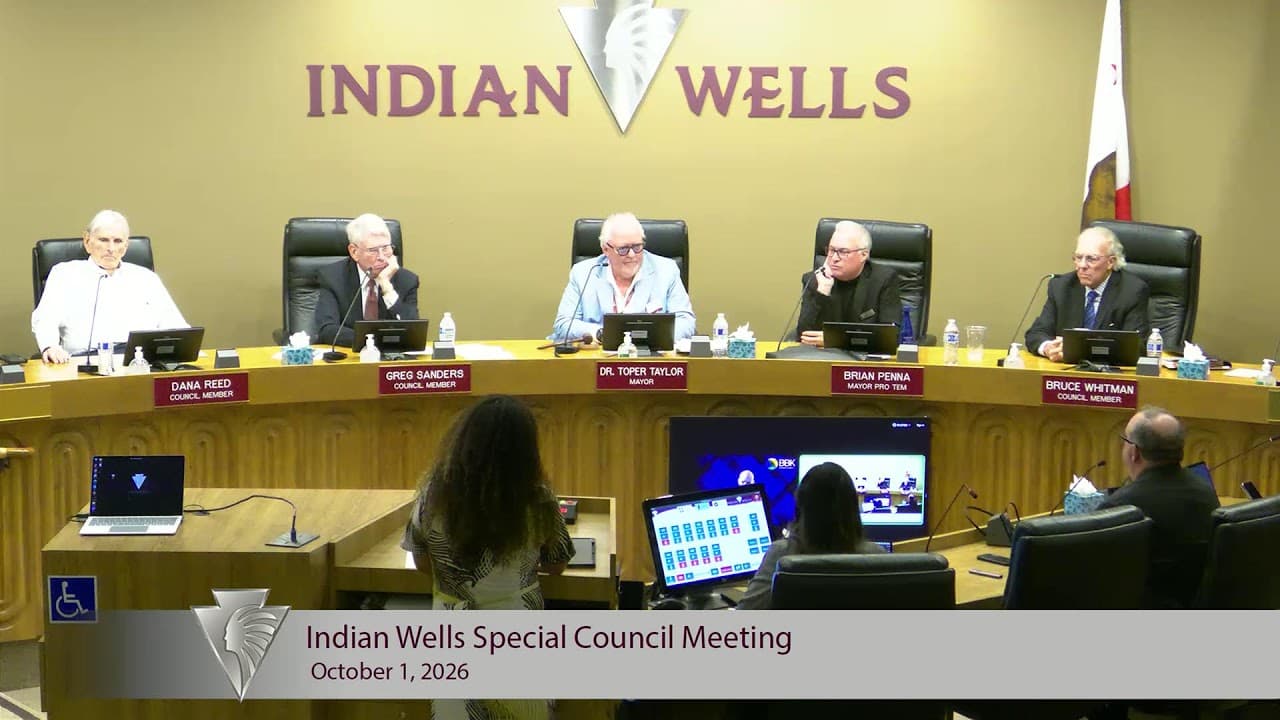
Council Backs Revised $900,000 WTA Finals Deal on 4-1 Vote
City Council • Indian WellsOctober 1, 2026
Locunity is an independent informational service and is not an official government page for this commission. All information is sourced from public footage and an analysis of official agendas with the aid of responsible, fact-checked AI. to report an error or omission.
Indian Wells will put up to $900,000 in general-fund money behind this November's WTA Finals, even though the tournament is moving to Charlotte, North Carolina, after this year. The City Council approved a renegotiated sponsorship 4-1 on Oct. 1, 2026, after residents questioned its value and Councilmember Bruce Whitman's $250,000 counteroffer died without a second. The council also unanimously approved $110,000 to patch Fairway Drive while a larger street redesign is still in engineering.
Revised WTA Finals sponsorship passes 4-1, capping city exposure at $300,000 above admissions tax.
Four residents challenge the deal's value, citing disclosure gaps and the lack of vetting.
Whitman's $250,000 alternative fails without a second after he calls the benefits "vague."
$110,000 approved for Fairway Drive patching as the Safer Streets rebuild slips toward 2028.
A Smaller Check for a Departing Tournament
The council approved a revised host city sponsorship for the 2026 WTA Finals and a $900,000 supplemental general fund appropriation. The tournament runs Nov. 8-15 at the Indian Wells Tennis Garden.
The basics: On Aug. 25, the council approved $1 million. That included the greater of $750,000 or admissions tax collected, $50,000 for resident tickets and $200,000 for activations, the sponsor-run events and promotions around the tournament. The WTA and Charlotte then announced a 2027-2029 partnership, and on Sept. 17 the council asked the city manager to reconsider. According to staff, the WTA apologized for not disclosing those negotiations and offered a revised package.
Where things stand: The new deal cuts activations to $100,000. It caps any city spending beyond rebated admissions tax at $300,000.
"So we're asking as part of our recommendation to revise that $1 million and drop it down to just $900,000," said City Manager Christopher Freeland.
The package adds several benefits:
Visibility at the draw party
Reusable WTA digital assets and a daily welcome video produced by the WTA
A trophy tour
Social media creators promoting Kestrel and the Indian Wells Golf Resort
A post-event newsletter
A formal right to bid on the 2030 Finals
Staff estimated revenue of roughly $809,000 to $850,000. That includes about $600,000 in admissions tax, $165,000 in transient occupancy tax (TOT, the city's hotel tax) and $30,000 to $75,000 in sales tax.
The City Attorney said the content-creator language promises promotion only, not city access to the content, and that the bid right is limited. "What we're getting is a seat at the table," he said.
The tax wrinkle: Councilmember Greg Sanders said the city's ticket tax ordinance does not define "nonprofit." "Under the terms of the current ticket tax ordinance, the WTA is probably an exempt event," he said. To avoid a dispute, the WTA collects the tax and the city rebates it. A measure to clarify the exemption will be on the November ballot, and Sanders credited Councilmember Dana Reed with taking the lead on it.
Whitman disagreed. He said the city's practice of collecting the tax from nonprofits, including BNP, combined with the WTA's weak finances, makes a lawsuit implausible.
The other side: Whitman, who opposed the August vote, pointed to Freeland's acknowledgment that "if the tournament occurred, there would be no loss of revenues of admissions tax or sales tax or TOT." He also noted that no WTA representative attended.
"We did not offer this sponsorship to induce the WTA to come here. That is the seminal fact," Whitman said. "I don't think the WTA has been a good faith negotiator."
The case for: Sanders confirmed with staff that about 70% of city revenue comes from tourism. Freeland said the projected surplus of about $6.3 million could reach $8 million to $9 million, with cash reserves of roughly $80 million to $90 million.
"We have to go out and we have to be entrepreneurial and we have to drive people to this city to stay in our hotels and spend their money here," Sanders said.
Mayor Toper Taylor estimated the value of the city's name on the court at "probably" $5 million to $15 million. He said North Carolina paid the WTA, "from what I've read, $14.4 million" to move its headquarters there. One councilmember rejected comparisons to the city's BNP Paribas support: "So how can you sit here and compare this deal to a deal that was drafted 20 years ago?"
Decisions and stakeholder impacts: The vote was For: 4 (Reed, Sanders, Mayor Pro Tem Brian Penna, Taylor), Against: 1 (Whitman), Absent: 0. Hotels, Visit Greater Palm Springs partners and local resorts gain exposure. Taxpayers carry up to $300,000 in risk beyond the rebated tax for a one-time event.
What's next: The City Manager is authorized to execute the agreement before the Nov. 8-15 tournament.
Residents Ask: What Does the City Get?
Why it matters: Four speakers framed the vote as a test of how a city of about 5,000 decides who gets public money.
Where things stand:
Ty Peabody, public commenter, said the August staff report left out the WTA's finances, its attendance figures and the Charlotte negotiations. He asked why the city's sponsorship policy wasn't followed. "Why wasn't it disclosed that the WTA has serious financial situation?" he said, reminding the council "this is resident money."
James Lee, public commenter, said repeated gifts to the Eisenhower, Living Desert and tennis lack a clear purpose. He argued clicks and impressions are not a real return on investment and urged the Grants and Aid Committee to meet more often to vet requests.
David Cartel, public commenter, said the city shouldn't pick winners and losers and contrasted the deal with $250,000 for BNP Paribas. "You get nothing in return for giving $1 million of our public money, our money away, right?" he said.
Alex Soshin, public commenter, said he supports tennis. He argued the negotiation "doesn't stand up to scrutiny" for a one-week event with limited resident tickets, and said he would rather fund Living Desert or Eisenhower through grants.
The council also received a written comment from Mark Lilly.
What's next: None of the four received a direct policy commitment. The push for a structured vetting process remains an open question for future sponsorship requests.
Fairway Drive Gets a Patch, Not a Repave
1 big thing: The council unanimously approved $110,000 for Onyx Paving to saw-cut and repave the worst sections of Fairway Drive between El Dorado and Cook Street. The work includes spots where the pavement meets the gutters, and Public Works expects it to be done within about four weeks.
Why it matters: "We did pause the paving program on that portion of the street while we waited for Safer Streets, but it has continued to deteriorate," said Public Works Director Dina Purvis. Onyx is already under contract for the city's Phase 5 local road paving.
Where things stand: Purvis said engineering for the Fairway segment of Safer Streets is stuck at 70% while right-of-way issues are resolved. She said Public Works expects work on Fairway to slip to about 2028. Designs for Cook Street, El Dorado and Rancho Palmares are moving from 70% to 90%.
"Because when we do bring Safer Streets through, we do not want to rip up brand new asphalt that we just paid for," Purvis said. She estimated a full repave of the stretch at "probably about $1 million, give or take."
The other side:
Councilmember Dana Reed asked why the city patches instead of repaving. "If we would restrict this road and prohibit commercial traffic on it, we probably wouldn't have as many potholes," he said.
Whitman said he favors full repaving.
Cartel criticized years of Safer Streets delays: "Now we're asking for supplementary money to fill in potholes on a thing that started in 2023."
Mayor Pro Tem Brian Penna, who lives on Fairway, sided with staff on timing. Citing an earlier Edison project that residents weren't told about, he asked for advance notice: "I'd like to have proper notice on this, please."
Decisions and stakeholder impacts: The motion passed unanimously by voice vote, seconded by Whitman. Residents get short-term relief but should expect rough pavement to linger until the redesign.
What's next: Plans for Cook Street, El Dorado and Rancho Palmares are due at the Oct. 16 council meeting. Taylor suggested bringing back a full Fairway repave as a future agenda item. Freeland said any repave would likely happen next summer to avoid disrupting the season.
Minor Items
The meeting opened with a moment of silence for Dick Oliphant.
The council approved the final agenda unanimously by voice vote.
Looking ahead: Watch the Oct. 16 council meeting for Safer Streets plans and the November ballot measure defining the ticket tax's nonprofit exemption.