
IID Adopts Large Load Tariff to Keep Data Center Costs Off Ratepayers
Board of Directors • Imperial Irrigation DistrictSeptember 15, 2026
Locunity is an independent informational service and is not an official government page for this commission. All information is sourced from public footage and an analysis of official agendas with the aid of responsible, fact-checked AI. to report an error or omission.
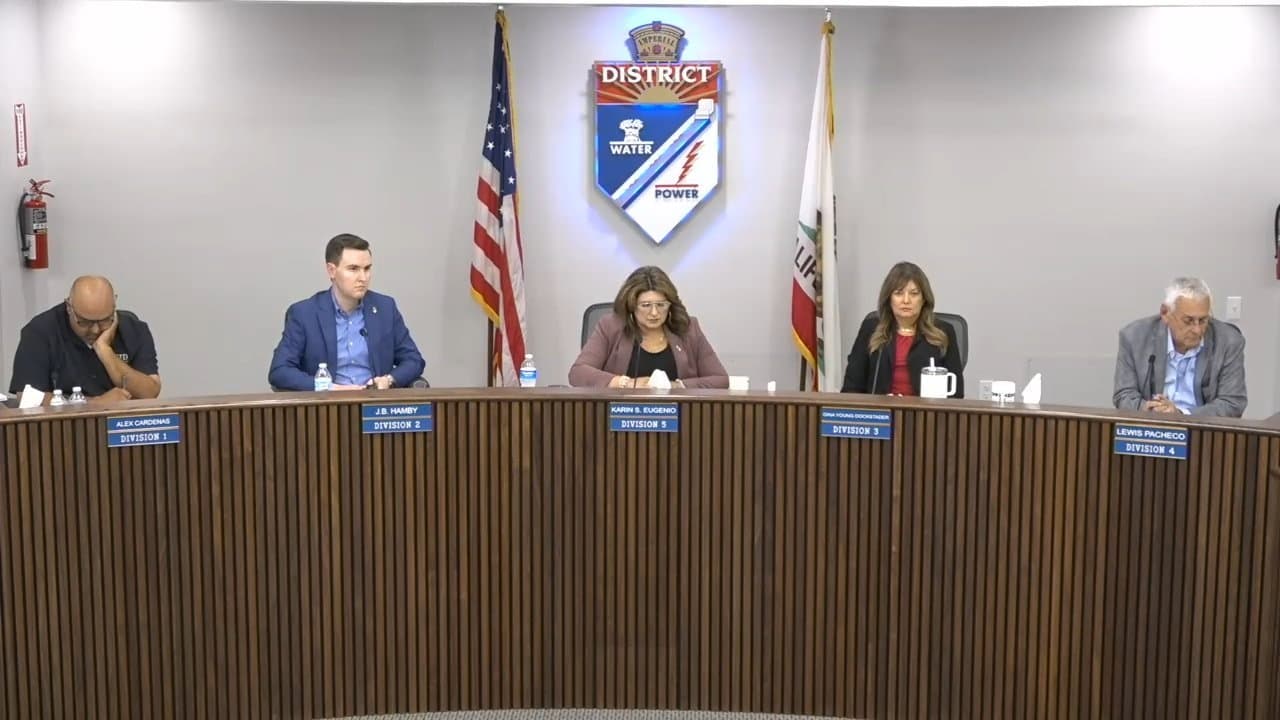
The Imperial Irrigation District board on Sept. 15, 2026, adopted a new rulebook for electricity customers drawing 20 megawatts or more, a category that includes data centers. Directors approved the Large Load Tariff on a voice vote after nearly a year of staff work and 243 public comments. Directors then cleared a series of Colorado River and grower water actions before recessing.
Large Load Tariff approved: 20 MW-plus users must cover their own grid costs and are first in line for power cuts.
Colorado River forbearance deals and 2026 Water Conservation Plan approved for Lake Mead and federal review.
Growers can return up to 7% of 2026 apportionment without year-end payment.
Power staff report more than 1,000 poles replaced, with quarterly progress reports promised.
Big Users, Big Bills: Tariff Clears Board
Why it matters: The tariff decides how data centers and other very large electricity users connect to IID's grid and who pays for it. Board members and most speakers framed it as protection against shifting those costs onto existing ratepayers.
The basics: A load factor compares a customer's average power use with its peak use. A high load factor means near-constant demand, the profile of computing facilities.
Where things stand: Deputy Power Manager Paul Rodriguez said the tariff was nearly a year in the making. Staff worked with finance, risk management and outside technical, legal and strategic consultants. He traced the effort to grid reliability concerns in 2023 and 2024 and to activity at federal grid regulators FERC and NERC.
A draft went to the board May 15. A 30-day comment period on OASIS, the utility's public transmission information system, drew 243 comments from developers and the public. In response, staff lowered the load-factor threshold and added language on co-located generation. "We were comfortable bringing it down to 80% from 85%," said Rodriguez.
The core framework did not change. It keeps the 20 MW definition, requires service at 69 kilovolts and preserves IID's right to interrupt service. "So they would be the first to go on the load shed block if we ever interconnect one of these," Rodriguez said.
The companion documents include:
A queue and service request process, cut from about 75 pages to 20 to 25 pages, with provisions on stalled applicants and clusters.
A cost responsibility agreement template.
Feasibility and full applications.
Confidentiality and nondisclosure agreements covering critical energy infrastructure information.
Why 80%: "The reason for 80% for you guys is very strategic," said consultant Ali Koslow. She said Arizona Public Service uses 92% for historical incentive reasons. IID's 80% line is meant to capture computational load without sweeping in mineral extraction or manufacturing, which run at about 70%.
Director Alex Cardenas asked whether the tariff squares with the federal Public Utility Regulatory Policies Act (PURPA) and with the board's control over its own ratepayer protections. Koslow said PURPA concerns generation, not load. "So really here what we're dealing with is load," she said.
Cardenas praised the transparency, collateral deposits and cost-shift protections. "I believe the policy is consistent, transparent, and non-discriminatory," he said.
The chair's stand: Board Chair Karin Eugenio delivered a pointed statement that referenced a lawsuit and intimidation. She framed the tariff as defending the community. "I will not be intimidated. I will not be silenced," said Chair Eugenio. "This is our home, not a dumping ground and not a colony for outside interests to exploit."
The other side: All three public speakers backed ratepayer protection, but one said the tariff does not go far enough. "I oppose hyperscale AI data centers in Imperial Valley because our communities should not shoulder their demands for electricity and water or the pollution from their generators," said public commenter Jake Tyson, an IID resident. Tyson noted the tariff could also cover crypto mining and lithium processing and cited SB 887. He asked for four stronger provisions: on curtailment, on water and environmental clearance before energization, on binding ESA protections, and on mandatory collateral. "Do not leave that protection discretionary," he said.
Gilberto Manzanares of Valle Imperial Resiste supported the tariff on cost grounds. "Then that corporation should be responsible for the costs necessary to meet that demand, not the ratepayers," he said. Public commenter Peter Rodriguez praised the board and staff. He also criticized the County Board of Supervisors over data-center and CEQA matters.
Decisions and stakeholder impacts: The tariff passed on a voice vote. Individual tallies were not announced. Existing ratepayers gain cost-shift and curtailment protections. Large-load developers get a defined, shorter queue process, but they must sign cost responsibility agreements and accept being cut off first. Water and air conditions that Tyson requested were not added.
Colorado River: Water Stays in Lake Mead
Why it matters: Two forbearance agreements give IID the legal basis to conserve Colorado River water. Under these agreements, other parties will not divert the unused water, and it stays in Lake Mead. Tina Shields of IID staff described the purpose as a way to "leave that water in Lake Mead to benefit the system."
Where things stand: The first agreement amends the 2026 agreement. It adds the additional SCIA conservation IID approved in May and a Metropolitan SCIA. The second covers 2027-28 extensions for the Coachella Valley Water District, a new wastewater plant, and the Bard and Quechan tribes.
Shields said most of the water stems from 2022 federal funding for 700,000 to 1 million acre-feet of lower-basin conservation. California's share is 300,000 acre-feet. The agreements remain in draft, but staff expect no changes.
The conservation plan: Directors also adopted the 2026 Water Conservation Plan. They approved a resolution authorizing its submittal to the U.S. Bureau of Reclamation, which federal law requires. Shields described a 100-page document covering 2022-24 history and 2025-29 planning, to be shared with California.
On fallowing, Shields said the district is not directing growers to idle land. "So it's not IID-directed fallowing," she said. She pointed instead to a temporary solar fallowing program and the Deficit Irrigation Program, which has about 75,000 acres left and is winding down. Director Cardenas praised staff for the work.
Decisions and stakeholder impacts: Both forbearance agreements passed on a voice vote with no board discussion. The conservation plan resolution also passed on a voice vote. Tallies were not announced for either. The actions advance California's federally funded conservation share and keep IID in line with federal planning rules.
Growers Get Year-End Water Relief
Why it matters: Growers can now hand back unused water without paying for it. That relief has been missing for years, and the returned water can flow to produce growers who need it.
Where things stand: Under the Equitable Distribution Plan, relief periods run during the last two weeks of each month from September through December. Growers will get email and text reminders. "You can return up to 7% of your apportionment, and you will not face the obligation to pay at the end of the year if you don't use that supply," said Shields. Farm units will also authorize IID to true up balances through end-of-year clearinghouse paperwork.
Director Cardenas asked three questions:
Why 7%? Shields said a 2013 committee estimated the figure to give flexibility and prevent hoarding.
Why no relief from 2018 to 2022? "I think there was a little litigation and we suspended the EDP during that time period," said Shields.
Do produce growers benefit? Shields said the program will push water into the clearinghouse.
Shields said no concerns had been raised. A director noted that Deficit Irrigation Program water is already removed from farm unit balances.
Decisions and stakeholder impacts: The measure passed on a voice vote. Tallies were not announced. Staff described 2026 as a year when water supply is not tight. Growers with surplus gain certainty, and produce growers gain access to more clearinghouse supply.
Power Projects Move Ahead of Schedule
Where things stand: Power Manager Matthew Smelser reviewed the Powering Our Communities Together program:
Completed work at El Centro Generation Station Units 2 and 3.
Repowering projects at Yucca and El Centro.
El Centro wastewater mitigation, at $18M in 2027 and $28M in 2028.
Drop unit rebuilds and joint powers projects with Indio on Avenues 40 and 42.
K-line hardening funded by a 70/30 grant.
The R-Line transmission project.
Energy Imbalance Market implementation in 2028.
On poles, IID has a 5,000 replacement target within an 8,000-pole, five-year transmission and distribution plan. "So right now we're over 1,000," Smelser said. He pledged quarterly reports to the board with key performance indicators.
What's next: Director Cardenas asked for an update on the Energy Imbalance Market and called it "an absolute game changer for us." Chair Eugenio asked for an update on ADMS. No vote was taken.
Minor Items
Drinking water aid rises: Directors approved an increase of about 14%, roughly $60 a year on a benefit of about $440, for low-income rural canal water users who must buy alternative drinking water.
Pole attachment fee lowered: A consent resolution amending Resolution No. 35-2024 cuts IID's annual pole attachment fee, which could ease costs for broadband and telecom providers.
Solar-plus-storage amendment: The board approved a first amendment to the Cedar 2 SES LLC solar and battery storage purchase agreement on consent.
CA-Line upgrade: The board approved Amendment No. 1 to the CA-Line Upgrade Project work authorization on consent. All four consent items, including the Sept. 1 minutes, passed on one voice vote.
Looking Ahead
Finance staff previewed a refunding of about $124.9M in Series 2016 B1 and B2 electric bonds, possibly paired with repaying about $40M in commercial paper. Staff estimated about $13M in cash-flow savings through 2046, roughly $9M in net present value and a 3.94% true interest cost. Documents come to the board for approval at the next meeting. Policy monitoring items, board reports and the 2026 annual work plan review were not reached before the board recessed.