
Commission Delays Rainbow East Gold Drilling Amid Quechan Opposition
Planning Commission • Imperial CountyOctober 28, 2026
Locunity is an independent informational service and is not an official government page for this commission. All information is sourced from public footage and an analysis of official agendas with the aid of responsible, fact-checked AI. to report an error or omission.
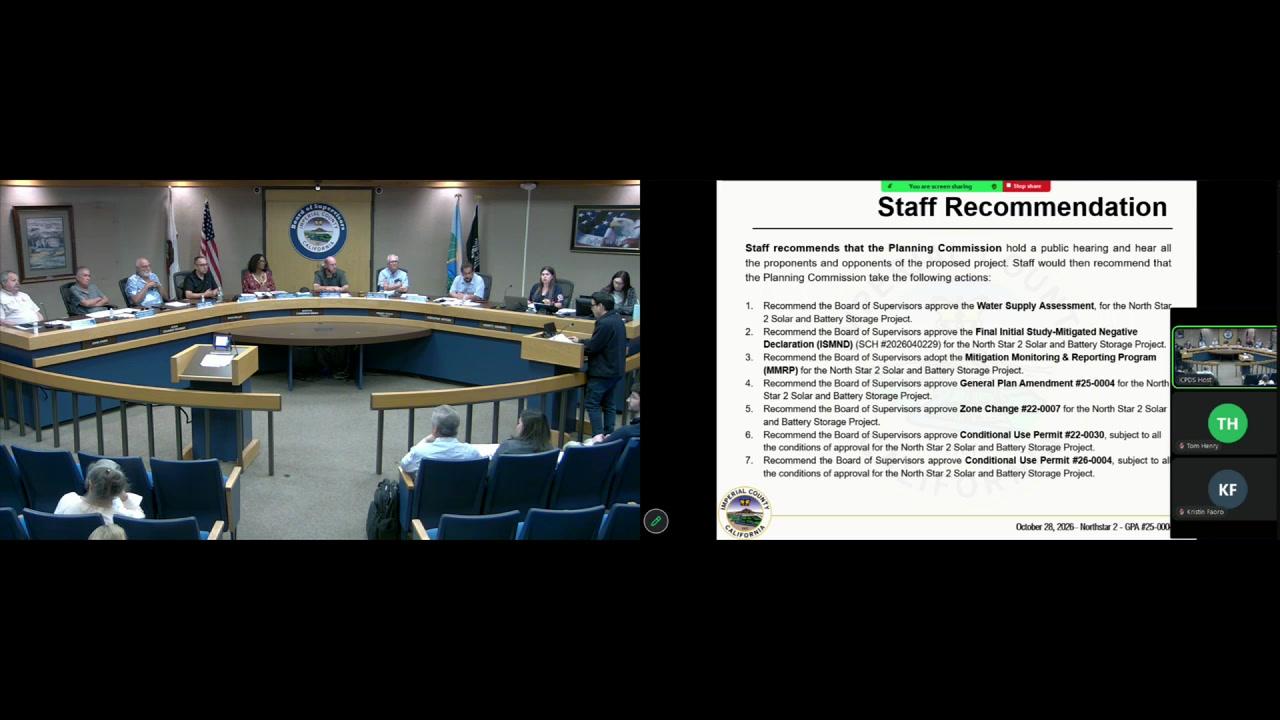
Imperial County's Planning Commission spent more than two hours on a proposal to drill for gold east of Highway 78. Tribal leaders and environmental groups lined up against it, and commissioners voted 8-0 to push the decision to Dec. 9. Earlier in the Oct. 28, 2026, meeting, the commission sent two solar projects to the Board of Supervisors with unanimous recommendations: the 130-megawatt North Star 2 near Brawley and the 20-megawatt Heber 1 facility.
- Rainbow East exploration continued to Dec. 9 after opponents said a 2002 environmental review can't cover new ground
- Quechan leaders say tribal consultation is incomplete, and the county will invite the Bureau of Land Management (BLM) to the next meeting
- Heber 1 solar wins 8-0 recommendations despite a labor-backed coalition's call to send the environmental report back to staff
- North Star 2's 130 MW solar and 175 MW battery project advances with a rezone, a general plan change and a groundwater well
Rainbow East Drilling Hits Pause
The basics: Western Mesquite Mines wants up to 24 months of exploratory gold drilling near its Mesquite Mine. The plan calls for access roads, up to 22 drill pads and 23 holes, disturbing about 2.34 acres temporarily. The commission is weighing two items: an addendum to a 2002 environmental impact report and environmental impact statement (EIR/EIS), and Reclamation Plan Amendment 24-0001.
Why it matters: The legal fight is over whether an addendum to a 2002 document can stretch to land east of Highway 78. Opponents say it can't, and some raised the prospect of litigation.
Where things stand: Bruce Stubing, of Benchmark Resources, the county's environmental consultant, said the old document doesn't have to be a perfect fit. "All that is required really is for that document to be sort of pertinent and have relevant informational value," he said.
Stubing said new site-specific studies were prepared and that the county received about 4,682 form letters. Under questioning, he acknowledged the 2002 review covered the area west of the highway. He also said the FEMA floodplain falls outside the area the project would disturb.
Mine attorney Tom Henry cited case law supporting the approach. "You look at the old CEQA document and you look to see, does it have some informational value?" he said. Henry added that a federal categorical exclusion (CATEX) is not at issue. He said the project proposes a stream alteration agreement with the California Department of Fish and Wildlife.
Luis Blancarte, representing Western Mesquite Mines, framed the request narrowly. "All we are seeking from this Commission today is an approval of the reclamation of those exploration plots," he said. Blancarte cited 40 years of production and about 800 direct jobs averaging roughly $82,000 a year. He also pointed to more than $6M in property taxes paid to the San Pasqual School District over 12 years.
The other side: Speakers said the new area is a different, sensitive landscape. They cited the Gables Wash, desert tortoise habitat and the Picacho Area of Critical Environmental Concern. Several argued that permanent road widening contradicts the "temporary" label.
"Use of an addendum for this project outside the scope of the earlier EIR does not comply with CEQA," said Cameron Brock, Center for Biological Diversity. "It needs a new environmental impact report," said Kerry Meister, conservation chair, Yuma Audubon Society. Meister argued the question is legal procedure, not economics. Public commenter Dale Burden called $6M over 12 years minimal.
One commissioner said it seemed odd the new area had not been studied. "To answer your question, we did study it," replied Ron Lakin, permitting manager, Western Mesquite Mines. Lakin cited three years of work.
Staff noted the exploration sits on BLM land. Any mine expansion would come back for separate permits.
Quechan Leaders: Awareness Isn't Consent
Why it matters: A tribal letter arrived the day before the hearing. The commission, the county and BLM each run separate consultation tracks, and the gap between them drove the delay.
Where things stand: Tribal council members and the tribe's president said the area is ancestral land. They noted it lies in a proposed monument area and the Picacho conservation area. They said BLM has found a traditional cultural property there eligible for the National Register of Historic Places.
"It is premature for Imperial County to rely on an incomplete federal consultation process to support project approval," said Jonathan Cotien, President, Fort Yuma Quechan Indian Tribe.
"I want you to halt it where it's at so we can get adequate surveying and reports done and proper consultation government to government with the Quechan Tribe," said Zion White, Councilman, Quechan Indian Tribe.
Tribal council member Chris Boaty-Elward said undiscovered intaglios exist in the area and asked for more studies. Daniela Flores, Imperial Valley Equity and Justice, invoked free, prior and informed consent. She noted "the County of Imperial had to issue a public apology to the Quechan community." Queer Casa and students from San Diego State University Imperial Valley also spoke in solidarity.
The other side: Stubing laid out the timeline. AB 52 notices, required under California's tribal consultation law, went out in August 2025. The addendum was sent Sept. 25, and two letters arrived Oct. 27.
Blancarte said the mine has done outreach since 2023. "Their assigned person has not brought up any issues to us," he said. Cotien countered: "We are aware of the project, but that does not mean that we are in support or that we don't have any concerns moving forward with the project."
Director Jim Minnick of Planning & Development Services said the county has met its AB 52 mandate, "but there is always room to continue that conversation." He noted that federal and state consultation are separate processes. One commissioner urged both sides to communicate better and engage earlier in the process. "This is just the Planning Commission, a review commission that makes a recommendation," the commissioner said.
Decisions and stakeholder impacts: A commissioner moved to continue items 4A and 4B to Dec. 9 for more consultation. The chair said that is the next available date because the building is under renovation.
Blancarte asked for a firm date no more than two weeks out. Another commissioner proposed requiring an EIR for all affected land, but no vote on that proposal was recorded.
The continuance passed on a roll call: For: 8 (Chairman Rudy Schaffner, Vice-Chairman Carson Kalin, Commissioners Sergio Cabanas, Anthony Gallegos, Ernesto Medina, Scott Wright, Katheryn Cynthia Dunn and Jose Hinojosa), Against: 0.
What's next: "We can put an invite to the BLM to come to the next planning commission meeting when we schedule it," Minnick said.
Heber 1 Solar Advances Over Coalition Objections
The basics: Heber Field Company seeks Conditional Use Permit 25-0010 for a 20 MW solar facility at 602 Dogwood Road in Heber. The facility would supply "parasitic load," the power the existing Heber 1 geothermal plant uses to run itself. Three routes for the connecting cable are under consideration, and one will be chosen.
Where things stand: Planner II Alan Molina presented the project. The county's environmental consultant, HDR, walked through the review timeline: a notice of preparation on Oct. 29, 2025, and a draft EIR comment period from Jan. 28 to March 18, 2026.
The applicant's representative, Alyssa Sanchez, asked that Public Works condition S-23 reference compliance with Public Works regulations and the mitigation program. The chair accepted the change.
The other side: Khalila Fetterman spoke for Citizens for Responsible Industry, a coalition of individuals and labor organizations. She argued the county failed to respond adequately to comments and that decommissioning emissions were never quantified. She also said nitrogen oxide (NOx) and fine-particle (PM10) emissions exceed standards.
"The Planning Commission should remand the project to staff to prepare a legally adequate EIR," Fetterman said. HDR said its review of the coalition's late letter found no new issues.
Decisions and stakeholder impacts: Three roll calls each passed 8-0 (For: 8, Against: 0). They recommended the final EIR, the mitigation monitoring and reporting program, and the permit. The coalition's air quality and decommissioning objections remain on the record as the project heads to supervisors.
North Star 2 Clears Commission Without Opposition
The basics: APEX Energy Solutions plans a 130 MW solar facility with a 175 MW battery storage system at 3016 East US Highway 78 near Brawley. The project also includes a substation, a groundwater well and site access.
Why it matters: The parcels are designated recreational open space and zoned S-2, and they sit outside the county's renewable energy and transmission element. General Plan Amendment 25-0004 and Zone Change 22-0007 would shift the land to S-2RE, which adds a renewable energy overlay.
Where things stand: Planner II Luis Bejarano said the well would supply 7.2 to 10.8 acre-feet a month during 12 to 18 months of construction. In operation, it would supply about 10 acre-feet a year. The site borders BLM land, and access requires a Caltrans encroachment permit.
Sharon Hidalgo of HDR said the environmental review, a mitigated negative declaration, found significant but mitigable impacts to biological, cultural, geology and soils, and tribal cultural resources. Agencies and Defenders of Wildlife submitted comment letters. No one spoke during the public hearing.
Decisions and stakeholder impacts: The commission took seven roll-call votes covering the water assessment, environmental review, mitigation program, general plan amendment, rezone and two permits. Five votes were recorded 8-0. The other two passed with no dissent recorded. The chair declared items 2A through G approved for recommendation to the Board of Supervisors.
- Minutes: Commissioners held a roll call on the Sept. 23, 2026, minutes, but no result was announced.
Looking ahead: Rainbow East returns Dec. 9, and the county will invite BLM to attend. The North Star 2 and Heber 1 recommendations now go to the Board of Supervisors.