
Geothermal Plant Pushes Steep Tax Cut as Supervisors Race Election Clock
Board of Supervisors • Imperial CountyNovember 9, 2026
Locunity is an independent informational service and is not an official government page for this commission. All information is sourced from public footage and an analysis of official agendas with the aid of responsible, fact-checked AI. to report an error or omission.
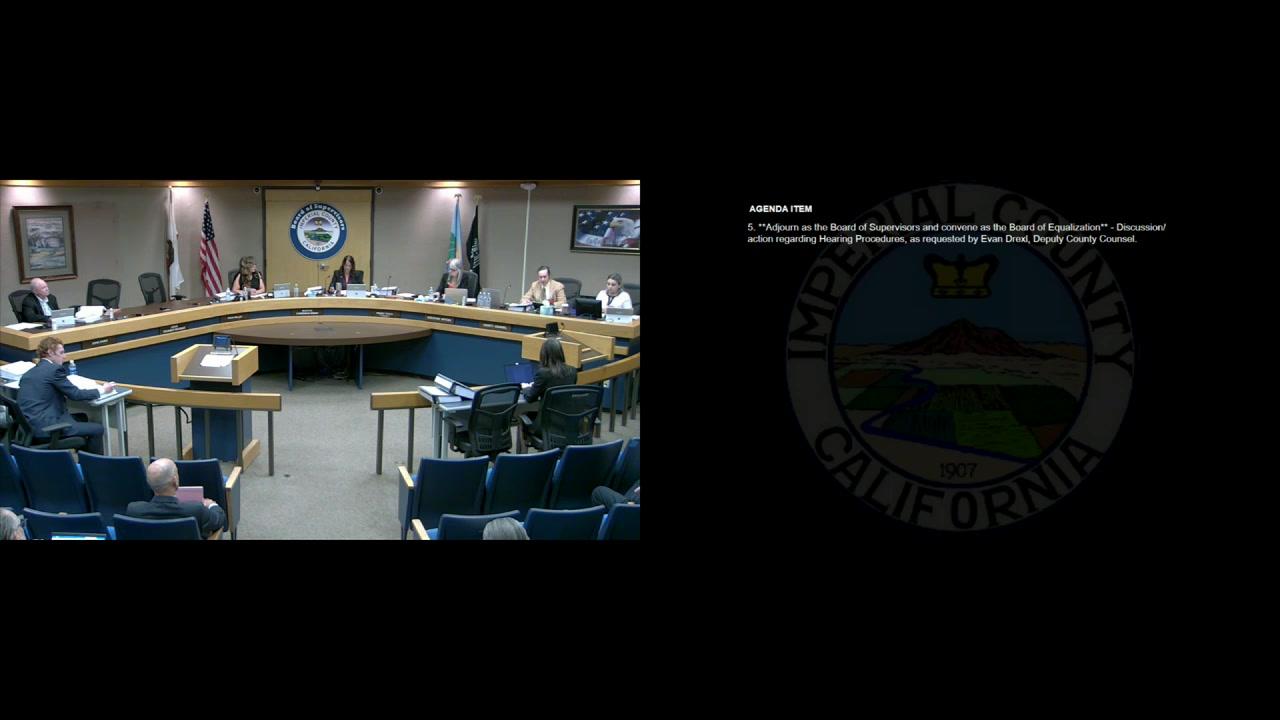
Hudson Ranch Power I LLC asked Imperial County to cut its geothermal plant's taxable value by tens of millions of dollars per parcel. It argues the plant should be taxed on market electricity prices, not its 2007 power contract. Sitting as the Board of Equalization on Nov. 9, 2026, three supervisors adopted hearing rules, heard the applicant's full case and set an expedited timeline to rule before possible post-election membership changes.
- Contract vs. market: Hudson Ranch says its 2007 Salt River Project contract is an untaxable intangible.
- Assessor vows to "hold the line," citing a 2025 California Supreme Court ruling.
- Applicant's appraiser values the plant at $63.9M, $46.6M and $15.2M for 2021–2023.
- Board admits a decade of prior market-based valuations over the assessor's objection.
- Election clock: Board fast-tracks the record, aiming to decide before Thanksgiving.
A Geothermal Plant, a 2007 Contract and a Tax Fight
Why it matters: The outcome sets how much property tax the county collects from a 55-megawatt geothermal plant. Valuations on the regular 2023–24 appeals alone differ by more than $60M per parcel.
The basics: The board heard six appeals together. Four are escape assessments, which are bills for value the assessor says was missed in earlier years, covering 2021–22 and 2022–23. Two are regular 2023–24 assessments. In those two, the applicant seeks reductions from about $82.8M to about $16.1M and from about $105.5M to about $20.4M.
Where things stand: "This is a property tax dispute about the fair market value of a geothermal power plant owned by my client," said Colin Fraser, counsel for Hudson Ranch Power I LLC.
The plant was built in 2012 and sells its power to Salt River Project under a 2007 agreement. Fraser argued that state law excludes above- or below-market contracts from taxable value as intangibles. He cited Revenue and Taxation Code sections 110 and 212, the Elk Hills case and others. He said the Freeport and Watson cases dealt with discontinued standard offer contracts. He also said the assessor used market rates from 2013 until changing course after a 2020 ownership change.
Supervisor, District 5, John Hawk asked the investor's witness, "What is the risk of building a plant without a PPA, in your opinion?" "Our investors don't give us money to speculate," replied Domingo Solis Hernandez, managing director, Macquarie Asset Management. He testified that investors expected property tax based on market value. "You don't value the PPA, you value the market," he said.
The other side: Robin Thornton, counsel for the Assessor, called contract versus market income "the core of this case." She acknowledged the assessor had previously valued the plant at market rates and called the county an outlier. She also conceded: "I would stipulate to the fact that the assessor did not follow the law in terms of capturing the value before."
To narrow the dispute, Thornton offered to accept the taxpayer's discount rates of about 10.98% and 12% in place of the assessor's 15%. She cited Olympic and Georgia Partners v. County of Los Angeles (18 Cal. 5th 739), the 2025 state Supreme Court decision. She also pointed to the portion of section 212 that allows intangibles to be assumed in valuation. "The assessor is here today to hold the line and make sure that the property does not continue to escape assessment," Thornton said.
Decisions and stakeholder impacts: No ruling yet. If the assessor prevails, the plant's taxable value and county revenue would rise. If Hudson Ranch prevails, its owners and Macquarie-backed investors keep a market-based tax bill. Hawk framed the county's stance: "The county is looking for a fair market, not to skin anybody that wants to invest."
Experts Say Market Prices Fell Below Contract
Why it matters: The applicant's expert values are its target number. They fall far below the assessed roll values.
Where things stand: Arne Olson, senior partner, Energy and Environmental Economics (E3), walked the board through decades of power market history. He covered the federal PURPA law, standard offer contracts, FERC Order 888, the state grid operator CAISO, resource adequacy and renewable credits. Asked whether plants like Hudson Ranch operate under mandated contracts, he said, "No, there are no government-mandated contracts."
Olson testified that natural gas, solar and wind prices fell through 2023. Asked why prices are now climbing, he answered: "It's the data centers."
Jeff Durant, appraiser and tax agent for Hudson Ranch, used a discounted cash flow analysis cross-checked against comparable sales. He recommended values of "January 1st, 2021, $63,898,000. For January 1st, 2022, $46,579,000. And for 2023, $15,206,000." The 2023 figure reflects a roughly $35M well and a higher discount rate. Durant said his team added $18.50 per megawatt hour to Wood Mackenzie price forecasts.
The other side: On cross-examination, Olson acknowledged he is not a lawyer and that the contract was in force on every lien date. Durant said he holds no appraisal licenses or certification. "I'm not an attorney," he added.
Decisions and stakeholder impacts: The applicant moved exhibits 14 through 30 into evidence. These are stipulations to value and assessor valuations from 2013 through 2022. Thornton objected on relevance, saying past resolutions arose from ongoing appeals. Deputy County Counsel Evan Drexl recommended admitting the exhibits and weighing the objection later. Board Chair and Supervisor, District 3, Peggy Price overruled the objection.
The ruling lets Hudson Ranch argue that the 2023 methodology departs from a decade of practice. Fraser then rested: "Our direct case in chief is complete."
Rules Set, Clock Ticking Toward Dec. 3
Why it matters: Under state law, a missed decision deadline can default the outcome to the taxpayer. A change in board membership could also force a retrial.
The basics: Drexl explained the board's role this way: "The primary function of the local board of equalization is to increase or decrease individual assessments in order to equalize assessments on the local assessment roll." The board acts quasi-judicially. It hears sworn testimony, applies a preponderance-of-the-evidence standard and issues final decisions appealable only to Superior Court.
Where things stand: Supervisor, District 4, Ryan E. Kelley recused himself over a financial interest. Supervisor, District 1, Jesus Eduardo Escobar was absent. That left Price, Vice Chair and Supervisor, District 2, Martha Cardenas-Singh and Hawk as a bare three-member quorum.
The parties disputed six sections of the proposed procedures, and the board settled each by motion:
- Hearing days were set for Nov. 9, 12 and 13.
- The 2.5-hour per-side limit was dropped, with openings of about 20 minutes.
- Written testimony was allowed without a fixed 10-minute presentation limit.
- The parties' joint statement was accepted as the written offer of proof for extra time.
- No witnesses will be excluded.
On burden of proof, the assessor carries it on the four escape assessments and the applicant on the two regular ones. Hudson Ranch presents first on all six.
The other side: Hudson Ranch proposed 75- to 90-day timelines for findings. The assessor's counsel pushed a compressed schedule, citing election certification on Dec. 3 and possible changes in the board's makeup. One supervisor warned that a departing member could not vote and that a statutory default would favor the taxpayer. Counsel noted that the last meeting with current members is Dec. 22.
Decisions and stakeholder impacts: On Hawk's motion, the board waived the November deadline, allowed post-hearing findings and briefs of up to 30 pages, and ordered an expedited court reporter record. Drexl urged the board to "make every effort to finalize the results before the Thanksgiving break, basically." The board then adopted all procedures as amended. All nine motions passed by voice vote; tallies were not announced.
Minor Items
- Agenda order approved by voice vote on Hawk's motion, seconded by Cardenas-Singh.
- Hearing program entered into the administrative record by order of the chair.
Looking Ahead
The assessor presents its case Thursday, Nov. 12, at 8:30 a.m., with Friday also proposed as a hearing day. Watch whether the board can rule before Dec. 3 certification. The current board's last meeting is Dec. 22.