Niger's Justice Minister Clashes With NGOs as Council Adopts Four UPR Outcomes
Human Rights Council • United NationsSeptember 25, 2026
Locunity is an independent informational service and is not an official government page for this commission. All information is sourced from public footage and an analysis of official agendas with the aid of responsible, fact-checked AI. to report an error or omission.
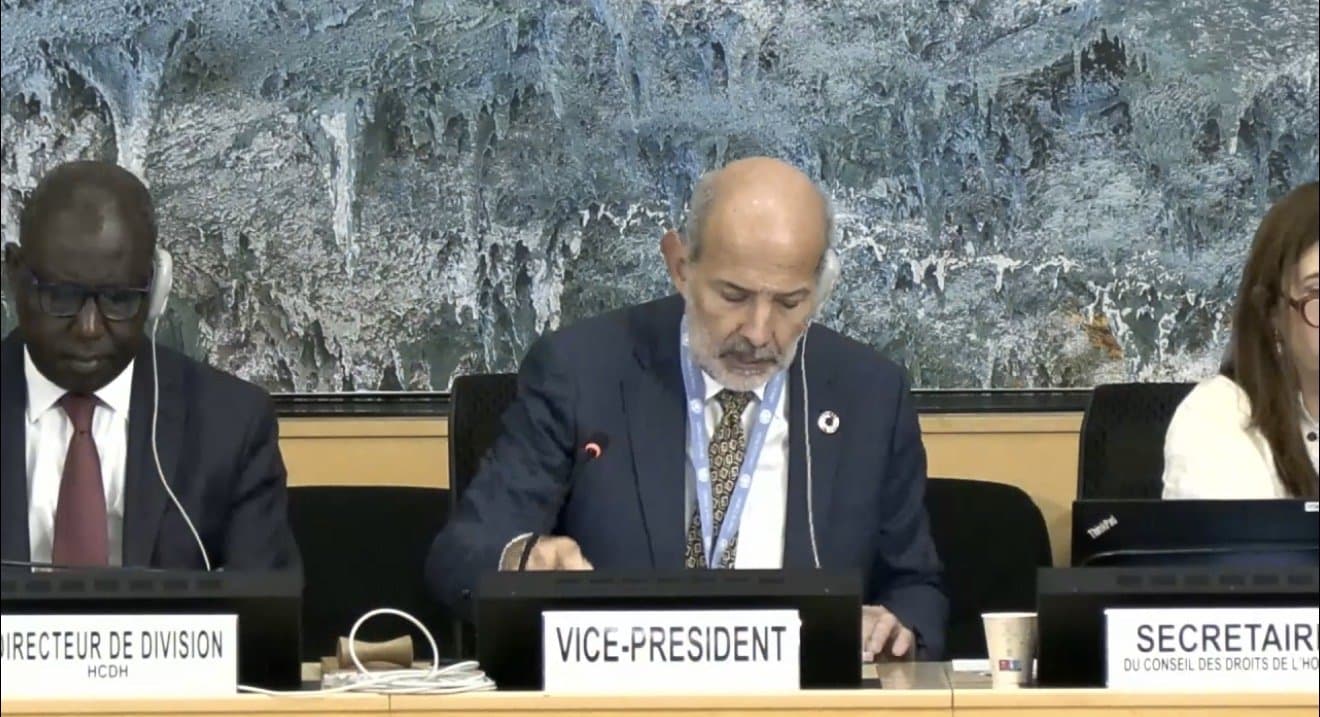
The Human Rights Council wrapped a marathon session adopting Universal Periodic Review outcomes for Namibia, Niger, Mozambique, and Estonia — all by consensus, none without friction. The sharpest confrontation came when Niger's justice minister rejected point-by-point the claims of civil society groups documenting a civic-space collapse since the country's 2023 military coup, while Mozambique faced pressure over near-total impunity for security forces accused of post-election killings.
- Niger's justice minister delivers combative defense of military government, rejecting NGO claims of disappearances and arbitrary detention while accepting 254 of 265 UPR recommendations
- CIVICUS reports Niger has fully implemented just 1 of 14 prior civic-space recommendations since the 2023 coup; defender Moussa Changari remains detained
- Mozambique accepts 284 of 292 recommendations but only 2 of 742 post-election criminal cases have resulted in security-force indictments
- Namibia posts one of the cycle's highest acceptance rates — 255 of 290 recommendations — while its government appeals the court ruling that decriminalized same-sex conduct
- Estonia announces consent-based rape law and hate-speech bill already advancing through parliament; Russia objects on minority-language education
Niger Defends Its Record as Civil Society Documents Crackdown
The basics: The Universal Periodic Review is the U.N.'s peer-review mechanism through which every member state's human rights record is examined on a regular cycle. Countries receive recommendations from other states and must publicly accept or "note" each one. Niger's review comes amid its most turbulent period in years — a military junta seized power in July 2023, dissolved political parties, suspended civil society organizations, and banned several international media outlets.
Why it matters: Niger accepted 254 of 265 recommendations and noted 11, some touching on what the delegation called "cultural and religious values." But the gulf between accepted commitments and conditions on the ground made this the session's most contentious adoption.
Where things stand: Minister of Justice and Human Rights Aliou Daouda delivered lengthy opening and closing statements framing Niger's challenges through the lens of sovereignty. He accused "foreign powers" of destabilization attempts and defended the country's withdrawal from the International Criminal Court and restrictions on civic space as security measures.
When confronted with reports of forced disappearances, the minister was categorical: "Niger is not a country which disappears its citizens. Nobody has been disappeared in Niger. They are being held in detention. They committed offenses and they'll have to answer for them in court."
He also defended the suspension of NGO prison visits as a security necessity after an armed assault on a high-security facility: "Hodkala High Security Prison was attacked. That's the proof of what we're saying. There are countries that decided they would attack that prison in order to release terrorists."
The other side: Civil society groups painted a starkly different picture. A delegate from CIVICUS told the Council: "Since the July 2023 military coup, the situation has severely deteriorated. CIVICUS rates Niger civic spaces repressed, indicating severe restrictions." The organization reported that only 1 of 14 prior civic-space recommendations had been fully implemented, that human rights defender Moussa Changari remains arbitrarily detained, and that the cybercrime law has been used against journalists.
The International Federation for Human Rights Leagues flagged the disappearance of journalist Musaka and the stripping of nationality from 25 dissidents. A delegate from Advocates for Human Rights commended Niger for accepting all 28 death-penalty recommendations but noted that courts continue issuing death sentences and that NGO access to prisons has been suspended.
Decisions: The UPR outcome was adopted by consensus with no objections. Multiple member states — including Ethiopia, Ghana, India, Iran, Nigeria, Russia, and others — offered supportive statements and recommended adoption.
What's next: With civic-space conditions worsening and political detainees still held without trial, implementation monitoring will be the critical test. The gap between Niger's 96% acceptance rate and its on-the-ground record since the coup makes this one of the cycle's most watched cases.
Mozambique Faces Accountability Questions Over Post-Election Violence and Cabo Delgado
Why it matters: Mozambique accepted 284 of 292 recommendations — but noted those related to the Rome Statute of the International Criminal Court and those concerning associations of persons with "alternative sexual orientation." The high acceptance rate masks serious enforcement concerns, particularly around the country's two overlapping crises: the Cabo Delgado insurgency and the violent crackdown on post-election protests in 2024.
Where things stand: Minister of Justice, Constitutional and Religious Affairs Mateus de Cecília Finhas Sales presented a detailed national position, emphasizing the Malabo Protocol — the African Union's own mechanism for international criminal jurisdiction — as Africa's alternative to the ICC.
The most damning statistic of the session came from a delegate from Ingenieur du Monde: "Of 742 criminal cases opened following the 2024 post-election violence, 31 involved security forces, yet only 2 had resulted in indictments by April 2025."
NGO statements also raised concerns about ongoing displacement and child recruitment in Cabo Delgado, the killing of Bishop Afonso, internet shutdowns targeting journalists, one of the world's highest child-marriage rates, and risks to communities near liquefied natural gas projects.
Decisions: Adopted by consensus. Member states including Ghana, India, Portugal, Brazil, and Russia commended Mozambique's engagement with the process.
What's next: With near-total impunity for security forces and the Cabo Delgado conflict still displacing hundreds of thousands, the Council's ability to press for meaningful follow-through will define whether these accepted recommendations carry any weight.
Namibia Posts High Acceptance Rate, but LGBTQ+ Advocates Press on Decriminalization Appeal
Why it matters: Namibia supported 255 of 290 recommendations — an 87.9% acceptance rate, one of the highest this UPR cycle — while 35 recommendations were noted and remain under review. But the country's decision to appeal a 2024 High Court ruling that decriminalized same-sex conduct creates a direct tension with several of the recommendations it accepted on anti-discrimination.
Where things stand: A delegate from ILGA World welcomed Namibia's acceptance of four LGBTQ+-related recommendations on discrimination and gender recognition but urged the government to withdraw its appeal of the High Court ruling and to review the Marriage Act 2024's exclusion of same-sex marriages. The International Planned Parenthood Federation called for domestic violence protections to be extended to same-sex couples.
Other stakeholders raised technology-facilitated gender-based violence, indigenous San communities' land rights, and Namibia's foreign policy stances. A delegate from United Nations Watch delivered a sharp critique: "Where is Namibia's solidarity with Iranian women beaten and imprisoned for demanding freedom? Where is the solidarity of Namibia with Ukrainians invaded, bombed, and abducted by Russia?"
Ambassador Elvis Tolotashi Weida, Namibia's Permanent Representative, closed by framing the country's approach in practical terms: "Our aim is not compliance in form of a law, but progress in practice; not commitments on paper, but improvements lived by our people."
Decisions: Adopted by consensus with no objections.
Estonia Advances Consent-Based Rape Law and Hate Speech Bill
Why it matters: Estonia accepted 208 of 273 recommendations, noted 61, and partially supported 4 — a rate above 75%. Unlike several other countries reviewed this session, Estonia arrived with concrete legislative action already underway on key commitments.
Where things stand: Ambassador Riia Salsa-Audiffren, Estonia's Permanent Representative, highlighted the country's June penal code amendments: "The Estonian Parliament adopted amendments to the Penal Code introducing a consent-based definition of rape, an important step towards bringing Estonia's legal framework in line with international standards."
She also outlined a draft hate-speech law broadening hate-crime definitions, the "AI Leap" program for digital literacy, and simplified naturalization for children of undetermined citizenship. Estonia committed to a voluntary midterm report on implementation.
The other side: Russia's delegation criticized Estonia for not accepting recommendations on simplifying naturalization broadly, ending linguistic inspections in Russian-language schools, ensuring equal representation, and what it called annual "Waffen-SS demonstrations." A delegate from the World Jewish Congress raised concerns about rising antisemitism, vandalization of a Holocaust memorial, and the absence of dedicated hate-crime or Holocaust-denial criminal provisions. Advocates for Human Rights flagged domestic violence funding gaps.
Decisions: Adopted by consensus with no objections.
What's next: Estonia's voluntary midterm report commitment will provide an early test of follow-through on the consent-based rape law and hate-speech legislation. Russia's objections on minority-language education signal that the issue will remain a recurring point of friction.