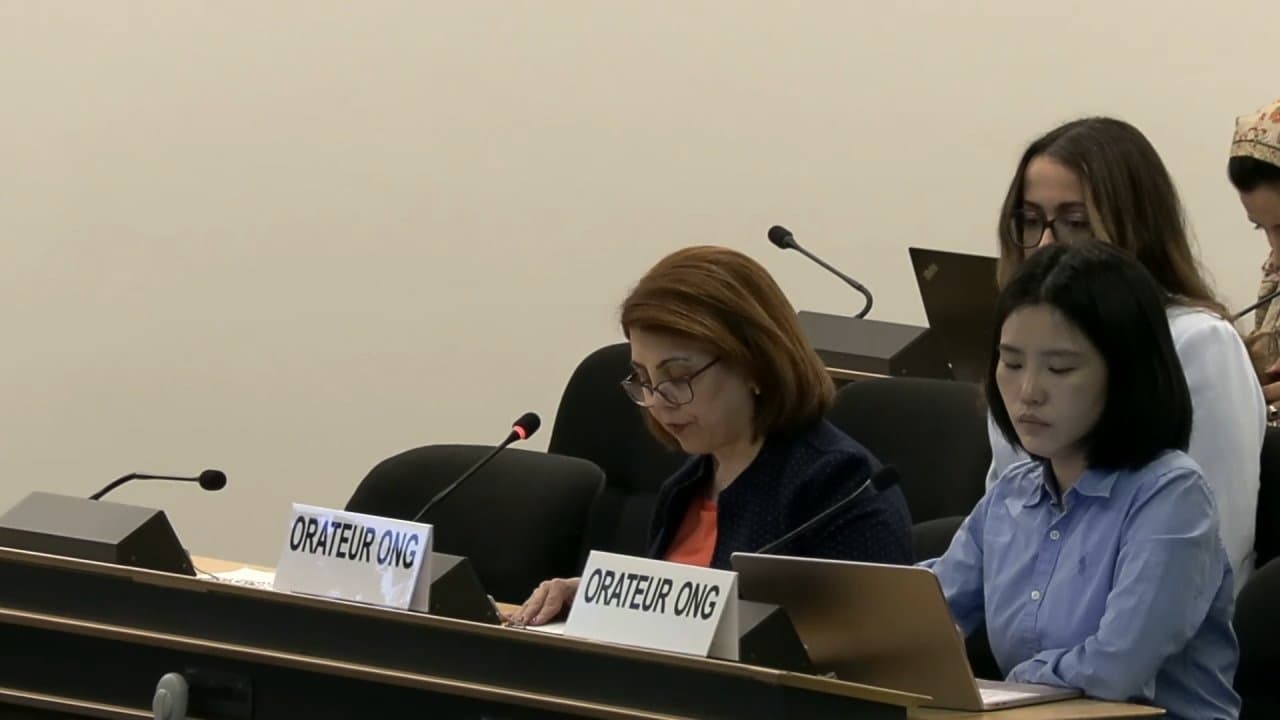
22nd Meeting - 63rd Session of Human Rights Council
Human Rights Council • United NationsSeptember 22, 2026
Locunity is an independent informational service and is not an official government page for this commission. All information is sourced from public footage and an analysis of official agendas with the aid of responsible, fact-checked AI. to report an error or omission.
NGOs Sound Alarm on Iran Executions, Kashmir Crackdown, and ICC Sanctions
The Human Rights Council's 63rd session heard more than 60 NGO and national human rights institution statements in a marathon general debate that laid bare the scale of global human rights crises demanding international action. From Amnesty International's finding that Iran committed crimes against humanity to crush the Women, Life, Freedom uprising, to reports of over 100 civilians killed in Pakistan-administered Kashmir, to U.S. sanctions targeting International Criminal Court judges, the session underscored the growing gap between documented abuses and Council accountability mechanisms.
- Amnesty International alleges Iran committed crimes against humanity to crush the Women, Life, Freedom uprising, calls for ICC referral
- Over 100 civilians reportedly killed in Pakistan-administered Kashmir since June 2026 as security forces use lethal force against protesters
- U.S. sanctions target over a dozen ICC personnel including 9 judges; Human Rights Now says goal is to "systematically disable" the court
- Human Rights Watch calls for dedicated Xinjiang discussion 10 years after abuses escalated, citing unaddressed OHCHR findings of possible crimes against humanity
- At least five NGOs demand a Special Rapporteur on Sri Lanka, ICC referral, and recognition of Tamil self-determination
- Over 3,000 Christians reported massacred in Nigeria in the first eight months of 2026, with 19,000 churches torched over 16 years
- Bahrain strips 69 people of nationality without judicial proceedings and re-arrests political prisoners released under the 2024 Royal Amnesty
Iran's Uprising Crackdown Labeled Crimes Against Humanity
Why it matters: Amnesty International's new report represents the most detailed documented case yet for international criminal prosecution of Iranian officials over the 2022–2023 protest crackdown — and the execution machinery shows no sign of slowing.
Where things stand: A delegate from Amnesty International told the Council the organization had "exposed how the Iranian authorities committed crimes against humanity to crush the Women, Life, Freedom uprising, unlawfully killing hundreds of protesters and bystanders, persecuting their families, and subjecting thousands to arbitrary detention and forced disappearance or torture."
The scale of ongoing executions drew coordinated alarm. A delegate from the Advocates for Human Rights, co-signed by Iran Human Rights, reported at least 56 executions on political and security charges since March, with more than 100 protesters already sentenced to death. The organization called for an immediate halt and moratorium.
Other organizations spotlighted specific cases. A delegate from International Educational Development and the Kurdistan Human Rights Association Geneva highlighted the executions of Kurdish athletes including wrestler Saleh Mohammadi and karate champion Mohammad Mehdi Karimi. A delegate from ARC/ARCDH documented over 225 years of prison sentences imposed on Azerbaijani activists in Iran. The Human Women Human Rights International Association called for preservation of Gohardash Prison and mass graves as evidence of the 1988 massacres and reported that at least 23 women had been executed in 2026, with eight women currently under death sentence.
The Iranian Thalassemia Society raised a different dimension of the crisis, describing how U.S. sanctions have cut off Iranian patients — particularly those with thalassemia — from essential medications.
What's next: Multiple organizations called for an ICC referral and establishment of an international independent investigative mechanism. The concentration of demands signals likely pressure for new Council action on Iran in the remaining weeks of the 63rd session.
Over 100 Reported Dead in Pakistan-Administered Kashmir
Why it matters: Multiple organizations described what they called a major escalation of lethal force by Pakistan security forces against civilians in Azad Jammu and Kashmir, with communication blackouts preventing independent verification.
Where things stand: A delegate from Kudde Pus reported that since June 5, 2026, "Pakistan security forces, including Rangers and other formations, have used excessive and lethal force against civilians. Alongside allegations of targeted killings, arbitrary detention, looting, vandalism, and violation of private property. More than 100 civilians have reportedly been killed, including a female lawyer, 2 doctors, a PhD scholar, elderly persons, and predominantly young people."
The African Development Association corroborated these reports and called for an independent investigation. The Al Baraim Association drew contrasts between conditions in Pakistan-administered and Indian-administered Jammu and Kashmir.
The other side: Several organizations broadened the lens on Pakistan beyond Kashmir. The Patiala Foundation raised the destruction of Hindu temples and Sikh gurdwaras, citing Pakistan's own parliamentary committee data showing only 37 of 1,817 remain functional. The Sambhali Trust reported on forced conversions of Hindu women and girls in Sindh province. The Focus Asia Foundation condemned enforced disappearances across Pakistan and called for the release of Dr. Mahrang Baloch.
What's next: NGOs called on the Council to authorize an independent investigation into the Kashmir crackdown and to press Pakistan to lift internet blackouts and release detainees.
U.S. Sanctions on ICC Judges Draw Sharp Condemnation
Why it matters: The United States has sanctioned over a dozen International Criminal Court personnel — including nine judges — in what one organization described as an explicit campaign to destroy the court's operational capacity, raising existential questions about international criminal justice.
Where things stand: A delegate from Human Rights Now told the Council that U.S. "officials have been explicit that their goal is to systematically disable the ICC's ability to operate, and they have pressured other states to also reject it." The organization reported that sanctions have seized bank accounts and disabled financial services for ICC judges and prosecutors, including President Tomoko Akane and Adoulaye Sey.
Human Rights Now called on ICC member states to adopt domestic "blocking legislation" to shield court personnel from the sanctions' effects.
Decisions: No vote was taken; this was a general debate statement. The call for blocking legislation represents a concrete ask that member states could act on independently.
Ten Years On, Council Urged to Act on Xinjiang and Renew Venezuela Mission
The basics: The OHCHR issued an assessment report on Xinjiang concluding that grave abuses may constitute crimes against humanity, but the Council has not yet taken formal action on its findings.
Why it matters: A decade after abuses escalated against Uyghurs, and with the OHCHR report still unactioned, advocates say the Council's credibility is on the line.
Where things stand: A delegate from Human Rights Watch told the Council that "10 years since abuses escalated against Uyghurs in Xinjiang, the Chinese government crackdown remains severe. This Council should convene a dedicated discussion to follow up on the recommendations of the OHCHR assessment report, which concluded that grave abuses in Xinjiang may constitute crimes against humanity."
The Helsinki Foundation for Human Rights welcomed the High Commissioner's call to abolish China's Ethnic Unity and Progress Law and called for unfettered access to Tibet, describing China's response to Kirong floods as emblematic of tight information control. Stichting Global Human Rights Defense documented over 400 cases of Uyghur refoulement from multiple countries, with current deportation risks in Thailand.
The other side: The Beijing and Jiu Association defended Hong Kong's rule of law and National Security Law, arguing defendants receive fair trials. The China Ethnic Minority Association promoted Xinjiang's economic development and rising life expectancy.
On Venezuela, Human Rights Watch warned that the country's repressive machinery remains operational and those found to bear responsibility for crimes against humanity remain in key positions. Despite some prisoner releases, hundreds remain arbitrarily detained. The organization called for a two-year renewal of the Fact-Finding Mission.
Coordinated Push for Sri Lanka Special Rapporteur and ICC Referral
Why it matters: The volume and coordination of demands from at least five organizations for the same set of actions — a country-specific Special Rapporteur, ICC referral, and investigative mechanism — signals sustained NGO pressure that could shape future Council mandates on Sri Lanka.
Where things stand: A delegate from AESD invoked the ICCPR's self-determination provisions, described decades of discrimination against Eelam Tamils, and called for a Special Rapporteur, ICC referral, and an independent investigative mechanism. Multiple organizations reinforced this message from different angles.
The CFDH described Tamil children in northern Sri Lanka living under continued militarization, referencing the reported execution of 12-year-old Balachander Prabhakaran. The FEDH highlighted military occupation of civilian land more than 15 years after the war ended, with the army still holding thousands of hectares belonging to Tamil families. The International Network for Human Rights focused on the plight of Tamil women heading thousands of households after losing family members, reporting harassment and surveillance of mothers of the disappeared.
Citizen Aid and Development highlighted Tamil refugees stranded in transit countries for 15 to 20 years, unable to return or resettle.
Gaza Crisis: UNRWA Defunding, Settler Violence, and Competing Narratives
Why it matters: The defunding trend accelerated as Finland joined the United States and Sweden in cutting UNRWA support, even as the agency reported 393 personnel killed.
Where things stand: A delegate from the Badil Resources Center called on UN member states to end complicity with UNRWA's dismantlement and demanded sanctions against Israel, revocation of UN membership, and reparations. The Vice-President reminded speakers to uphold UN standards in referring to member states.
The International Institute of Human Rights described the collapse of Asaad Tower killing 21 Palestinians, infant deaths, and the blocking of humanitarian aid, painting a picture of systematic deprivation making Gaza unlivable. The World Evangelical Alliance focused on Israeli settler violence in the occupied West Bank, particularly against the Christian village of Taybeh, reporting incursions, property damage, and new outpost establishment.
The other side: A delegate from Ingénieurs du Monde offered a counter-narrative defending Israel, arguing: "If Israel sought to annihilate Gaza, why is the death count not exponentially higher? The IDF that sent 200 jets 1,000 miles away to destroy Iran's nuclear facilities in 12 days could have killed many times the amount without warning."
Bahrain: Nationality Stripped, Political Prisoners Re-Arrested
Why it matters: Bahrain's removal of judicial oversight for nationality revocations and the re-arrest of amnestied prisoners represent what organizations described as systematic dismantling of legal safeguards against political persecution.
Where things stand: A delegate from Americans for Democracy and Human Rights in Bahrain detailed the April 2026 nationality revocation of 69 people without judicial proceedings, a decree removing judicial oversight, and the exclusion of three members of Parliament.
CIVICUS and Salam for Democracy and Human Rights reported nearly 300 arrests since the regional conflict outbreak, including arbitrary detention of activists and children, plus arbitrary denationalization. The Al-Salam Foundation highlighted the re-arrest of human rights defender Naji Fathil — previously deemed arbitrarily detained by the UN Working Group — who was rearrested at dawn without a warrant over an unpayable fine after 11 years of detention and torture.
U.S. Immigration Courts Gutted
A delegate from Lawyers' Rights Watch Canada, in a joint statement with the International Bar Association and the Law Society of England and Wales, reported that "since February 2025, the US has fired over 100 immigration judges mandated to conduct individualized reviews of immigration cases according to law. The US administration has framed immigration courts and judges as obstacles to its deportation objectives, issued directives to judges as to its preferred outcomes, and replaced terminated judges with so-called deportation judges."
The organizations warned this creates risks of indefinite detention and refoulement. The Organization for Defending Victims of Violence called for stronger Council monitoring of U.S. policies, urging consistent scrutiny regardless of a country's political power.
Minor Items
- Libya executions resume: The International Commission of Jurists reported more than 30 executions in August and September 2026 following military trials lacking fair trial guarantees, calling for re-establishment of a human rights monitoring mechanism.
- Sudan conflict: Fundación Vida documented Turkish-designed Akıncı drones in Sudanese Armed Forces strikes on civilian objects and called on Turkey, Saudi Arabia, and Egypt to cooperate with the fact-finding mission.
- Saudi executions: The Gulf Centre for Human Rights reported Saudi executions exceeding 860 since 2024, with non-lethal drug offenses making up over half, disproportionately affecting foreign nationals.
- Yemen displacement: IRADA documented 154 civilians killed in Hodeidah and Taiz, with 10,667 families displaced. The Human Rights Research League reported 22 million Yemenis in need of assistance and 100,000 newly displaced by Houthi attacks.
- Western Sahara: Multiple organizations highlighted 50-plus years of Sahrawi refugee displacement, restricted OHCHR access to occupied territory, and deteriorating conditions in camps.
- Religious persecution globally: Christian Council International cited 388 million Christians facing severe persecution worldwide. The European Center for Law and Justice reported over 3,000 Christians massacred in Nigeria in eight months of 2026 and 19,000 churches torched over 16 years.
- India's FCRA amendments: Christian Solidarity Worldwide raised concerns that India's Foreign Contribution Amendment Bill threatens faith-based organizations.
- Morocco: The Center for Inquiry highlighted the arrest of feminist Iftissam Lachgar, sentenced to 30 months for wearing a t-shirt.
- Malaysia: Humanists International called on Malaysia to ratify the ICCPR and reform apostasy laws.
- Mapuche rights: Jaime Guantecolawul of the Mapuche Collective denounced over 4.5 years of militarization of Mapuche territory and the arrest of ancestral leader Jorge Juan Chulán in Operation Trident.
- Ukraine: A delegate representing the Ukrainian Orthodox Church denounced illegal forced mobilization of clergy, calling it religious discrimination since other denominations receive deferments.
- Technical disruption: The meeting experienced a system crash near its conclusion; the Vice-President announced the general debate would resume the following day after a panel discussion.