Voucher Subsidy Cuts Approved as $11.4M Federal Shortfall Threatens 5,500 Families
Housing Authority Board of Commissioners • Contra Costa CountySeptember 15, 2026
Locunity is an independent informational service and is not an official government page for this commission. All information is sourced from public footage and an analysis of official agendas with the aid of responsible, fact-checked AI. to report an error or omission.
The Contra Costa County Housing Authority board approved painful reductions to rental subsidies on Sept. 15 in a race to close a massive federal funding gap — one that could leave thousands of families without rent payments by December. The unanimous vote came after an unusually candid staff briefing that laid bare the scale of HUD's nationwide funding crisis and the agency's own diminished capacity to respond.
Board approves voucher payment standard cuts to save $3.9 million, but $7.5 million shortfall remains
Up to 5,500 families face non-payment of rent in December if HUD cannot cover the gap
HUD has lost 60% of its staff, severely limiting communication with local housing authorities
38% of voucher holders will now pay more than 30% of their income toward rent
Special November meeting planned to develop contingency plans
$11.4M Shortfall Puts Voucher Families on the Brink
The Housing Authority of Contra Costa County has been in a Housing Choice Voucher funding shortfall seven of the last 10 years — but this year's gap is different in both scale and uncertainty.
The basics: When Congressional appropriations fail to keep pace with rent increases, housing authorities must spend more on voucher subsidies than they receive from HUD. The federal agency typically backstops these gaps through a shortfall fund, but this year, HUD has set aside only $400 million nationally against an estimated need of $600 million to $800 million — a number that could climb to $1 billion next year.
Why it matters: The authority's initial projected shortfall was $13.3 million. Staff actions already cut that to $11.4 million, and the payment standard reductions approved Monday will save an additional $3.9 million — bringing the remaining gap to roughly $7.5 million. But if HUD cannot cover that balance by December, approximately 5,500 families across Contra Costa County simply will not receive rent payments.
Where things stand: Joseph Villarreal, Executive Director of the Housing Authority, walked commissioners through a detailed analysis of 13 potential changes, weighing impacts across bedroom sizes and distinguishing between "protected" families — elderly and disabled residents on fixed incomes like Social Security and CalWORKs — and unprotected households. The numbers are stark: unprotected families will see average rent increases of about $104, while protected families will face increases of roughly $93.
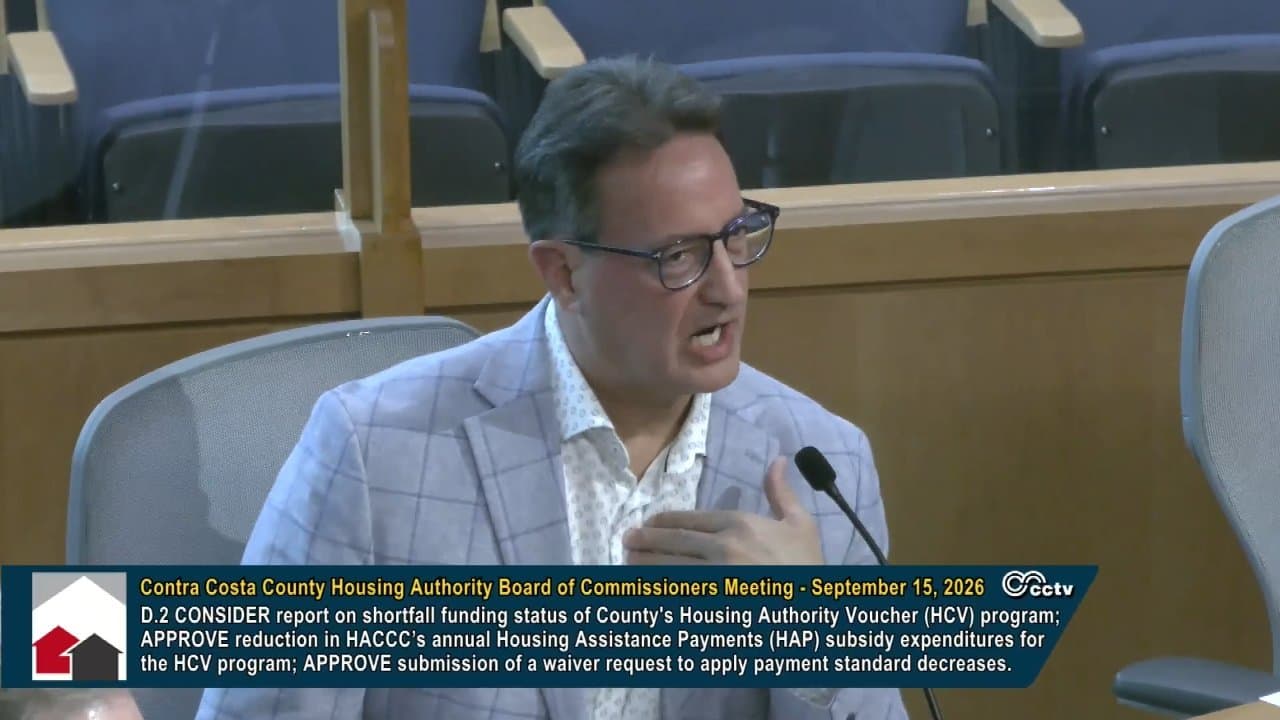
"We're going to see that about 38% of our program is going to be paying more than 30% of their adjusted income for rent," the Villarreal said, adding that the situation is compounded by contradictory federal guidance. "Two years ago, HUD is telling us that we have to increase our subsidies. So some of what our increases have been, have been tied to HUD telling us to raise our subsidies."
The Mr. Villarreal was blunt about HUD's diminished capacity to manage the crisis: "Like a lot of federal agencies, they're down, they've lost 60% of their staff. So part of the problem is HUD themselves are very stretched." The authority has had only one meeting with HUD this year, compared with six meetings that would typically have occurred by this point in the shortfall process.
East county payment standards are currently set at 100% of fair market rent, while the rest of the county sits at 110%. The fair market rent decreases adopted through the consent calendar earlier in the meeting will separately reduce subsidies by approximately $3.8 million, affecting about 3,100 families — roughly 800 of whom are in the protected class.
The other side: A commissioner reflected on the contradictions embedded in the vote: "The complexity of this is crazy. And on the last agenda item where you talked about getting us out of that onerous position we were in, which is great. And it's just a very interesting while we're approving these cuts, there's still hope that somehow it's all going to work out."
Public commenter Craig Lazzeretti connected the crisis to the broader political landscape, urging commissioners to think beyond the immediate shortfall. "I really do believe that housing will become the preeminent political issue in this country heading into the 2028 presidential election," he said. "And I think that will be a key time to really ask voters to zero in on this matter." He urged the board to consider a housing-focused ballot measure for 2028 and pointed to midterm elections as critical for federal housing funding.
Public commenter Jan highlighted the squeeze from both sides — reduced subsidies for tenants and rising costs for landlords — and pushed for a broader economic lens: "We have to find ways to increase the kinds of jobs and the kind of money people are receiving so they can live with dignity."
Decisions: The board voted unanimously (For: 7, Against: 0) to approve the payment standard reductions and to submit a waiver request to HUD to apply the decreases immediately, in accordance with notice PIH 2025-28. Even with the waiver, savings will not fully materialize until later next year.
What's next: Staff proposed a special meeting on Nov. 17 to develop contingency plans in the event HUD cannot cover the remaining shortfall by December. The stakes could not be higher: without federal action, the authority would face the prospect of halting payments for thousands of voucher-holding families across the county.
HUD Assessment Signals Clean Bill of Health for Public Housing Program
Why it matters: Contra Costa County is planning to exit traditional public housing because its buildings require extensive capital work. A clean federal assessment validates that approach and protects the authority's standing with HUD during the transition.
Villarreal reported that a recent HUD Public Housing Agency Recovery and Sustainability (FARS) assessment found no adverse findings, with areas previously rated as weak — particularly physical inspections — showing significant improvement. But the director tempered expectations: "I have had auditors tell me that on the way out the door and then give me a very different letter. So until we get the letter, it's not sealed, but it seemed like it went well."
Decisions: The board voted unanimously (For: 7, Against: 0) to accept the report. No public comment was received on the item.
Minor Items
Consent calendar (C1–C6) approved unanimously (For: 7, Against: 0), covering Housing Authority operations including fair market rent changes effective Oct. 1. Public commenter Jan asked about the funding source for housing services; staff confirmed the money does not come from the pool used for rental subsidies and is legally required to remain separate, though it will improve service delivery in east county.
Public commenter Craig Lazzeretti urged the authority to expand ADU construction, calling it "the low-hanging fruit of affordable housing." Villarreal confirmed the authority already funds ADUs but cautioned they are "not quite as cheap as they should be" and carry significant ongoing costs.